The intricate physics and chemistry governing the aftermath of a nuclear detonation have long remained one of the most challenging areas of study for the global scientific community. When a nuclear device detonates or a catastrophic reactor failure occurs, the resulting release of energy is nearly instantaneous, occurring in less than a microsecond. This colossal energy output creates a localized environment of extreme heat, reaching millions of degrees, which vaporizes all surrounding materials into a state of high-energy plasma. As this fireball expands and rises through the atmosphere, it begins a complex process of cooling and condensation, eventually transforming from a gaseous state into the microscopic solid particles known as nuclear fallout. Understanding the precise chemical pathways of this transition is critical for national security, public health assessments, and nuclear forensics.
In a landmark study recently published in the journal Analytical Chemistry, researchers at Lawrence Livermore National Laboratory (LLNL) have provided new clarity on these processes. By utilizing a sophisticated plasma flow reactor to simulate the cooling environments of a nuclear fireball, the team investigated the behavior of uranium, cerium, and cesium. Their findings suggest that current predictive models, which have been used for decades to estimate the distribution and composition of fallout, may be missing critical chemical interactions that occur during the cooling phase.
The Evolution of Nuclear Fallout Research: A Historical Context
To appreciate the significance of the LLNL study, one must look at the history of fallout modeling. During the era of atmospheric nuclear testing, which spanned from the mid-1940s to the early 1960s, scientists relied heavily on empirical data gathered from actual detonations in the Pacific Proving Grounds and the Nevada Test Site. Early models, such as the Miller model developed in the 1960s, were primarily based on the physical size of particles and the altitude of the burst. These models aimed to predict "ground zero" contamination and the trajectory of the radioactive cloud.
However, these early assessments often treated fallout particles as inert physical objects rather than products of complex chemical reactions. As the Cold War progressed, the focus shifted toward "nuclear forensics"—the ability to analyze debris to determine the design, fuel type, and origin of a weapon. This required a much deeper understanding of how different elements, such as plutonium or fission products like cesium-137, incorporate themselves into the glassy, silicate-based particles formed from vaporized soil and structural materials.
Despite decades of progress, the transition from vapor to solid remains a "black box" in many aspects. The extreme conditions inside a fireball are impossible to observe directly in real-time. Consequently, researchers have turned to laboratory-scale simulations to recreate the cooling curve of a nuclear event. The recent work by Rakia Dhaoui and her colleagues at LLNL represents the next generation of this effort, moving away from simplified assumptions and toward empirical, measurement-based science.
Recreating the Heart of a Fireball: The Plasma Flow Reactor
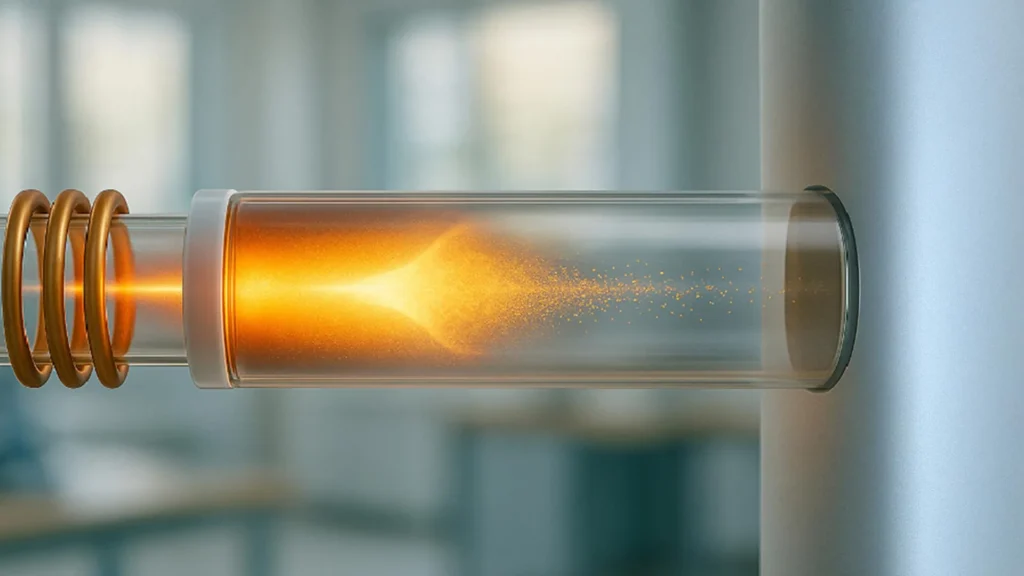
The centerpiece of the LLNL research is a plasma flow reactor, a specialized instrument designed to mimic the thermal gradients of a cooling nuclear fireball. In a real-world detonation, materials are vaporized and then subjected to a "thermal history"—a specific path of temperature change over time. The rate at which the fireball cools depends on various factors, including the yield of the weapon, the height of the burst, and the surrounding environment (e.g., urban versus desert).
The LLNL team introduced specific combinations of uranium, cerium, and cesium into a high-temperature plasma. This plasma environment serves as a proxy for the initial stages of a nuclear fireball. As the vaporized material moved through the reactor’s tube, the researchers could precisely manipulate the temperature at various stages.
The experiment focused on two distinct "thermal histories":
- Gradual Cooling: A scenario where the temperature declines steadily as the material moves away from the plasma source.
- Extended High-Heat Cooling: A scenario where the materials are held at an elevated temperature for a longer duration before undergoing rapid cooling.
By collecting samples at multiple locations along the flow path, the team could observe the "evolution" of the particles. This continuous sampling allowed them to see exactly when and how different elements transitioned from gas to solid.
The Role of Uranium, Cerium, and Cesium in Fallout Chemistry
The choice of elements for this study was highly strategic. Uranium is the primary fuel for most nuclear devices and serves as a fundamental benchmark for fallout studies. Because it is relatively less volatile, it is one of the first elements to condense as the fireball cools.
Cerium was included as a chemical surrogate for plutonium. Plutonium is difficult and hazardous to work with in a laboratory flow reactor, but cerium shares many of its chemical properties, particularly its oxidation states and condensation behavior. By observing how cerium behaves, scientists can infer the likely behavior of plutonium in a real-world scenario.
Cesium, conversely, is highly volatile. In the context of nuclear accidents or detonations, cesium-137 is one of the most concerning isotopes due to its long half-life and its tendency to remain in the atmosphere or spread over large areas. Because cesium condenses at much lower temperatures than uranium or cerium, it is often the last element to be incorporated into fallout particles.
The study’s findings revealed a significant discovery: the "pathway" of cooling matters just as much as the final temperature. When materials remained at high temperatures for longer periods (the second thermal history), the volatile cesium did not simply stay as a separate vapor. Instead, it mixed extensively with the already-condensed uranium and cerium. This suggests that the chemical "speciation"—the specific chemical form of an element—is highly sensitive to the duration of heat exposure.
Implications for Current Fallout Models
The LLNL findings present a challenge to existing fallout models, such as the Defense Land-震 Fallout Interpretive Code (DELFIC). Many of these models operate on the "independent element" assumption, which treats the condensation of each element as a separate event based solely on its individual boiling and melting points.
"Historical fallout studies indicate that the path materials take as they cool is important," stated Rakia Dhaoui, the lead LLNL scientist on the project. "Our results indicate that fallout formation depends not only on when different elements condense, but also on how they chemically interact with one another as temperatures drop."
If elements are interacting chemically during the cooling phase, the resulting fallout particles will have a different internal structure and chemical stability than previously thought. For example, if cesium is deeply integrated into a uranium-rich silicate particle rather than just coating the surface, it may be less "bioavailable" or harder to remove during environmental remediation. Conversely, if certain cooling paths lead to more brittle or porous particles, the radioactive material might spread more easily into the groundwater or the food chain.
National Security and Nuclear Forensics
Beyond environmental safety, this research has profound implications for nuclear forensics. In the event of an unattributed nuclear explosion, the international community would look to forensic scientists to identify the perpetrator. This is done by analyzing the "signature" of the fallout.
If scientists understand exactly how thermal history affects the distribution of isotopes within a particle, they can work backward from a sample of dust collected hundreds of miles away to determine the conditions of the initial blast. They could potentially estimate the yield of the device or the specific materials used in its construction with much higher accuracy. By replacing "assumptions with measurements," as Dhaoui noted, the LLNL team is providing the forensic community with a more reliable "fingerprint" library for nuclear materials.
Technical Analysis: The Shift from Physics to Chemistry
For decades, the study of nuclear weapons effects was dominated by physics—calculating blast overpressure, thermal radiation, and initial ionizing radiation. Chemistry was often relegated to a secondary concern, focused mostly on the long-term decay of fission products.
However, this LLNL study highlights a shift toward "high-temperature chemistry." The interaction between vaporized metals in a plasma state is a frontier of science that bridges the gap between atomic physics and material science. The discovery that cerium and uranium chemistry changes based on thermal history suggests that the oxidation states of these metals are shifting in real-time as the fireball interacts with atmospheric oxygen.
This chemical complexity means that fallout is not a uniform substance. A single detonation could produce a wide variety of particle types depending on whether the material was in the center of the fireball or on the cooler periphery. Understanding this heterogeneity is essential for improving the accuracy of atmospheric transport models, which predict where the "plume" will travel.
Reactions from the Scientific Community and Future Directions
While official reactions from government agencies like the National Nuclear Security Administration (NNSA) are typically reserved, the publication of this data in a peer-reviewed journal like Analytical Chemistry signals a high level of confidence in the findings. Scientists in the field of radiochemistry have noted that the use of a plasma flow reactor provides a much cleaner data set than historical "shot" data, which was often contaminated by environmental debris.
The LLNL team has already outlined the next steps for this research. The current study used relatively simple mixtures of uranium, cerium, and cesium. However, a real-world nuclear event involves a "messy" chemistry including soil, concrete, steel, and water vapor. The researchers plan to expand their experiments to include these complex matrices.
"The goal is to better capture the complex processes that govern fallout formation during real-world nuclear events," the team noted. By adding silicates (soil) and iron (structural steel) to the plasma flow reactor, they hope to see how these "carrier" materials influence the capture of volatile radioactive isotopes.
Conclusion: A Vital Tool for Decision-Making
The work being conducted at Lawrence Livermore National Laboratory is more than just an academic exercise in chemistry. It is a vital component of global security and disaster preparedness. In a world where the risk of nuclear proliferation and reactor accidents remains a persistent concern, the ability to accurately model the aftermath of such events is indispensable.
By proving that the "thermal history" of a fireball fundamentally alters the chemical makeup of fallout, the LLNL team has provided a new lens through which to view nuclear debris. This research ensures that if a nuclear event were to occur, decision-makers would not be relying on simplified 1960s-era assumptions, but on a sophisticated, measurement-backed understanding of how radioactive particles form and behave in the environment. As these models improve, so too does our ability to protect the public, attribute nuclear materials to their source, and manage the long-term consequences of a nuclear age.