For decades, astrophysicists have been haunted by a cosmic accounting error. According to the foundational laws of physics and observations of the early universe, there should be significantly more ordinary matter in the cosmos than what we can actually see. While dark matter remains a separate, invisible mystery, even the "ordinary" matter—the protons and neutrons that make up stars, planets, and people—has been largely unaccounted for in the modern epoch. Now, a breakthrough study led by researchers at the Massachusetts Institute of Technology (MIT) and the CHIME/FRB Collaboration has finally tracked down this elusive substance, revealing that it hides in vast, diffuse clouds stretching far beyond the boundaries of known galaxies.
The research, recently published in the prestigious journal Physical Review Letters, utilizes a novel method involving Fast Radio Bursts (FRBs) to map the distribution of this missing matter. By analyzing the "smearing" of radio signals as they traverse the cosmos, the team has confirmed that the missing baryons—the subatomic particles that constitute the bulk of observable mass—are being flung into deep space by violent galactic processes. This discovery not only solves a long-standing mystery but also suggests that the energy released by black holes and exploding stars is far more potent than previously estimated.
The Missing Baryon Problem: A Cosmic Discrepancy
To understand the significance of this discovery, one must look back to the origins of the universe. In the immediate aftermath of the Big Bang, the composition of the universe was set. Modern cosmological models, supported by observations of the Cosmic Microwave Background (CMB), indicate that roughly 83 percent of the universe’s total matter is "dark matter"—a mysterious substance that does not interact with light. The remaining 17 percent is "baryonic matter," the ordinary matter that forms the periodic table.
However, when astronomers add up the mass of all the stars, gas clouds, and galaxies observable through telescopes today, the numbers do not match. Only about 10 percent of the expected baryonic matter is found within galaxies. The remaining 90 percent has been "missing" for billions of years. Scientists long suspected that this matter resided in the intergalactic medium (IGM)—the vast, empty spaces between galaxies—but detecting it has proven nearly impossible. Because this gas is extremely diffuse—estimated at a density of roughly one proton per cubic meter—it does not emit enough light to be seen by conventional optical or X-ray telescopes.
Fast Radio Bursts: The Universe’s Measuring Tape
The solution to this invisibility problem came from an unexpected source: Fast Radio Bursts. First discovered in 2007, FRBs are intense, millisecond-long flashes of radio energy coming from distant galaxies. While their exact origins remain a subject of intense debate, their utility as astronomical probes is becoming increasingly clear.
As an FRB travels through billions of light-years of space, it encounters free electrons associated with the missing baryonic matter. These electrons act like a cosmic prism. High-energy "blue" radio waves travel slightly faster through this medium than low-energy "red" waves. By the time the signal reaches Earth, it has been "smeared" or dispersed in time.
"What makes FRBs good to probe missing matter is that they have a special property," explains Haochen Wang, a graduate student at MIT’s Kavli Institute for Astrophysics and Space Research and a lead author of the study. "They start out as a very quick flash, and as they pass through matter, they smear out in time. We can measure that smearing very precisely, which is directly proportional to how much missing matter the FRB passed through."
A Multi-Instrumental Approach: CHIME and DESI
The MIT-led team did not rely on FRBs alone. To pinpoint where the matter was located, they needed to correlate the signal smearing with the positions of known galaxies. This required a massive data-sharing effort between two of the world’s most powerful astronomical surveys: the Canadian Hydrogen Intensity Mapping Experiment (CHIME) and the Dark Energy Spectroscopic Instrument (DESI).
CHIME, located at the Dominion Radio Astrophysical Observatory in British Columbia, Canada, is a unique stationary radio telescope with no moving parts. It scans the entire northern sky every day, making it an FRB-hunting powerhouse. For this study, the researchers analyzed 2,870 FRB signals from the CHIME catalog.
DESI, mounted on the Mayall Telescope at Kitt Peak National Observatory in Arizona, provided the second half of the puzzle. DESI is currently engaged in a five-year mission to map the 3D positions of 30 million galaxies to study the expansion of the universe. By cross-referencing the "smear" data from CHIME with the galactic coordinates provided by DESI (encompassing over 6 million galaxies), the researchers could determine exactly how much matter was clustered around specific galactic structures versus the "voids" of space.
Findings: Galactic Fountains and Violent Feedback
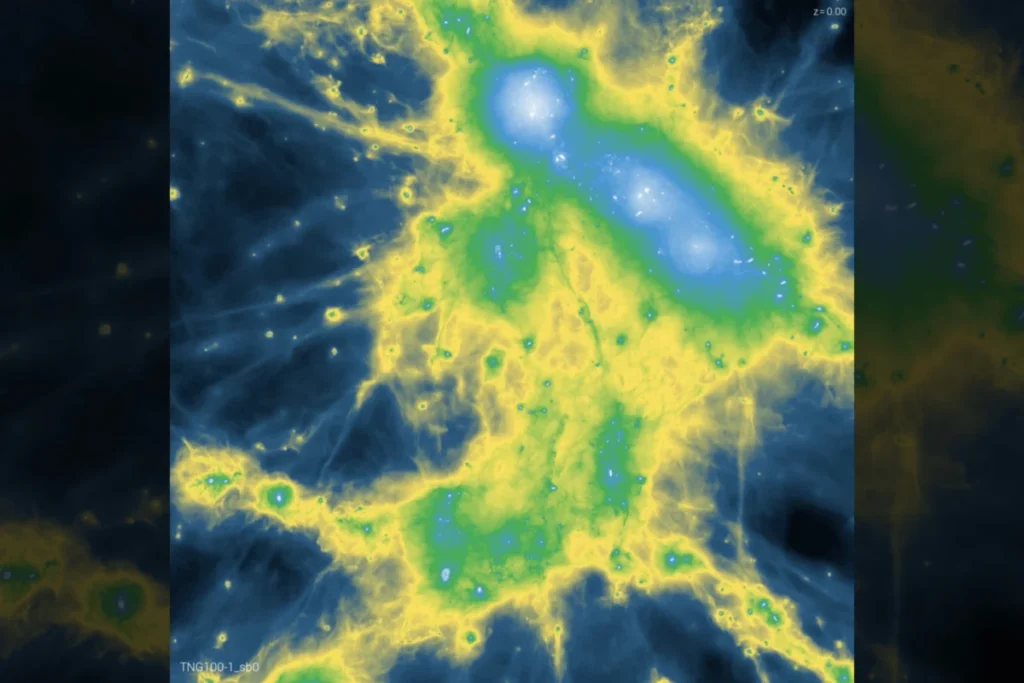
The results of the analysis were startling. The team found that the missing matter is not evenly distributed across the universe, nor is it tightly packed within galaxies. Instead, it exists in enormous, diffuse halos surrounding groups of galaxies.
The most surprising discovery was the scale of these halos. While a typical large galaxy might span 100,000 light-years, the researchers found the missing matter extended as far as 4 million light-years from the galactic centers. This is significantly further than any previous theoretical models or computer simulations had predicted.
"We are finding that the activity in galaxies is messier than we thought," says Wang. "They’re more like fountains, and really push out gas to very large distances."
This "fountain" effect is the result of what astrophysicists call "feedback." Within a galaxy, two primary engines drive matter outward: supermassive black holes and supernovae. As black holes consume matter, they often emit powerful jets of energy that blast gas out of the galaxy. Similarly, when massive stars explode as supernovae, they create galactic winds that carry baryons into the intergalactic medium.
The fact that the matter is found so far away—4 million light-years—indicates that these feedback processes are far more violent and energetic than previously assumed. It suggests that galaxies are not closed systems but are constantly "breathing" matter out into the cosmos with incredible force.
Chronology of the Discovery
The journey to this discovery has been decades in the making:
- 1990s: Cosmologists first identify the "Missing Baryon Problem" after comparing Big Bang Nucleosynthesis models with observable stellar mass.
- 2007: The first Fast Radio Burst (the "Lorimer Burst") is discovered in archival data, though its nature remains unknown.
- 2018: The CHIME telescope begins full operations, rapidly increasing the number of known FRBs from dozens to thousands.
- 2020: Early studies begin to use FRBs to confirm that the missing matter exists in the IGM, but they lack the resolution to map its shape.
- 2021: The DESI survey begins its comprehensive mapping of the 3D universe.
- 2024: The MIT-led collaboration publishes its findings in Physical Review Letters, providing the first detailed map of the "shape" of the missing matter.
Scientific Implications and Future Research
The implications of this research extend far beyond simply finding "lost" matter. By understanding how matter is distributed around galaxies, scientists can better understand the lifecycle of galaxies themselves. If gas is being pushed too far away, it may never fall back into the galaxy to form new generations of stars, effectively "starving" the galaxy over billions of years.
Furthermore, this data provides a new benchmark for dark matter research. By accurately accounting for all the baryonic matter, scientists can isolate the gravitational effects of dark matter with greater precision, potentially leading to a breakthrough in understanding what the invisible 83 percent of the universe’s mass actually is.
Kiyoshi Masui, an associate professor of physics at MIT and co-author of the study, emphasizes that this is only the beginning. "We got it to work for the first time, and will get it to work even more precisely as data gets better," Masui said. As the CHIME/FRB catalog grows from thousands to tens of thousands of detections, the resolution of these cosmic maps will improve, allowing scientists to see the "fine structure" of the intergalactic medium.
Conclusion
The discovery of the universe’s missing matter in the form of gargantuan, diffuse galactic fountains marks a turning point in modern astronomy. It validates the long-held theory that the "missing" 90 percent of ordinary matter was simply too thin to see with light, while simultaneously challenging our understanding of how energetic galaxies truly are.
As radio astronomy continues to evolve, the once-mysterious Fast Radio Bursts have transitioned from being cosmic enigmas to being the most powerful tools in the astrophysicist’s toolkit. The universe, it seems, has finally been forced to balance its books, revealing a cosmos that is far more interconnected—and far more violent—than we ever imagined.