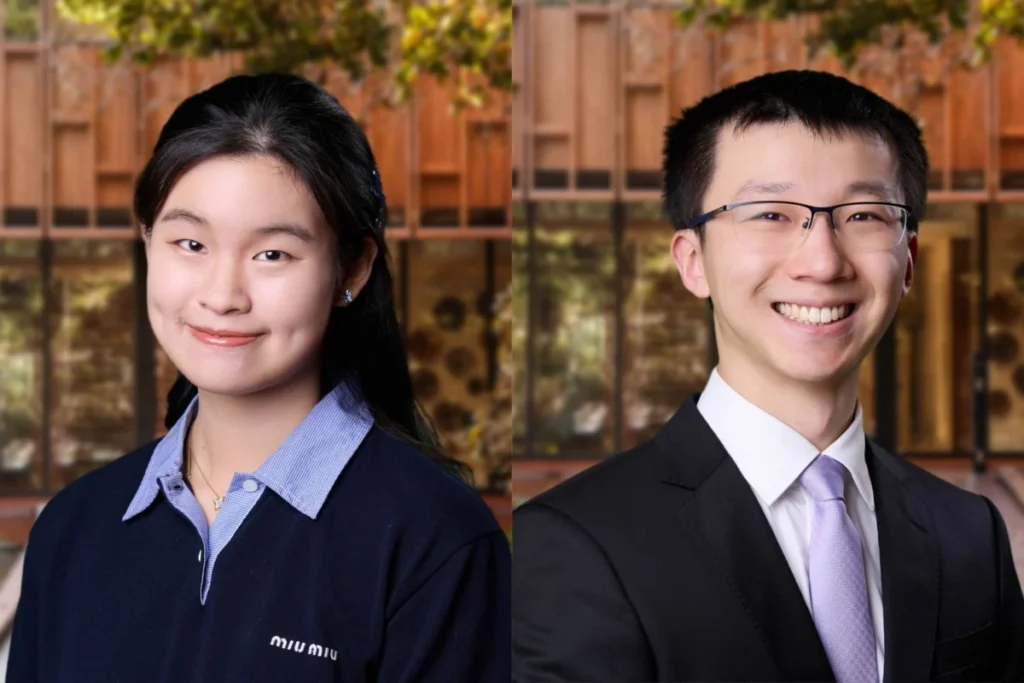
The Knight-Hennessy Scholars program at Stanford University has officially announced its 2024 cohort, naming Massachusetts Institute of Technology (MIT) students Sunshine Jiang and Rupert Li as recipients of the prestigious award. Now entering its ninth year of operation, the scholarship has established itself as one of the most competitive and comprehensive graduate fellowships in the world, providing up to three years of financial support for graduate studies across all seven of Stanford’s schools. The selection of Jiang and Li underscores a continuing trend of interdisciplinary excellence, as both scholars bridge the gap between theoretical science, advanced engineering, and social advocacy.
The Knight-Hennessy Scholarship was founded in 2016 through a $750 million endowment, largely funded by Phil Knight, the co-founder of Nike, and named in honor of John L. Hennessy, the former president of Stanford and current chairman of Alphabet Inc. The program aims to develop a community of future global leaders who are equipped to address complex challenges through collaboration and innovation. Jiang and Li join a global cohort selected for their academic achievement, independent thought, and leadership potential.
Academic Profiles and Research Specializations
Sunshine Jiang, a native of Hangzhou, China, represents the vanguard of the next generation of artificial intelligence researchers. Graduating from MIT in 2025 with a bachelor’s degree, Jiang pursued an ambitious double major in physics and electrical engineering and computer science (EECS), supplemented by minors in mathematics and economics. This month, she will conclude her Master of Engineering degree at MIT before transitioning to the Stanford School of Engineering this fall to begin her PhD in computer science.
Jiang’s research is situated at the intersection of embodied artificial intelligence and robotics. Her work focuses on the development of data-efficient, adaptive systems designed for general-purpose robots. The objective of her research is to move beyond specialized industrial robots—which often require rigid environments—toward versatile machines capable of operating in diverse, unstructured human settings. By prioritizing data efficiency, Jiang’s models seek to lower the barriers to robot deployment, potentially broadening accessibility for smaller institutions and developing regions. Her academic contributions have already gained international recognition, with research presentations at premier venues including the Conference on Robot Learning (CoRL), the International Conference on Robotics and Automation (ICRA), and the International Conference on Learning Representations (ICLR).
Rupert Li, hailing from Portland, Oregon, is currently a PhD student in mathematics at the Stanford School of Humanities and Sciences. Li’s academic trajectory is marked by a relentless pursuit of mathematical depth and breadth. He graduated from MIT in 2024 with a bachelor’s degree, double majoring in mathematics and the triple-threat combination of computer science, economics, and data science. Concurrently with his undergraduate studies, Li completed a master’s degree in data science at MIT.
Following his time in Cambridge, Massachusetts, Li was awarded the Marshall Scholarship, which enabled him to study in the United Kingdom. There, he earned a Master of Mathematics from the University of Cambridge, a program renowned for its rigor. Li’s primary research interests involve probability, discrete geometry, and combinatorics—fields that form the backbone of modern algorithmic theory and statistical physics. His work is not merely theoretical; Li has demonstrated a commitment to the mathematical community through extensive mentorship, serving as a mentor for MIT PRIMES-USA, a national research program for high school students, and as an advisor for the Duluth Research Experience for Undergraduates (REU).
A History of Distinguished Recognition
The inclusion of Jiang and Li in the Knight-Hennessy program is the latest in a series of high-profile accolades for both scholars. Rupert Li, in particular, has secured nearly every major fellowship available to domestic graduate students in the United States. In addition to the Knight-Hennessy and Marshall Scholarships, he is a recipient of the Hertz Fellowship, the Paul & Daisy Soros Fellowship for New Americans, and the Goldwater Scholarship. He also received an honorable mention for the Frank and Brennie Morgan Prize, which is the highest honor for an undergraduate mathematician in the U.S., Canada, and Mexico.
Sunshine Jiang has also distinguished herself through social entrepreneurship and media. Beyond the laboratory, she led the development of AI-driven systems designed to bring traditional Chinese art curricula to rural classrooms, leveraging technology to bridge the educational divide between urban centers and the countryside. Furthermore, she founded cross-country programs aimed at expanding STEM (science, technology, engineering, and mathematics) access for young girls. Her multifaceted approach to leadership was further evidenced by her production of a documentary regarding the community impact of COVID-19, which was featured by China Daily, highlighting her ability to use media to amplify underrepresented voices.
The Knight-Hennessy Selection Context and Data
The Knight-Hennessy Scholarship is notoriously selective, often receiving thousands of applications for fewer than 100 spots. While specific acceptance rates fluctuate yearly, the program typically accepts between 1.5% and 3% of its applicant pool. The 2024 cohort continues the program’s mission of diversity, with scholars representing dozens of countries and a wide array of academic disciplines.
The financial support provided by the scholarship includes full tuition and associated fees, a stipend for living and academic expenses, and a travel grant for one annual return trip to Stanford. Beyond the financial benefits, scholars reside and interact at Denning House, a dedicated hub on the Stanford campus designed to facilitate the "King Global Leadership Program." This program offers workshops, lectures by global leaders, and community-building retreats intended to foster "soft skills" such as negotiation, public speaking, and ethical decision-making.
The scholarship’s emphasis on multidisciplinary collaboration is reflected in the pairing of Jiang and Li. While one focuses on the physical manifestation of intelligence in robotics and the other on the abstract structures of probability and geometry, both fields are increasingly interdependent. Modern robotics relies heavily on the probabilistic models and combinatorial optimization that Li studies, while the advancement of pure mathematics is often spurred by the computational challenges posed by researchers like Jiang.
Timeline of Achievement: From MIT to Stanford
The path taken by these two scholars illustrates a rapid and high-impact academic timeline:
- 2020–2021: Both scholars enter MIT, navigating the challenges of high-level research during the global pandemic. Jiang begins work on her COVID-19 documentary and rural education initiatives.
- 2022–2023: Li secures the Goldwater Scholarship and begins his tenure with the Duluth REU. Jiang presents her first major papers at ICRA and CoRL.
- 2024: Li graduates from MIT, moves to the UK as a Marshall Scholar, and later begins his PhD at Stanford. Jiang prepares to complete her M.Eng.
- May 2025: Jiang officially completes her master’s degree at MIT.
- Fall 2025: Jiang joins Li at Stanford University, with both supported by the Knight-Hennessy Scholarship for their doctoral research.
Implications for Robotics and Mathematics
The research being conducted by Jiang and Li has significant implications for the future of technology and science. In the realm of robotics, Jiang’s focus on "embodied AI" addresses one of the "Grand Challenges" of the field: the "Moravec’s Paradox." This paradox notes that while high-level reasoning requires very little computation, low-level sensorimotor skills require enormous computational resources. By creating data-efficient systems, Jiang is working toward a future where robots can learn from fewer examples, much like humans do, making them more adaptable to the home, healthcare, and disaster relief environments.
In mathematics, Li’s work in combinatorics and discrete geometry is foundational to the security of digital communications and the efficiency of data processing. As quantum computing looms on the horizon, the mathematical structures Li investigates will be essential in developing "post-quantum cryptography," ensuring that global data remains secure against new forms of computational attacks.
Official Responses and Institutional Impact
While official statements from university departments are typically reserved for internal communications, the MIT Office of Distinguished Fellowships has historically noted that the success of students like Jiang and Li reflects the institute’s commitment to "mens et manus" (mind and hand). By combining theoretical rigor with practical application, these scholars embody the MIT ethos.
At Stanford, the Knight-Hennessy program’s leadership has emphasized that the 2024 scholars were chosen not just for what they have done, but for what they intend to do. "We are looking for scholars who have the capacity to lead and the humility to learn," John Hennessy has remarked in previous cohort announcements. The selection of Jiang and Li suggests that the program continues to value the intersection of high-tier technical capability and a demonstrated commitment to the public good.
Broader Impact on the Global Academic Landscape
The success of Jiang and Li also highlights the increasing globalization of elite education. Jiang’s work bridging the U.S. and China through art and STEM education, and Li’s transition from the U.S. to the UK and back, represent the fluid exchange of ideas that characterizes modern academia.
Furthermore, the focus on "general-purpose" systems and "mentorship" in their respective profiles indicates a shift in the academic zeitgeist. There is a growing recognition that the "lone genius" model is insufficient for solving 21st-century problems. Instead, the academic community is moving toward a model of the "engaged scholar"—individuals who are as comfortable in a high-school classroom or a rural village as they are in a multi-million-dollar laboratory or a doctoral seminar.
As Jiang and Li begin their tenure as Knight-Hennessy Scholars, they will be positioned at the heart of Silicon Valley’s innovation ecosystem. Their work over the next three years at Stanford is expected to yield not only new theorems and robotic architectures but also a new framework for how elite graduate education can be leveraged to address global inequities and technological hurdles. The eyes of the academic and tech communities will undoubtedly remain on these two scholars as they transition from the halls of MIT to the research frontiers of Stanford.