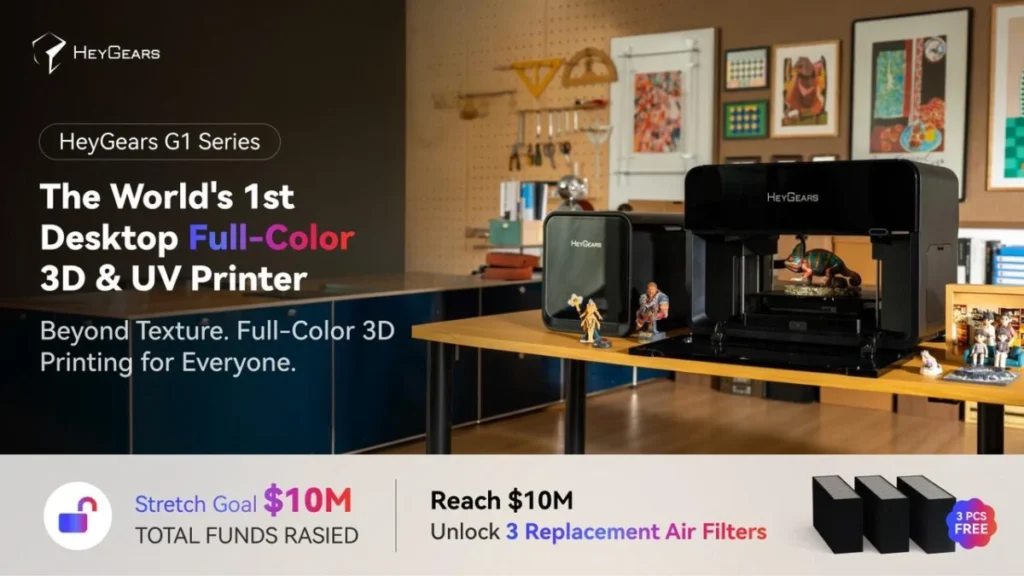
The global landscape of desktop manufacturing is undergoing a significant transformation as the boundary between hobbyist tools and industrial-grade machinery continues to blur. At the center of this evolution is the HeyGears G1 Series, which has recently made headlines by becoming the world’s first integrated desktop platform to combine full-color 3D printing, 3D-texture printing, and high-resolution 2D UV printing. This modular system aims to solve a long-standing bottleneck for creators and small businesses: the need for multiple, disparate machines to move a product from a digital concept to a finished, retail-ready physical object.
The momentum behind this technology is evidenced by its performance in the crowdfunding arena. The HeyGears G1 Series campaign on Kickstarter recently surpassed its $10 million stretch goal, a milestone that reflects a high level of market confidence and demand for versatile, multi-functional manufacturing tools. With the campaign scheduled to conclude on September 11 at 9:00 AM PDT, the industry is closely watching how this device might disrupt the traditional workflows of custom apparel, personalized gifts, and rapid prototyping.

The Technological Core: Industrial-Grade Precision on a Desktop
The primary differentiator of the G1 Series lies in its internal hardware, specifically the Epson i3200-U1HD printhead. While many desktop UV printers utilize the more common F1080 printhead, the G1 Series has integrated an industrial-grade component featuring 3,200 nozzles. This hardware configuration allows for the ejection of ultra-fine 3.9 pL droplets, resulting in a UV resolution of up to 1440 × 2400 DPI.
From a productivity standpoint, the move to the i3200-U1HD represents a quantitative leap. Data provided by HeyGears indicates that the G1 Series prints up to three times faster than standard desktop UV printers. More importantly for small businesses concerned with overhead, the service life of this printhead is estimated at 2,100 hours—triple the 700-hour lifespan typical of the F1080. When factoring in speed and durability, the company claims a ninefold increase in lifetime productivity, which directly translates to lower operating costs and reduced downtime for maintenance.
To maintain this level of precision over time, the G1 Series incorporates a suite of automated maintenance features. These include automatic white-ink agitation to prevent pigment settling, printhead heating to ensure consistent ink viscosity, and a software-guided maintenance system. The machine offers three distinct cleaning modes—jetting, regular, and deep cleaning—allowing users to manage nozzle health while minimizing the consumption of expensive inks and cleaning fluids.

A Tripartite Material System: 3D, 2D, and Textiles
The G1 Series is built around three dedicated material systems, each catering to a different sector of the creative economy. By housing these capabilities in a single modular platform, the system eliminates the need for manual coloring and repeated positioning, which are often the most labor-intensive parts of the customization process.
- Wide Gamut UV Ink (2D and Texture): This system supports over 10 million colors and is compatible with more than 400 base materials, including metals, acrylics, and various films. Beyond flat printing, it enables 3D-texture printing, allowing creators to add tactile depth to products like phone cases or signage.
- UV 3D Resin (Full-Color 3D): This mode focuses on the production of vivid, durable 3D models. By integrating color directly into the resin printing process, it removes the need for post-print painting. The system is capable of producing transparent effects and fine geometric details that were previously the domain of high-end industrial resin printers.
- True DTF Transfer Printing (Textiles): Perhaps the most versatile addition is the Direct-to-Film (DTF) capability. This water-based textile printing process allows users to print designs onto a transfer film, which can then be applied to fabrics through powder application and heat pressing. The result is custom apparel that remains soft, breathable, and resistant to repeated washing.
Evolution of the "Maker" Business Model
The shift toward modularity in the G1 Series represents a broader trend in the "Maker Movement"—the transition from individual hobbyists to "prosumers" and small-batch manufacturers. Historically, a small business looking to offer custom 3D models, printed phone cases, and branded t-shirts would have needed to invest in a resin 3D printer, a flatbed UV printer, and a DTF setup. This would require significant floor space, multiple software subscriptions, and a steep learning curve for each device.
The G1 Series addresses this through an expandable ecosystem. Users can start with a basic setup and add modules as their business grows. These modules include a Resin Station for 3D production, flatbeds for direct-to-object printing, a rotary module for cylindrical items like bottles, and a Roll-to-Film module for extended artwork. This "pay-as-you-grow" model reduces the initial capital expenditure for entrepreneurs and allows for rapid pivoting between product categories based on market demand.

Software Integration and the Role of AI
A hardware platform is only as effective as the software that drives it. HeyGears has developed the Blueprint Studio ecosystem to manage the complexities of a three-in-one machine. The software integrates "HeyVerse" and an "AI Playground," which are designed to lower the barrier to entry for 3D modeling.
The AI integration allows users to generate ready-to-print 3D models from text descriptions or transform a 2D image into a full-color 3D object. For creators who may not have mastered complex CAD (Computer-Aided Design) software, these tools represent a significant democratization of 3D creation. By automating the layout and print job management, the software aims to provide a "one-click" workflow from digital concept to physical output.
Chronology and Market Reception
The development of the G1 Series follows HeyGears’ established history in the digital manufacturing sector. Founded with a focus on high-precision 3D printing for the dental and medical industries, the company has leveraged its experience in those rigorous fields to enter the consumer and small business markets.

The Kickstarter campaign serves as a critical validation phase for the G1 Series. Reaching the $10 million milestone ahead of the September 11 deadline suggests that there is a significant vacuum in the market for high-resolution, multi-functional desktop tools. Industry analysts note that while the 3D printing market has seen many "all-in-one" machines in the past—often combining 3D printing with laser engraving or CNC milling—the G1 Series is unique in its focus on high-fidelity color and industrial printhead technology.
Analysis of Implications for Localized Manufacturing
The introduction of the G1 Series could have profound implications for the "long tail" of manufacturing. As global supply chains remain sensitive to disruption, there is an increasing move toward localized, on-demand production. Tools like the G1 Series allow small, local workshops to produce goods that are indistinguishable in quality from mass-produced items, but with the added value of extreme customization.
Furthermore, the environmental impact of such a device cannot be ignored. By enabling "True DTF" and high-efficiency UV printing in a single unit, the system potentially reduces the carbon footprint associated with shipping samples and small batches between different specialized facilities. The ability to print on over 400 materials also encourages the use of local substrates, further shortening the supply chain.

However, the success of the G1 Series will ultimately depend on its long-term reliability in a non-industrial environment. While the i3200-U1HD printhead is a proven industrial workhorse, its performance in a desktop setting—where environmental controls like temperature and humidity may be less consistent—will be the true test of HeyGears’ engineering. The company has attempted to mitigate these risks with a 180-day warranty on printheads and a one-year warranty on the printer unit, supported by ongoing maintenance and repair services after the warranty period expires.
Conclusion: A New Standard for the Desktop Factory
As the Kickstarter campaign enters its final days, the HeyGears G1 Series stands as a testament to the rapid maturation of additive manufacturing technology. By consolidating three distinct creative worlds—3D, UV, and Textile—into a single modular footprint, it challenges the traditional boundaries of what a "printer" can be.
For the small business owner, the artist, and the industrial designer, the G1 Series offers more than just a tool; it offers a scalable production platform. Whether the goal is to produce a single, highly detailed prototype or a small batch of custom-branded merchandise, the integration of industrial-grade hardware with accessible AI-driven software marks a significant step toward the realization of the "desktop factory." The success of this campaign likely signals the beginning of a new era where the complexity of the manufacturing process is no longer a barrier to the speed of creative innovation.