The journey towards achieving unparalleled precision in industrial automation culminates not in the selection of individual components, however advanced, but in their meticulous integration. This final installment of a comprehensive series, guided by Corey Foster, Director of Automation Sales & Application Engineering at Valin Corporation, underscores the critical role of system integration in unlocking true precision in motion control applications. Moving beyond the discrete specifications of mechanics, motors, drives, and controls, this analysis reveals how the synergy of these elements, orchestrated through expert integration, dictates the ultimate performance of a high-precision system.
The Unseen Architects of Accuracy: A Series Overview
In an era where manufacturing tolerances are shrinking and operational speeds are accelerating, the demand for high-precision motion control has never been more pronounced. Industries ranging from semiconductor fabrication and medical device manufacturing to aerospace and advanced robotics rely heavily on systems capable of micron-level, and often sub-micron-level, accuracy. Yet, as Valin Corporation’s series has consistently highlighted, the path to achieving this precision is multifaceted and fraught with hidden complexities.
The series began by dissecting the mechanics in Part 1, revealing often-overlooked factors such as bearing deflection, body stiffness, and structural smoothness that fundamentally limit an actuator’s inherent precision. It then transitioned to the motors in Part 2, examining how their design, construction, and inherent quality contribute to the system’s dynamic capabilities. Part 3 subsequently delved into the sophisticated world of drives and controls, exploring how their advanced features and intelligent algorithms translate commands into precise physical movements. Each installment progressively built a case for a holistic understanding, challenging the conventional wisdom that system performance is solely a function of component datasheets. This fourth and final article serves as the capstone, arguing that even the most perfectly specified individual layers will falter without astute system integration, which acts as the overarching design process bringing all these elements into harmonious, high-performance operation.
Beyond the Datasheet: Why Integration Matters
The notion that high-precision motion control systems can be assembled by simply selecting components with impressive individual specifications is a pervasive misconception in the industry. While component specifications for repeatability, accuracy, and load capability are essential starting points, they often represent ideal-world scenarios achieved under specific, controlled conditions. As Corey Foster emphasizes, "Achieving true precision requires a deeper understanding of the full motion control system from the mechanics to the motors, drives and controls." This perspective challenges engineers to look beyond the numbers printed on a product sheet and consider the dynamic interplay of forces, energies, and environmental factors that define real-world performance.
The global precision motion control market, projected to exceed $10 billion by 2027, is driven by the relentless pursuit of higher throughput, greater reliability, and finer resolution in automated processes. However, a significant portion of project failures or underperformance can be traced back to inadequate system integration rather than faulty components. Data from industry surveys often indicate that system integration challenges account for up to 30% of project delays and cost overruns in complex automation projects. These costs extend beyond initial deployment, impacting long-term operational expenses through increased maintenance, reduced system lifespan, and compromised product quality.
A common theme throughout Valin Corporation’s series is the existence of critical details that do not appear on data sheets but can significantly "make or break" high-performance expectations. As motion systems push beyond micron-level accuracy, traditional specifications begin to lose their typical meaning and relevance. For instance, a linear stage boasting sub-micron repeatability on a test bench might perform significantly worse when mounted on a non-planar surface in a real-world application. This necessitates a shift in engineering philosophy from a product-centric approach to a system-centric one, where every decision, from mounting hardware to cable routing, is considered for its impact on overall precision.
Real-World Integration Challenges and Their Consequences
Optimal performance is not an inherent quality of a sub-system; it emerges from the meticulously engineered whole. System integration is, in essence, the art and science of ensuring that all mechanical, electrical, and control components function cohesively to their full potential within the operational environment. Every stated specification for a component implicitly relies on a set of "hidden assumptions" about its operational context. When these assumptions are not met, performance invariably degrades.
Consider the foundation of any mechanical system: its mounting surface. Precision mechanical actuators assume a certain degree of flatness and stability from their mounting surfaces. If an actuator, designed for high linearity, is mounted on an uneven or vibrating base, its inherent precision will be compromised, leading to positional errors, increased wear, and reduced lifespan. Similarly, motors are designed with assumptions about adequate airflow for cooling and effective heat sinking. Deploying a motor in a confined space without proper thermal management can lead to overheating, reduced efficiency, and premature failure, irrespective of its rated power output. Drives and controllers, the brains of the operation, assume a supply of clean, stable electrical power. In industrial environments rife with electromagnetic interference (EMI) and voltage fluctuations, a lack of proper grounding, shielding, and EMC filters can lead to erratic behavior, communication errors, and compromised control fidelity.
Case Studies in Misalignment and Environmental Impact
The real-world implications of poor integration are best illustrated through specific examples:
Linear Motor and Guide Misalignment: A high-precision linear motor system typically combines the motor with linear guides that bear the load. This creates a critical three-component system—motor, left guide, right guide—that must be precisely aligned. If these components are not perfectly parallel or coplanar, mechanical binding can occur. At best, this introduces uneven friction, leading to increased power consumption, accelerated wear on bearings and guides, and subtle but significant positional inaccuracies. At worst, severe misalignment can cause the system to jam, halting operations and potentially damaging components. This often manifests as non-linear motion, hysteresis, and an inability to achieve specified velocity or acceleration profiles.

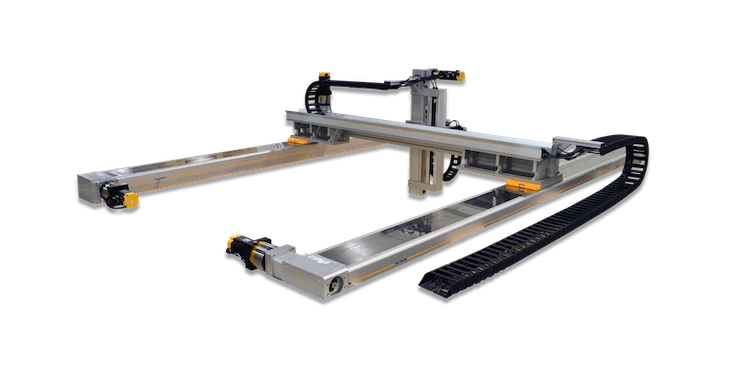
Parallel Actuator Synchronization: In gantry systems or applications requiring coordinated movement of two parallel axes, such as two long linear belt and pulley actuators, synchronization is paramount. Beyond ensuring parallel alignment, an additional challenge arises from the variability in belt tension. If the belt tensions differ between the two actuators, the effective distance traveled per revolution of their respective pulleys will vary. While seemingly minor over short distances, this variance can accumulate significantly over long travel lengths. For instance, over a two-meter travel, a 5-mm positional discrepancy between the two actuators at the end of their stroke can be catastrophic in applications demanding precise synchronous movement, leading to twisting forces, material distortion, or imprecise placement. Tuning these systems requires not only mechanical precision but also sophisticated control algorithms that compensate for dynamic differences in load and friction.
Power Quality and Environmental Interference: The pristine conditions of a lab or workshop, where electrical power is typically clean and stable, often mask potential integration flaws. When the same system is deployed to a factory floor, which is often a noisy electrical environment with inductive loads, welding equipment, and long cable runs, "dirty power" becomes a significant threat. Insufficient grounding, inadequate shielding of signal cables, and the absence of appropriate electromagnetic compatibility (EMC) filters allow noise to propagate through the control system. This can lead to sensor signal corruption, motor commutation errors, and unreliable controller performance, manifesting as intermittent faults, reduced accuracy, or complete system shutdowns. The cost of troubleshooting such intermittent issues can be substantial, often eclipsing the initial investment in proper integration measures.
Thermal Expansion and Environmental Control: Temperature fluctuations represent another often-underestimated environmental factor. A system meticulously assembled and calibrated in a climate-controlled workshop may experience significant performance degradation when deployed in a hot or rapidly changing thermal environment. Materials expand and contract with temperature variations, leading to thermal expansion that directly impacts mechanical alignments. For example, a linear stage with a long travel might experience changes in its effective length or straightness due, in part, to temperature variations affecting its baseplate or guide rails. This can throw off critical alignments, reduce positioning accuracy, and even induce stresses that lead to premature wear or component failure. Ultra-high precision systems, such as those used in metrology or lithography, often require not only temperature-controlled rooms but also foundations isolated from the vibrations of the surrounding facility to maintain nanometer-level stability.
Pillars of Precision: Best Practices in System Integration
To mitigate these challenges and realize the full potential of high-precision motion control, several integration practices are essential:
- Mounting Surface Adherence: Actuators must be mounted to surfaces that meet or exceed their specified flatness and rigidity requirements. The use of dowel pins for repeatable positioning of actuators on their mounting surfaces, or even between stacked actuators, is a simple yet effective practice. This ensures that if the system is ever disassembled for maintenance or upgrades, it can be reassembled with minimal loss of calibration or alignment, saving significant time and effort.
- Encoder Alignment Precision: For axes utilizing encoders—whether linear, rotary, or ring-type—proper alignment is paramount. Encoders are the feedback mechanisms that allow the control system to know the exact position of a moving element. Misalignment can introduce significant measurement errors, directly impacting positional accuracy and repeatability. This often necessitates the use of specialized fixtures, laser alignment tools, and sophisticated measurement equipment to ensure sub-micron alignment during installation.
- Disciplined Cable Management: Cable routing is a discipline often overlooked but critical for signal integrity. Low-power control signals and high-power motor cables should ideally be routed separately. When they must cross paths, they should do so perpendicularly to minimize inductive coupling and electromagnetic interference. Running them in parallel over long distances in the same cable tray can induce noise in sensitive signal lines. Furthermore, coiling excess high-power cable should be avoided as it creates inductive loops that can generate significant EMI. Proper cable shielding, grounding, and selection of appropriate cable types (e.g., shielded twisted pair for feedback signals) are non-negotiable for high-precision systems.
- Environmental Isolation: Ultra-high precision systems are exquisitely sensitive to their environment. Isolating them from external disturbances is often critical. Vibration dampers, carefully selected and tuned to the system’s natural frequencies, can significantly reduce the impact of floor vibrations. Temperature-controlled environments, maintaining constant temperature and humidity, prevent thermal expansion and material deformation. In the most demanding applications, systems are housed in dedicated, temperature-controlled rooms built on separate foundations, completely decoupled from the rest of the facility to eliminate minute seismic and structural vibrations. Air pressure and particulate control (cleanrooms) are also crucial in sensitive applications.
The Human Element: Cultivating a Systems Engineering Mindset
The transition from a basic understanding of components to a mastery of system integration requires a fundamental shift in mindset. Engineers must evolve from being "product selectors" to "systems engineers," adopting a holistic view where the interdependencies of all elements are continuously considered. This involves asking critical questions throughout the design and integration process:
- How does the mounting surface affect the actuator’s performance?
- Are the environmental conditions (temperature, humidity, vibration, EMI) within the operational limits of all components?
- How will cable routing impact signal integrity and power delivery?
- Are there any unforeseen mechanical interactions between moving parts or between the system and its environment?
- What are the failure modes, and how can they be mitigated through design and integration?
- How will the system be calibrated, maintained, and potentially upgraded in the future, and how does the initial integration support these activities?
According to Foster, "In the end, it is the questions unasked that will come back to haunt the system." This underscores the need for proactive, thorough analysis and design validation, often involving advanced simulation tools and iterative prototyping.
Market Dynamics and the Future of Precision Motion Control
The growing complexity of automation systems and the increasing demands for precision are fueling a significant demand for skilled system integration engineers. Universities and vocational programs are recognizing this need, incorporating more interdisciplinary courses that bridge mechanical, electrical, and software engineering. Companies like Valin Corporation play a pivotal role in this ecosystem, not only by providing cutting-edge components but also by offering comprehensive engineering services and expertise in system design and integration. Their commitment to educating the industry through series like this highlights the importance of knowledge transfer in advancing the field.
The future of precision motion control is intertwined with advancements in artificial intelligence and machine learning. These technologies are increasingly being leveraged for predictive maintenance, anomaly detection, and real-time optimization of integrated systems. AI algorithms can analyze vast datasets from sensors within a motion control system to identify subtle deviations from optimal performance, predict potential failures, and even suggest dynamic adjustments to control parameters. This adds another layer of complexity, but also immense potential, to the integration challenge, requiring seamless data flow and intelligent decision-making at the system level.
Valin Corporation’s Role in Advancing Integrated Solutions
As a leading provider of automation solutions, Valin Corporation exemplifies the system-centric approach. Their expertise spans the full spectrum of motion control, from individual components to complete, integrated solutions tailored to specific application requirements. By emphasizing the importance of a holistic design process, they help clients avoid the pitfalls of component-level thinking and achieve robust, high-performance systems. Their work with gantry systems, often customized from standard actuator building blocks, perfectly illustrates the principle that true precision is engineered, not simply purchased off-the-shelf.
Conclusion: The Enduring Pursuit of Flawless Motion
The four-part series on layers of performance and specifications in motion control conclusively demonstrates that achieving true precision is a multi-layered endeavor, culminating in the critical discipline of system integration. From the foundational mechanics and the dynamic capabilities of motors to the intelligent orchestration by drives and controls, every element contributes to the whole. However, it is the artful combination and meticulous alignment of these elements, accounting for hidden assumptions and environmental variables, that ultimately determines a system’s ability to perform at its peak. As industries continue to push the boundaries of what’s possible with automation, the role of the systems engineer, with their holistic vision and commitment to flawless integration, will only grow in importance, guiding the way to the next generation of precision manufacturing and technological innovation.