This groundbreaking achievement, spearheaded by researchers from the Niels Bohr Institute in collaboration with the international ALICE experiment at CERN, marks a significant leap in humanity’s quest to understand the Universe’s earliest moments and the fundamental forces governing matter. By generating microscopic versions of the early cosmos, these experiments not only shed light on the initial millionth of a second following the Big Bang but also offer an unprecedented method for probing some of the deepest mysteries in nuclear physics, particularly the structure of atomic nuclei and the nature of the strong force.
Unveiling the Universe’s Infancy: The Primordial Soup
For billions of years, the Universe has been a tapestry of stars, galaxies, planets, and the familiar atoms that constitute all visible matter. Yet, immediately after its birth in the Big Bang approximately 13.8 billion years ago, the cosmos was a vastly different place. In its first fleeting moments, temperatures and densities were so extreme that protons and neutrons – the building blocks of atomic nuclei – could not yet form. Instead, the Universe was a superheated, ultra-dense "soup" of fundamental particles known as quarks and gluons, freely moving in a state called quark-gluon plasma (QGP).
This exotic state of matter is theorized to have existed for only a tiny fraction of a second, cooling rapidly as the Universe expanded. As the temperature dropped, quarks and gluons coalesced, binding together to form protons and neutrons, which subsequently assembled into atomic nuclei, and eventually, the atoms we observe today. Recreating this primordial state in a laboratory setting allows physicists to rewind the cosmic clock, offering direct experimental insights into the conditions that prevailed when the Universe was barely an infant.
CERN’s Grand Stage: The ALICE Experiment at the LHC
The stage for these extraordinary experiments is CERN, the European Organization for Nuclear Research, home to the Large Hadron Collider (LHC) – the world’s most powerful particle accelerator. Deep beneath the Franco-Swiss border, the LHC accelerates beams of atomic nuclei to nearly the speed of light before smashing them into each other. These collisions unleash immense energy, momentarily recreating the extreme conditions necessary to form tiny, fleeting droplets of quark-gluon plasma.
The ALICE (A Large Ion Collider Experiment) collaboration, comprising over 1,800 scientists from more than 100 institutes across 30 countries, is specifically designed to study the properties of this quark-gluon plasma. Its sophisticated detectors track the thousands of particles produced in each collision, providing crucial data on the plasma’s characteristics, such as its temperature, density, and flow patterns. Historically, the ALICE experiment, along with other heavy-ion experiments at the LHC and the Relativistic Heavy Ion Collider (RHIC) in the United States, focused on colliding very heavy nuclei like lead or gold. These heavy-ion collisions were thought to be the only way to generate enough energy and particle density to form QGP.
A New Frontier: The "Little Big Bang" with Smaller Nuclei
The recent breakthrough challenges this long-held assumption. Scientists had previously believed that the formation of quark-gluon plasma necessitated collisions between massive atomic nuclei, such as lead-208, which contains 208 protons and neutrons. However, the new experiments demonstrate that much smaller nuclei are also capable of generating this primordial material.
Associate Professor You Zhou, who led the experiment and was formerly affiliated with the Niels Bohr Institute at the University of Copenhagen, explained the significance: "We have pushed the boundary for how small the atomic nuclei can be while still recreating this primordial matter – what you could call a Little Big Bang. We now know more about the fundamental conditions required for matter to transition into this extreme state."
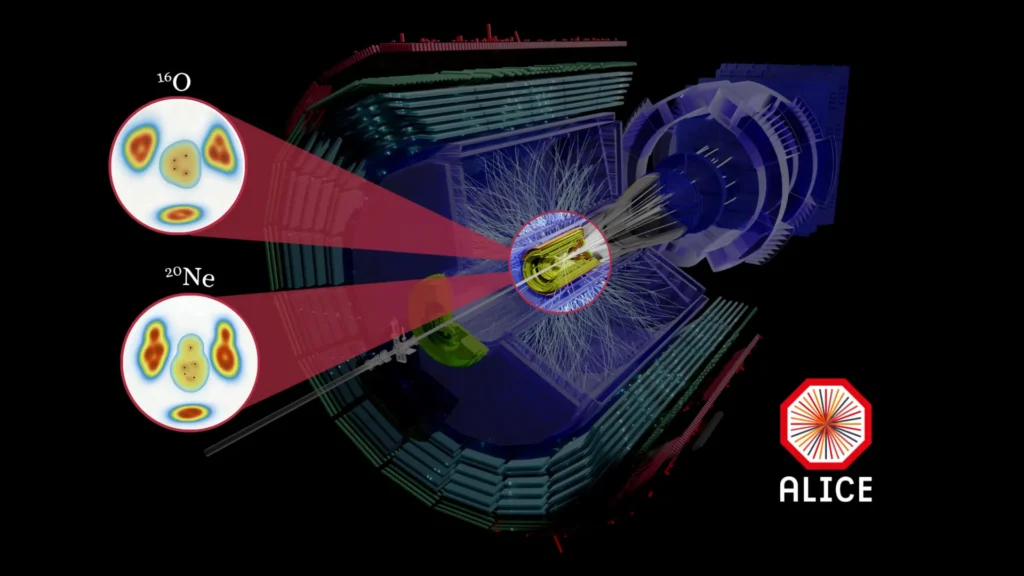
The researchers successfully created QGP by colliding oxygen-16 nuclei (with 16 nucleons) and neon-20 nuclei (with 20 nucleons). This discovery suggests that QGP formation might be a more ubiquitous phenomenon than previously thought, potentially occurring in systems of matter far smaller than the colossal collisions of heavy ions. It refines our understanding of the critical energy density and temperature thresholds required for the phase transition from ordinary nuclear matter to the quark-gluon plasma.
"Hopefully, this will help us better understand how the plasma behaved during the first moments of the Universe – and how it later evolved into the forms of matter that everything around us is made of," You Zhou added. The research findings, which are the culmination of intensive data analysis from the ALICE experiment, have been published in the prestigious journal Physical Review Letters, signifying their profound impact on the field.
Chronology of Quark-Gluon Plasma Research
The journey to understanding QGP has been a multi-decade endeavor:
- 1970s: Theoretical physicists first propose the existence of QGP based on Quantum Chromodynamics (QCD), the theory of the strong force.
- 1980s-1990s: Early experiments at CERN’s Super Proton Synchrotron (SPS) and Brookhaven National Laboratory’s Alternating Gradient Synchrotron (AGS) begin to probe conditions for QGP.
- 2000s: The Relativistic Heavy Ion Collider (RHIC) at Brookhaven begins operation, providing strong evidence for QGP formation using gold nuclei collisions. The "perfect fluid" nature of QGP is first observed.
- 2208-Present: The Large Hadron Collider (LHC) at CERN, with its significantly higher collision energies, begins to produce QGP in lead-lead collisions (ALICE, CMS, ATLAS experiments), confirming and expanding on RHIC’s findings.
- 2010s: Experiments at LHC and RHIC begin to explore QGP-like phenomena in smaller collision systems, such as proton-lead and even proton-proton collisions, leading to intriguing questions about the minimum system size for QGP.
- Recent Breakthrough: The current study using oxygen-16 and neon-20 nuclei definitively demonstrates QGP formation in even lighter systems, pushing the boundaries of the "Little Big Bang" concept.
A Tiny Big Bang with a "Bowling Pin Signature": Probing Nuclear Structure
Beyond illuminating the early Universe, these high-energy collisions offer a revolutionary new approach to understanding the intricate internal structures of atomic nuclei themselves. When nuclei collide at enormous speeds, the resulting quark-gluon plasma droplet survives for only an incredibly short duration – fractions of a femtosecond (10^-15 seconds) – before expanding and transforming into a cascade of other particles. Scientists cannot directly observe the plasma; instead, they meticulously measure the movement patterns of these emergent particles.
The recent results reveal a fascinating correlation: these movement patterns preserve information about the original geometric shape of the colliding nuclei. For instance, collisions between two relatively spherical oxygen nuclei generate a distinctly rounded particle flow pattern. In contrast, collisions involving neon-20 nuclei, which are believed to have a more elongated, "prolate" or "deformed" shape akin to a bowling pin, create a unique, elongated "bowling-pin-shaped" particle flow pattern.
"The particles from the primordial matter are directly governed by the geometric shape of the atomic nucleus. If the two nuclei we smash together are spherical, we get one pattern. If they are shaped like bowling pins, we get another," explained Postdoctoral Researcher Emil Gorm Dahlbæk Nielsen from the Niels Bohr Institute, a co-author of the study. He used a compelling analogy: "It is a bit like shining light on an object and seeing its shadow. You cannot see the object directly, but its shadow reveals its shape. In the same way, the movement of the particles reveals the geometric shape of the atomic nuclei that was present at the beginning of the collision."
Using Extreme Collisions to Unlock Nuclear Secrets
Understanding the shapes and internal configurations of atomic nuclei has been a central pursuit in physics for over seven decades, with deep historical roots at the Niels Bohr Institute. Aage Bohr, son of the renowned physicist Niels Bohr, received the Nobel Prize in Physics in 1975 for his seminal work on the collective motion and structure of the atomic nucleus, particularly for developing the model of the atomic nucleus that linked its collective (rotational and vibrational) properties with the individual motion of nucleons.
The shape of a nucleus is not merely a geometric curiosity; it provides critical insights into how protons and neutrons are arranged within its confines and, crucially, how the strong force operates at the subatomic level. The strong force, one of nature’s four fundamental forces, is responsible for binding quarks together to form protons and neutrons, and subsequently, for holding these nucleons together within the nucleus, overcoming the immense electromagnetic repulsion between positively charged protons. Despite its fundamental importance, physicists are still working towards a complete theoretical understanding of the strong force, as described by Quantum Chromodynamics (QCD).
Traditionally, nuclear structure has been investigated through relatively low-energy experiments, such as scattering experiments, or by studying the rotational and vibrational spectra of nuclei. These methods involve gently probing the nucleus to deduce its properties. The new approach dramatically redefines this strategy. Instead of gentle probing, researchers are now "smashing them together at the highest energies we can create and can now read their shape from the imprint they leave behind," as You Zhou describes it.
This method represents a potential paradigm shift. If refined and developed further, it could offer a novel and powerful tool for scientists to investigate the shapes and internal structures of a wide array of atomic nuclei, especially those whose configurations remain poorly understood due to limitations of traditional techniques. It provides a unique window into the strong force under extreme conditions, potentially revealing aspects that are inaccessible through other means.
Broader Implications and Future Horizons
The dual implications of this research are profound. On one hand, it deepens our understanding of cosmic evolution, providing tangible experimental data to validate theoretical models of the Big Bang and the subsequent formation of matter. The precise conditions under which QGP forms, its properties, and how it cools into ordinary matter are crucial pieces of the puzzle that explains how the Universe transitioned from a formless energy state to the complex structures we observe today.
On the other hand, the innovative use of high-energy nuclear collisions to infer nuclear shapes opens up an entirely new avenue in nuclear structure physics. This could lead to a more comprehensive understanding of the strong force, its behavior within different nuclear configurations, and the fundamental properties of nuclear matter.
Looking ahead, a key objective for the ALICE collaboration is to determine the absolute minimum size of a collision system that can still produce quark-gluon plasma. The team plans to conduct further experiments using even lighter atomic nuclei, including helium-4 (alpha particles). By systematically reducing the size of the colliding systems, physicists aim to pinpoint the precise boundary conditions for QGP formation, which could further refine our models of the early Universe and the strong force.
"What is fascinating is that we can use the same experiment both to learn about the structure of atomic nuclei and to gain a better understanding of what happened during the birth of the Universe," You Zhou concluded. "These two things turn out to be much more closely connected than one might initially think." This interconnectedness underscores the holistic nature of fundamental physics research, where probing the smallest constituents of matter can unlock secrets about the grandest cosmic phenomena. The "Little Big Bangs" created at CERN continue to be a fertile ground for discovery, promising to reshape our understanding of both the infinitely small and the infinitely vast.