The European Space Agency (ESA) is meticulously preparing for the ambitious ExoMars Rosalind Franklin rover mission, a scientific endeavor poised to revolutionize our understanding of life beyond Earth. Central to this preparation is the highly specialized sterilization process for the rover’s critical landing components, particularly its colossal parachute system. Albert Haldemann, ESA’s chief engineer for the Mars program, recently offered a detailed insight into this crucial procedure, underscoring its paramount importance for both mission success and the safeguarding of the Martian environment.
A Parachute Built for Martian Extremes
The ExoMars Rosalind Franklin rover, slated for launch in 2028, is designed to embark on a multi-year journey to the Red Planet, with a primary objective of searching for biosignatures – definitive evidence of past or present life – beneath the Martian surface. To achieve a safe landing in Mars’s thin atmosphere, the rover relies on an advanced parachute system. The primary parachute, a staggering 35 meters in diameter, is a marvel of engineering. Constructed from a robust combination of nylon and Kevlar fabrics, this 74-kilogram marvel is engineered to withstand the extreme conditions of a six-minute atmospheric descent. Upon deployment, it will be tasked with significantly decelerating the rover, a feat that will make it the largest parachute ever to be deployed on Mars, and indeed, the largest beyond Earth in the entire solar system.
The Imperative of Planetary Protection
The scientific objective of the ExoMars mission – the search for life – inherently necessitates an unparalleled level of cleanliness. The potential existence of life, past or present, on Mars is a question that demands absolute scientific rigor. Any terrestrial microbes inadvertently transported to Mars could compromise the integrity of the mission by introducing "forward contamination." These hardy microorganisms, capable of surviving the harsh journey through space, could mimic Martian life, leading to false positives and jeopardizing decades of scientific inquiry.
This concern is addressed through stringent international protocols known as planetary protection. These measures are designed not only to prevent Earth’s biosphere from contaminating other celestial bodies but also to protect Earth from potential extraterrestrial life forms, should they be discovered. For a mission like ExoMars, which aims to delve beneath the Martian surface, the risk of forward contamination is particularly acute. Therefore, every component, especially those directly interacting with the Martian environment during descent, must be sterilized to an extraordinary degree.
The Sterilization Process: A Symphony of Cleanliness and Heat
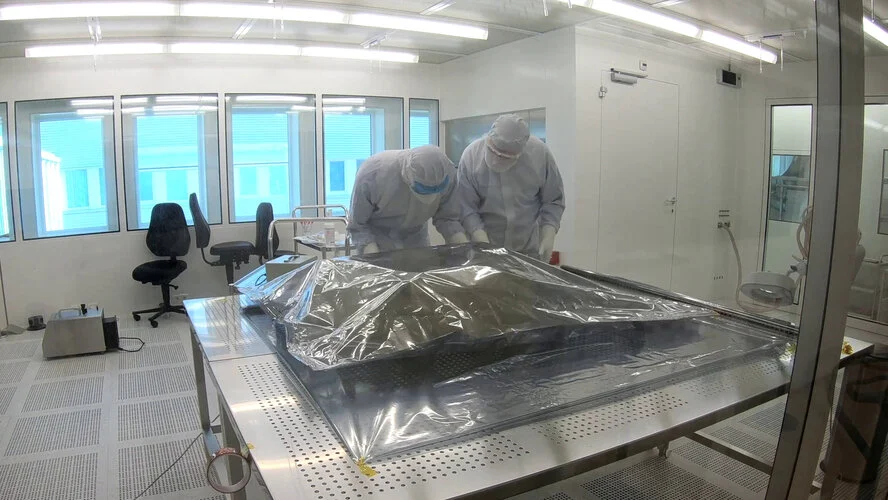
The sterilization of the ExoMars parachute is a multi-faceted process that combines meticulous environmental controls with precise thermal treatment. The parachute, carefully encased in a donut-shaped bag, undergoes a rigorous heating process within a specialized dry-heat sterilizer oven. This oven is not a standard industrial appliance; it is a highly calibrated piece of equipment designed to reach and maintain specific temperatures for extended periods, ensuring the eradication of all viable microbial life.
The required level of cleanliness is staggering. Haldemann emphasized that the parachute needs to be at least 10,000 times cleaner than a typical smartphone. This benchmark highlights the extraordinary commitment to preventing even the most resilient microbial spores from hitching a ride to Mars.
Inside the Cleanroom: A Sanctuary of Purity
The preceding stages of preparation for sterilization take place within ESA’s Life Support and Physical Sciences Laboratory at ESTEC, the agency’s technical center located in the Netherlands. This laboratory is a testament to the agency’s dedication to extreme cleanliness. The air within the cleanroom is continuously filtered through a sophisticated two-stage system, removing particulate matter and potential contaminants. Furthermore, any individual entering this controlled environment must adhere to a rigorous gowning procedure, far exceeding the sterile protocols of a surgical operating theater. This includes wearing specialized suits that cover the entire body, hairnets, and masks, followed by a passage through an air shower designed to dislodge any lingering contaminants. This meticulous approach ensures that the parachute is as pristine as possible before its final sterilization.
A Chronicle of Preparation: From Design to Launch
The journey of the ExoMars Rosalind Franklin rover, and its colossal parachute, is a testament to years of dedicated research, development, and testing. The initial design concepts for the ExoMars mission have evolved over more than a decade, with numerous technological challenges overcome. The development of the parachute system itself has involved extensive wind tunnel testing and simulations to accurately replicate the Martian atmospheric entry conditions.
The sterilization process, while appearing as a final preparatory step, is the culmination of a long chain of events. It follows the manufacturing of the parachute, which itself requires specialized materials and techniques to ensure durability and reliability. Each step, from the selection of raw materials to the final packaging, is meticulously documented and controlled to meet the stringent requirements of space missions.
The 2028 launch window represents a carefully chosen period for optimal orbital mechanics and trajectory to Mars. This launch date has been influenced by previous mission schedules and the availability of launch vehicles. The transit to Mars is projected to take over 25 months, a significant duration that further emphasizes the need for robust and long-lasting sterilization of all components.
Expert Insights and the Broader Context
Albert Haldemann’s explanation provides a crucial window into the intricate operational realities of interplanetary missions. His role as chief engineer signifies his deep understanding of the technical hurdles and the innovative solutions required to overcome them. The emphasis on "why it matters" underscores the scientific and ethical imperatives driving these extreme sterilization measures.
The scientific community has long been captivated by the question of life on Mars. Previous missions, such as NASA’s Viking landers in the 1970s, provided tantalizing but ultimately inconclusive results. More recent missions, like the Curiosity and Perseverance rovers, have focused on identifying environments that could have supported life in the past, discovering evidence of ancient lakes and rivers. The ExoMars Rosalind Franklin rover, with its ability to drill up to two meters below the surface, is designed to access environments that may have been shielded from surface radiation and thus more likely to preserve biosignatures.
The Implications for Future Exploration
The successful sterilization of the ExoMars parachute and its subsequent deployment on Mars will not only be a triumph of engineering but also a significant milestone in the ongoing quest for extraterrestrial life. The data gathered by the Rosalind Franklin rover has the potential to fundamentally alter our understanding of biology and our place in the universe.
Furthermore, the advanced sterilization techniques developed for this mission contribute to the broader field of planetary protection. As humanity’s space exploration ambitions grow, with plans for future missions to the Moon, Mars, and beyond, the lessons learned from ExoMars will be invaluable in ensuring responsible and scientifically sound exploration. The success of this mission will also pave the way for future human exploration of Mars, where stringent contamination control will be even more critical.
A Global Effort in Scientific Pursuit
The ExoMars program is a collaborative effort involving ESA and its international partners. The Rosalind Franklin rover itself is a testament to global cooperation in scientific endeavor. The development of its instruments, its mobility system, and its landing technology has involved expertise from numerous countries. The shared commitment to planetary protection further highlights the unified approach to safeguarding celestial bodies for scientific inquiry.
The rigorous sterilization of the ExoMars Rosalind Franklin rover’s parachute is not merely a technical detail; it is a critical safeguard that underpins the entire scientific premise of the mission. It represents the meticulous planning, advanced engineering, and unwavering commitment to scientific integrity that define humanity’s pursuit of knowledge beyond our home planet. As the launch date approaches, the world watches with anticipation, eager for the insights that this groundbreaking mission promises to deliver.