More than 50 years after physicist Sir Roger Penrose first theorized the audacious possibility of extracting energy from a rapidly spinning black hole, researchers at the Advanced Science Research Center (ASRC) at the CUNY Graduate Center have achieved a significant experimental milestone, demonstrating a laboratory-based method to replicate and amplify waves inspired by these profound astrophysical concepts. Published in the prestigious journal Nature, their groundbreaking work reveals how "synthetic rotation" can simulate the extreme rotational dynamics of black holes, enabling wave amplification without the need for any physically moving parts. This innovative approach not only validates the long-standing theories of Penrose and physicist Yakov Zel’dovich but also opens unprecedented avenues for exploring extreme physics and developing advanced technologies in communications, optics, photonics, and quantum science.
The Genesis of an Extraordinary Idea: Penrose and Zel’dovich’s Vision
The journey to this experimental triumph began in 1969 with Sir Roger Penrose, the Nobel Prize-winning physicist, who put forth a remarkable hypothesis concerning the extraction of energy from Kerr black holes – those characterized by both mass and angular momentum. Penrose’s concept centered on the black hole’s ergosphere, a fascinating region just outside the event horizon where the immense gravitational pull of the spinning black hole is so powerful that spacetime itself is dragged along with its rotation. Within this exotic zone, Penrose proposed that a particle could enter and then split into two fragments. One fragment would possess negative energy and fall into the black hole, effectively reducing its rotational energy, while the other fragment, carrying positive energy, would escape, but with more energy than the original particle possessed upon entry. This mechanism, now known as the Penrose Process, illustrated a theoretical pathway to tap into the rotational energy of these cosmic behemoths.
A few years later, in the early 1970s, Russian physicist Yakov Zel’dovich expanded on Penrose’s fundamental idea, shifting the focus from individual particles to waves. Zel’dovich predicted that waves, such as electromagnetic or gravitational waves, could also interact with a sufficiently fast-rotating object and undergo amplification, a phenomenon now termed "superradiance." In essence, if a wave impinged upon an object rotating faster than the wave’s phase velocity, the wave could "steal" rotational energy from the object, emerging with enhanced amplitude and energy. This effect is analogous to a paddlewheel spinning in a current: if the wheel spins faster than the current, it can impart energy to the water, amplifying any ripples. However, simulating such extreme rotational speeds and precisely controlling wave-matter interactions in a laboratory setting to observe superradiance directly proved to be an insurmountable challenge for decades, relegating these profound theories largely to the realm of theoretical physics. The sheer physical forces required to spin an object at speeds comparable to the effective rotation of a black hole’s ergosphere were beyond any mechanical system.
CUNY ASRC’s Breakthrough: Synthesizing Extreme Rotation
The breakthrough achieved by the CUNY ASRC team, detailed in their Nature publication, directly addresses this long-standing experimental limitation. Instead of attempting to physically rotate an object at impossible speeds, the researchers devised an ingenious radio frequency (RF) device that simulates the effects of ultrafast rotation. This innovative approach sidesteps the mechanical constraints that have historically hindered experimental validation of Penrose and Zel’dovich’s theories.
The core of their invention lies in a carefully engineered system whose properties are rapidly and dynamically changed across both space and time. This intricate manipulation creates the "illusion" of extreme rotational motion for electromagnetic waves interacting with the device. By replacing actual physical motion with this "synthetic rotation," the team was able to achieve effective rotational speeds that far exceed what any conventional mechanical system could possibly sustain. This methodology has effectively unlocked a new frontier for studying extreme rotational physics, moving it from abstract theoretical discussions into tangible laboratory experiments.
Andrea Alù, the principal investigator, Distinguished Professor and Einstein Professor of Physics at the CUNY Graduate Center, and founding director of the CUNY ASRC’s Photonics Initiative, emphasized the novelty of their approach. "Our approach facilitates a new method of wave-matter interaction in which waves with selected rotational properties extract energy from synthetic time-engineered rotation, producing a form of broadband selective amplification," Professor Alù stated. This statement highlights not only the successful demonstration of the Penrose-Zel’dovich process in a controlled environment but also the development of a versatile platform for exploring previously inaccessible physical phenomena.
The Mechanics of Synthetic Rotation
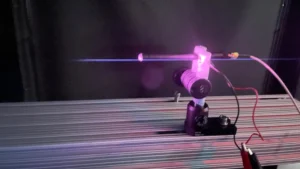
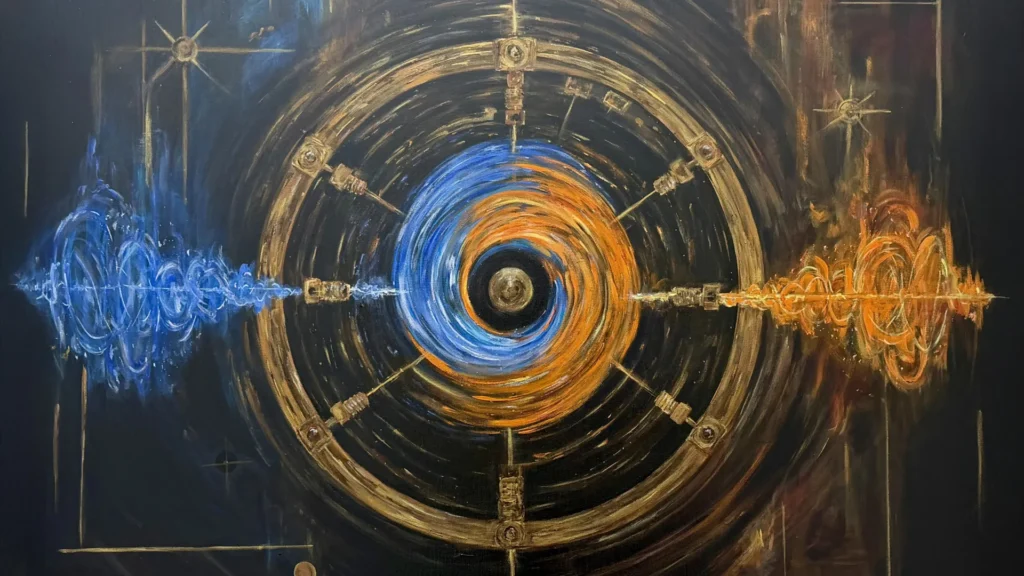
To delve deeper into the experimental setup, the CUNY ASRC researchers constructed a ring of electronic resonators. These resonators are individual components designed to interact with electromagnetic waves at specific frequencies. The genius of the system lay in how the properties of these resonators were not static but rapidly adjusted in a carefully synchronized sequence. This precise temporal and spatial modulation generated a dynamic, traveling pattern around the ring, even though the physical hardware itself remained completely stationary.
As electromagnetic waves propagated through this ring, they effectively experienced the system as if it were spinning at extraordinary speeds. The timed changes in the resonators’ properties mimicked the spacetime dragging effects of a rotating black hole’s ergosphere, allowing the waves to "perceive" and interact with a rotational field. Crucially, waves possessing the appropriate rotational characteristics — analogous to the specific trajectories required for particles or waves in the Penrose-Zel’dovich process – were able to extract energy from this synthetic motion. This energy transfer resulted in the amplification of these waves, directly reproducing the essential physics predicted by Penrose and Zel’dovich.
Hady Moussa, a co-lead author and former PhD student with the CUNY ASRC Photonics Initiative, elaborated on this aspect: "Waves with the appropriate rotational characteristics extracted energy from the system and became amplified, reproducing the essential physics of the Penrose-Zel’dovich process." He further added, "Our approach relies on engineered metamaterials that are designed to control how waves propagate." Metamaterials are artificially structured materials engineered to have properties not found in nature, allowing unprecedented control over wave propagation. In this context, they were instrumental in creating the desired synthetic rotational environment and guiding the waves to interact effectively with it.
Transforming Theory into Practical Research Tool
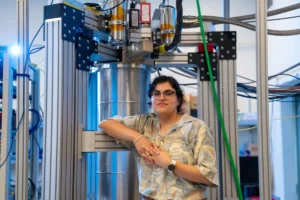
Hadiseh Nasari, lead author and a post-doctoral researcher with the CUNY ASRC’s Photonics Initiative, underscored the practical significance of the experiment. "This successful experiment moves ideas about extreme rotational dynamics from theory to practice and creates a versatile experimental platform for exploring a broad range of phenomena at the intersection of astrophysics, wave physics, and quantum science," said Nasari. She further noted the wide-ranging implications of this work, extending beyond fundamental science into areas like communications, optics, and photonics.
The ability to synthesize extreme rotation without physical movement is a game-changer. It allows scientists to probe physical regimes that are otherwise impossible to study directly due to the immense energy, forces, and practical limitations involved. For instance, creating a rotating system that effectively spins at "beyond the speed of light" (in terms of phase velocity, not actual matter transport) is now conceivable in a controlled laboratory environment. This opens up opportunities to test the boundaries of our understanding of wave-matter interactions under conditions previously only imaginable in the most extreme cosmic settings.
Broader Impact and Future Horizons
The implications of this research extend far beyond merely validating decades-old astrophysical theories. The platform developed by the CUNY ASRC team offers a versatile new tool for scientific exploration and technological innovation across multiple disciplines.
In Fundamental Science:
- Astrophysics: While not directly replicating a black hole, the synthetic rotation platform provides an analog for studying the physics of black hole ergospheres and superradiance. This could lead to a deeper understanding of energy extraction mechanisms from black holes, neutron stars, and other rapidly spinning cosmic objects. It also offers a pathway to experimentally probe aspects of general relativity in a controlled setting, albeit through simulation.
- Wave Physics: The ability to induce broadband selective amplification opens new avenues for understanding wave behavior in extreme rotational environments. This could lead to discoveries about how different types of waves (electromagnetic, acoustic, even quantum waves) interact with dynamic spacetime-like structures.
- Quantum Science: The principles demonstrated could potentially be applied to quantum systems, offering new methods for controlling light at the quantum level, manipulating quantum states, and developing novel quantum sensors or processors.
In Applied Technologies:
- Wireless Communications: The concept of broadband selective amplification could revolutionize wireless communication systems. Imagine antennas or transceivers that can dynamically amplify specific incoming signals while filtering out noise, significantly improving signal-to-noise ratios and extending communication ranges. This could lead to more efficient data transmission, faster networks, and more robust communication in challenging environments.
- Optics and Photonics: The ability to control light through synthetic rotation offers new paradigms for optical devices. This could include advanced optical modulators, isolators, or circulators that are more efficient and compact. It could also pave the way for novel light harvesting technologies, where incident light can be amplified and converted into electrical energy with greater efficiency.
- Quantum Technologies: The research hints at future applications in quantum computing and quantum information processing. Synthetic rotation could be used to manipulate qubits or to create novel interfaces between light and matter for quantum applications, potentially leading to more stable and scalable quantum devices.
While the researchers acknowledge that "additional work will be needed before these ideas can be translated into practical devices," the foundational principles have been firmly established. The current radio frequency demonstration is a crucial first step, and the team believes that the same principles can be applied to photonic systems, allowing for the control and amplification of light, and potentially to quantum systems. This would open entirely new possibilities for managing light, processing information, and studying wave behavior inspired by some of the universe’s most extreme environments, all within the confines of a laboratory.
The research was made possible through significant financial backing, underscoring its strategic importance and scientific merit. Support was provided by the U.S. Department of Defense, highlighting potential applications in advanced defense technologies; the U.S. National Science Foundation, which champions fundamental scientific discovery; and the Simons Foundation, known for its commitment to advancing scientific research. This collaborative funding environment has been critical in enabling the CUNY ASRC team to push the boundaries of physics and engineering, bringing long-standing theoretical concepts into the realm of experimental verification and practical application. The work stands as a testament to human ingenuity in unraveling the universe’s deepest mysteries and translating that understanding into tangible benefits for society.