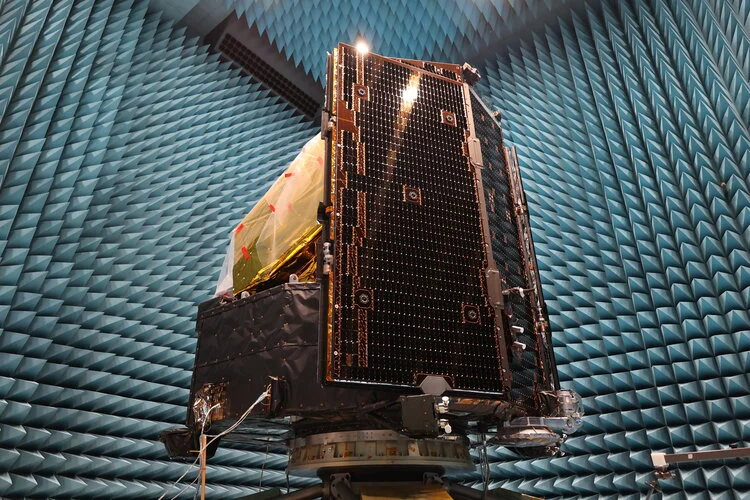
The European Space Agency’s (ESA) ambitious planet-hunting mission, Plato, has successfully completed a pivotal series of electromagnetic compatibility (EMC) tests within the specialized Maxwell Test Chamber at ESA’s technical heart, ESTEC, in the Netherlands. This rigorous testing phase is a significant milestone, verifying that Plato’s sophisticated electronic systems are robust and will function harmoniously in the unforgiving environment of space, free from disruptive interference.
Housed within the cavernous Maxwell Test Chamber, Plato, a testament to advanced space engineering, underwent a comprehensive evaluation designed to simulate the electromagnetic conditions it will encounter during its mission. The chamber itself is a marvel of engineering, constructed as a Faraday cage with its conducting metal walls, floor, and ceiling designed to completely shield the spacecraft from any external electromagnetic interference. Its impressive 9-meter height is further augmented by an internal lining of specially designed foam spikes, meticulously arranged from floor to ceiling. These spikes serve a crucial purpose: to absorb stray electrical signals and sound waves, effectively mimicking the vacuum and acoustic silence of outer space.
During these critical tests, engineers remotely activated and controlled Plato’s intricate array of electronic equipment. The objective was to meticulously scrutinize the interactions between the spacecraft’s various instruments and modules. The primary concern was to ensure that no single component would inadvertently interfere with others or with the mission’s vital communication systems, thereby preventing the occurrence of unwanted “crosstalk”—a phenomenon where signals bleed into adjacent circuits, potentially corrupting data or causing malfunctions. The success of these tests confirms that Plato’s internal electronic ecosystem is self-contained and resilient.
The inherent challenges of testing electronic equipment for space applications cannot be overstated. In the extreme vacuum of space, where there is no atmosphere to dissipate heat or scatter electromagnetic waves, electronic components can exhibit behaviors that differ significantly from their performance in a conventional terrestrial laboratory setting. Without thorough and specialized testing, these anomalies could lead to unforeseen consequences, jeopardizing the mission’s scientific objectives or, in the worst-case scenario, causing irreparable damage to the spacecraft’s sensitive hardware. The Maxwell Test Chamber provides a controlled environment that meticulously replicates these challenging conditions, allowing engineers to identify and rectify potential issues before launch.
The successful completion of the EMC tests in the Maxwell Chamber signifies that Plato’s numerous electronic systems have been definitively proven to coexist and operate in space without generating or succumbing to disruptive interference. This vital verification confirms the spacecraft’s electromagnetic compatibility, a non-negotiable prerequisite for any space mission.
This latest achievement marks the culmination of a comprehensive examination series for Plato, representing its final major hurdle before being declared “fit for launch.” The spacecraft has been systematically subjected to a gauntlet of demanding tests designed to simulate the rigors of its journey and operational life.
A Rigorous Preparation Timeline
Plato’s journey through its pre-launch assessment began in January of the current year with a series of intense vibration and acoustic tests. These tests are designed to simulate the extreme forces and noises the spacecraft will endure during its ascent into orbit aboard a powerful launch vehicle. Following these dynamic trials, Plato embarked on an extended, month-long stay within the Large Space Simulator (LSS), another critical ESTEC facility.
The Large Space Simulator is a colossal vacuum chamber capable of replicating the vacuum and temperature extremes of space. Within this simulated extraterrestrial environment, Plato underwent a battery of demanding tests, which it successfully navigated, further demonstrating its resilience and readiness to withstand the harsh conditions of its cosmic destination. These cumulative tests underscore ESA’s commitment to ensuring the highest levels of reliability and performance for its flagship missions.
Understanding Plato: A New Era of Exoplanet Discovery
Plato, an acronym for PLAnetary Transits and Oscillations of stars, is ESA’s next-generation cornerstone mission dedicated to discovering and studying Earth-like planets orbiting stars similar to our Sun. Its primary scientific goal is to find and characterize exoplanets within the habitable zones of their stars, regions where liquid water could potentially exist on a planet’s surface, a key ingredient for life as we know it.
The spacecraft will employ a unique approach, observing a large number of relatively bright stars in its field of view. By precisely measuring the minute dips in starlight caused by a planet passing in front of its star (a transit), Plato will be able to determine the planet’s size and orbital period. In addition, by studying the subtle oscillations (or "starquakes") on the surface of stars, Plato will precisely determine their mass and radius. Combining these measurements will allow scientists to calculate the density of the transiting exoplanets, providing crucial insights into their composition and potential for habitability.
Plato’s mission is particularly focused on finding and studying planets within the “habitable zone” of Sun-like stars. This focus is a significant step forward in the search for potentially life-supporting worlds beyond our solar system. Unlike previous missions that often targeted dimmer, cooler stars, Plato’s emphasis on brighter, Sun-like stars will enable more detailed characterization of the exoplanets discovered, including the potential for atmospheric studies in the future.
The mission’s observational strategy involves staring at specific fields of the sky for extended periods, allowing for the detection of numerous transits and the precise measurement of stellar oscillations. This long-duration observation strategy is crucial for confirming the existence of planets and for building a robust statistical sample of exoplanets, helping scientists to understand the prevalence of different types of planets in our galaxy.
Launch Preparations and Future Endeavors
With its critical EMC testing now successfully concluded, Plato is one significant step closer to its scheduled launch. The spacecraft is slated to lift off aboard an Ariane 6 rocket, a testament to the strong collaboration between ESA and its European partners in the space launch sector. Arianespace, the launch provider, has scheduled Plato’s departure for March 2027. This timeline allows for meticulous final preparations and integration of the spacecraft onto the launch vehicle.
The choice of Ariane 6 for Plato’s launch underscores the reliability and capability of Europe’s heavy-lift launch system. The successful development and operation of Ariane 6 are crucial for ensuring continued European access to space for ambitious scientific and exploration missions.
Expert Commentary and Mission Significance
Dr. Anya Sharma, a leading astrophysicist not directly involved with the Plato mission, commented on the significance of the EMC testing. "Electromagnetic compatibility is an absolutely fundamental aspect of spacecraft design. In the vacuum of space, where there’s no atmospheric buffer, even minor electromagnetic interference can have cascading effects. Successfully passing these tests in a controlled environment like the Maxwell Chamber is a strong indicator of the mission’s readiness and the meticulous engineering that has gone into Plato. It reassures us that the spacecraft’s sophisticated instruments will be able to communicate and operate flawlessly, which is paramount for achieving its groundbreaking scientific objectives."
The implications of Plato’s mission are far-reaching. By discovering and characterizing a diverse population of exoplanets, including those in habitable zones, Plato will contribute immensely to our understanding of planet formation and evolution. It will provide crucial data points in the ongoing quest to answer one of humanity’s oldest questions: are we alone in the universe? The detailed information gathered by Plato will not only expand our knowledge of exoplanetary systems but could also inform future, more ambitious missions aimed at directly searching for signs of life beyond Earth.
The successful completion of these rigorous tests demonstrates ESA’s unwavering commitment to scientific excellence and technological innovation. Plato represents a significant leap forward in exoplanet research, and its successful launch and operation promise to redefine our understanding of planetary diversity and the potential for life elsewhere in the cosmos. The meticulous preparation and validation processes undertaken at ESTEC are a critical foundation upon which the mission’s future discoveries will be built.
Image Description: A photograph showcases a spacecraft positioned centrally within a vast test chamber. The chamber’s interior is striking, with its walls and ceiling densely covered in rows of vibrant blue foam spikes, creating an intricate, geometric pattern that extends in all directions around the spacecraft. The right side of the spacecraft prominently features sleek, black, stowed solar panels. The spacecraft’s main body, visible on the left, is partially enveloped in reflective, gold-colored insulating foil and further shielded by a translucent protective sheet, secured with small pieces of red tape.