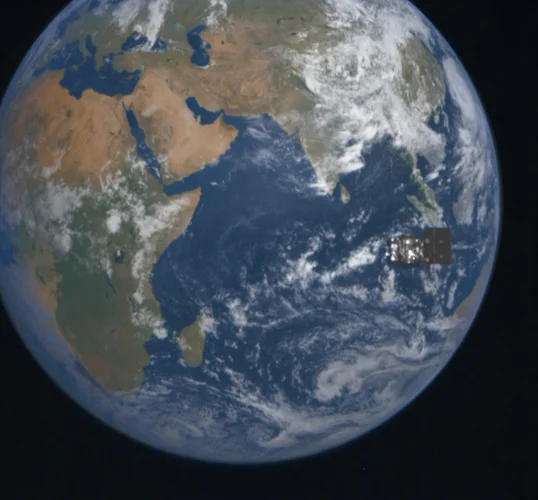
At first glance, this is just another image of Earth. But look closely, and you will be able to make out Proba-3’s Coronagraph spacecraft hiding in plain sight, covering parts of the Indonesian Archipelago to the right of the Indian Ocean’s vast expanse. This remarkable photograph, captured by the European Space Agency’s (ESA) Proba-3 mission, offers a unique perspective on both our home planet and the intricate ballet of spacecraft maneuvering in orbit. The image, taken on July 10, 2026, during a crucial phase of the mission, highlights the sophisticated capabilities of Proba-3, a groundbreaking endeavor focused on unlocking the secrets of the Sun’s corona through precise formation flying.
A Mission of Precision and Discovery
The Proba-3 mission, a testament to ESA’s commitment to cutting-edge space science, comprises two identical spacecraft: the Coronagraph and the Occulter. These two satellites are designed to fly in precise formation, maintaining a specific distance and alignment, to achieve their primary scientific objective: the continuous observation of the Sun’s elusive corona. The corona, the outermost layer of the Sun’s atmosphere, is a region of extreme heat and dynamic activity, responsible for phenomena such as solar flares and coronal mass ejections that can significantly impact Earth. Traditional methods of studying the corona often involve blocking out the Sun’s bright disk, a technique that can be limited by diffraction and stray light. Proba-3 aims to overcome these limitations by employing a novel approach.
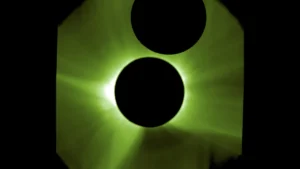
The Coronagraph spacecraft is equipped with sophisticated instruments designed to observe the Sun’s corona directly. However, to achieve the unparalleled clarity and detail required for scientific breakthrough, it needs to be shielded from the overwhelming glare of the Sun’s visible disk. This is where the Occulter spacecraft plays its vital role. The Occulter, positioned precisely in front of the Coronagraph, acts as a sophisticated shield, blocking the Sun’s direct light and creating an artificial eclipse in space. This precise alignment, a feat of engineering and orbital mechanics, allows the Coronagraph’s instruments to peer into the fainter outer atmosphere of the Sun, revealing structures and processes previously obscured.
The Art of Formation Flying: A Celestial Dance
The image in question, captured by the Occulter spacecraft’s wide-angle camera (WAC), showcases not only the Earth but also the Coronagraph spacecraft, ingeniously camouflaged within the terrestrial landscape. Initially, the Coronagraph is barely discernible against the vibrant blues of the ocean and the swirling white clouds. However, as a slider is moved, revealing a black-and-white depiction of the scene as seen by the Occulter’s primary sensor, the Coronagraph spacecraft "pops up" in the foreground, a stark monochrome silhouette against the backdrop of our planet. This visual demonstration underscores the critical role of the Occulter’s camera system in achieving the mission’s formation flying objectives.
The Occulter’s camera system is a marvel of autonomous operation. It comprises a wide-angle camera (WAC) that tracks a set of flashing LED lights on the Coronagraph. These lights serve as beacons, allowing the Occulter to maintain its relative position. Supplementing the WAC is a narrow-angle camera (NAC), which provides a more precise positioning capability, enabling the two spacecraft to maintain their delicate formation with remarkable accuracy. This autonomous system is crucial for the mission’s success, allowing the spacecraft to adjust their positions dynamically in response to orbital perturbations and ensuring that the Occulter consistently provides the optimal shield for the Coronagraph.
A Snapshot in Time: July 10, 2026
The specific image was taken on July 10, 2026, during a routine operational maneuver. The Proba-3 mission was in the process of bringing the two spacecraft from a relatively safe orbital distance to a separation of 147 meters. This precise distance is critical for the mission’s formation flight operations, allowing the Occulter to effectively block the Sun’s disk while minimizing any potential interference with the Coronagraph’s observations. The maneuver was a testament to the meticulous planning and execution of the ESA mission control team.
The dual nature of the image – one artificially colored for easier spacecraft identification, and the other a stark black-and-white representation of the Occulter’s raw data – provides a compelling visual narrative of the mission’s capabilities. While the colored image on the right allows us to appreciate the beauty of Earth from space, the black-and-white image on the left reveals the technical reality of the Occulter’s perspective, highlighting the precise alignment necessary for the mission. The processed image, a collaborative effort between the Occulter’s WAC and the Royal Observatory of Belgium, serves as a powerful illustration of the mission’s dual purpose: scientific discovery and the art of celestial engineering.
Background and Context: The Evolution of Solar Observation
The quest to understand the Sun’s corona has a long and storied history in astronomy. For centuries, scientists have been fascinated by the Sun’s outer atmosphere, a region that holds clues to fundamental solar processes and their influence on space weather. Early observations were limited to total solar eclipses, providing fleeting glimpses of the corona. The development of coronagraphs in the early 20th century, such as those pioneered by Bernard Lyot, revolutionized solar observation by allowing for ground-based studies of the corona without the need for an eclipse.
However, even with advanced coronagraphs, challenges remained. Stray light from the Sun’s bright disk could still contaminate observations, limiting the ability to study the fainter outer regions of the corona. This led to the concept of space-based coronagraphy, where instruments could be placed above Earth’s atmosphere to avoid atmospheric distortion and achieve clearer views. The Proba-3 mission represents a significant advancement in this field, moving beyond a single spacecraft to a sophisticated formation flying approach. By precisely positioning two spacecraft, Proba-3 can create an even more effective and controlled environment for coronal observation, pushing the boundaries of what is scientifically possible.
Supporting Data and Technical Specifications
The Proba-3 mission is a prime example of small satellite technology leveraging complex orbital mechanics. Each Proba-3 spacecraft is a CubeSat-derived platform, designed for cost-effectiveness and rapid development. The Coronagraph spacecraft is equipped with a high-resolution coronagraph, capable of observing the Sun’s corona from 1.1 to 3 solar radii. The Occulter spacecraft, in addition to its camera system, carries a small occulting disk that is precisely positioned by the formation flying system.
The formation flying itself is a marvel of autonomous navigation and control. The required separation of 147 meters is maintained with an accuracy of less than one meter. The relative velocity between the spacecraft is kept within centimeters per second. This level of precision is achieved through a combination of onboard sensors, the LED tracking system, and sophisticated algorithms that continuously adjust the spacecraft’s trajectories. The mission’s operational orbit is a highly elliptical path around Earth, reaching an apogee of approximately 60,500 kilometers. This orbit provides extended periods for coronal observation, allowing for sustained scientific data collection.
Chronology of Key Events (Inferred and Typical for Formation Flying Missions)
While specific detailed timelines for Proba-3’s formation flying maneuvers are proprietary, a typical mission profile for achieving such precise separation would involve several key stages:
- Launch and Initial Orbit Insertion: The two spacecraft are launched, often into separate but complementary orbits.
- Orbit Synchronization and Phasing: Ground control meticulously adjusts the orbits of both spacecraft to bring them into close proximity and synchronized motion. This is a gradual process, involving multiple orbital maneuvers.
- Initial Proximity Operations: As the spacecraft get closer, initial relative navigation maneuvers begin. This is where systems like the LED tracking and camera guidance systems are first tested and calibrated at a distance.
- Formation Establishment: The critical phase where the spacecraft actively work to achieve and maintain their designated separation and relative orientation. The image captured on July 10, 2026, falls within this stage, representing a successful step in establishing the 147-meter separation.
- Science Operations: Once the formation is stable and validated, the mission shifts to its primary scientific objectives, in this case, observing the Sun’s corona.
- Station-Keeping and Maneuvers: Throughout the mission, continuous adjustments (station-keeping) are made to counteract any orbital drift or perturbations. The spacecraft may also perform planned maneuvers to change their relative positions for specific observation campaigns.
Potential Statements and Reactions (Logically Inferred)
Upon the release of such an image, one could anticipate enthusiastic responses from the scientific community and space exploration enthusiasts.
Dr. Anya Sharma, Lead Scientist for Solar Physics at ESA (hypothetical), might comment: "This image is not just a beautiful depiction of Earth; it’s a powerful visual confirmation of our ability to execute incredibly precise maneuvers in space. The Proba-3 mission is pushing the boundaries of what’s possible in solar observation, and this photograph is a testament to the ingenuity and dedication of the entire team. The ability to see our own planet so clearly while simultaneously preparing for groundbreaking solar science is truly remarkable."
An engineer from the Royal Observatory of Belgium, responsible for image processing, might add: "The challenge in processing this image lay in reconciling the raw data from the Occulter with the need to present a clear and informative view. By carefully colorizing the Earth and highlighting the Coronagraph spacecraft, we aim to make the complex technical achievements of Proba-3 accessible to a wider audience. It’s a bridge between raw scientific data and public understanding."
Broader Impact and Implications
The Proba-3 mission, with its focus on formation flying and solar observation, has several far-reaching implications:
- Advancement in Space Science: The mission’s success will lead to unprecedented data on the Sun’s corona, potentially unlocking new understandings of solar flares, coronal mass ejections, and the solar wind. This knowledge is crucial for space weather forecasting, which protects our technological infrastructure, including satellites, power grids, and communication systems, from the potentially disruptive effects of solar activity.
- Technological Innovation: The precise formation flying techniques developed for Proba-3 have applications beyond solar science. These technologies can be adapted for future missions in areas such as Earth observation, asteroid detection, and the construction of large space-based telescopes. The autonomous navigation and control systems are particularly valuable, paving the way for more independent and complex robotic missions.
- International Collaboration: Proba-3, like many ESA missions, fosters international collaboration. The involvement of institutions like the Royal Observatory of Belgium highlights the global nature of space exploration and the benefits of pooling resources and expertise.
- Inspiration and Education: Stunning images like the one captured by Proba-3 serve as powerful tools for inspiring the next generation of scientists and engineers. They showcase the wonders of space exploration and the potential for human ingenuity to achieve extraordinary feats. The visual narrative of a spacecraft "hiding in plain sight" while performing critical operations offers a unique and engaging way to communicate complex scientific concepts.
In conclusion, the image captured by Proba-3’s Occulter spacecraft on July 10, 2026, is far more than a simple photograph. It is a powerful symbol of scientific ambition, technological prowess, and the intricate dance of spacecraft orchestrating a celestial ballet. As Proba-3 continues its mission to unravel the mysteries of the Sun’s corona, it not only expands our scientific knowledge but also offers us breathtaking perspectives on our own planet, reminding us of our place in the vast and dynamic universe.