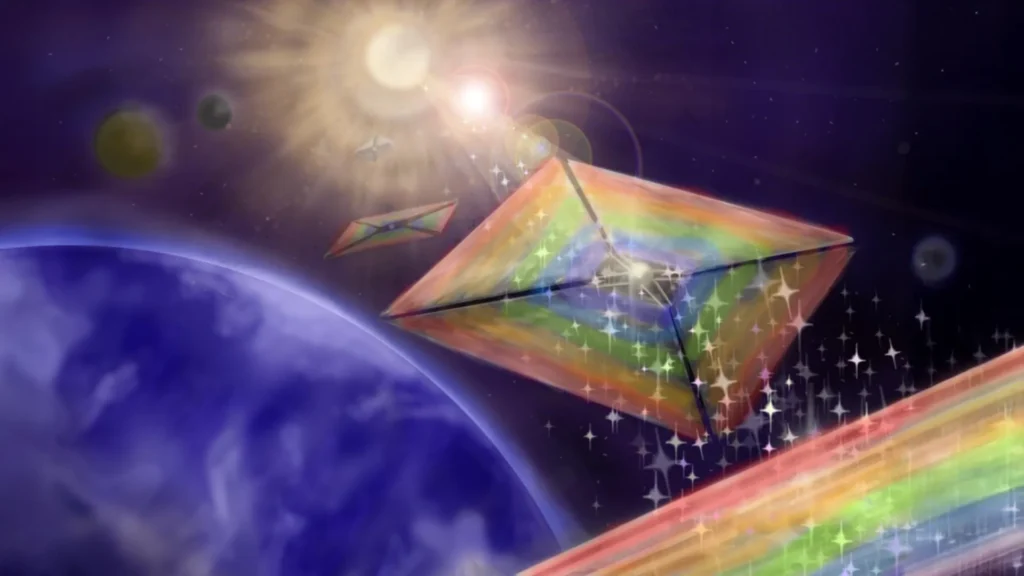
The pursuit of interstellar travel has long been characterized by a fundamental struggle against the vast distances of the cosmos. With the nearest star system, Alpha Centauri, located approximately 4.37 light-years away, conventional chemical propulsion systems—which have powered humanity’s journey to the Moon and Mars—are woefully inadequate. Even the fastest human-made object, the Parker Solar Probe, would take nearly 7,000 years to reach our nearest stellar neighbors. To bridge this gap within a human lifetime, scientists have turned to the concept of the "lightsail": a massive, ultralight reflective membrane propelled to relativistic speeds by the pressure of laser light. However, new research suggests that as these sails approach a significant fraction of the speed of light, they may encounter a counterintuitive and invisible barrier: a drag force generated by the very light intended to push them.
According to a recent study published on the preprint server arXiv by researchers Chao Shen and Jiaze Li of the Harbin Institute of Technology, the physics of light propulsion changes dramatically at relativistic velocities. Their findings indicate that once a lightsail reaches roughly 75% of the speed of light (0.75c), the phenomenon of diffuse scattering, which normally aids in propulsion, begins to act as a braking force. This discovery introduces a new layer of complexity for projects like Breakthrough Starshot, which aims to send gram-scale "StarChips" to Alpha Centauri at 20% of the speed of light.
The Mechanics of Photonic Propulsion
To understand the drag effect identified by Shen and Li, one must first examine how light exerts force on a physical object. Photons, though massless, carry momentum. When they strike a surface, that momentum is transferred to the object. In the context of a solar or laser sail, researchers categorize the resulting forces into three distinct physical interactions:
- Incident Light: This is the primary force generated by the raw momentum of photons as they first strike the sail. It provides the initial "push" from the laser source.
- Specular Reflection: This occurs when photons bounce off the sail’s surface like a mirror. Because the photons reverse direction, they impart nearly double the momentum of the initial impact to the sail, making high reflectivity a critical requirement for sail design.
- Diffuse Scattering: In real-world materials, not all light reflects perfectly. Some photons are absorbed by the surface and then re-emitted in random directions. This is generally the weakest of the three forces but remains a constant factor in the propulsion equation.
At the relatively "slow" speeds of current spacecraft, all three of these components contribute to forward thrust. However, as a spacecraft accelerates toward the speed of light, the relativistic laws of physics begin to distort these interactions.
The Relativistic Challenge: Doppler Shift and Power Loss
The first hurdle identified in the study is the relativistic Doppler effect. As a lightsail accelerates away from its laser source on Earth or in Earth’s orbit, the light waves reaching the sail are stretched out, or "redshifted." This increase in wavelength corresponds to a decrease in frequency and, consequently, a decrease in the energy and momentum of each photon.
For a sail traveling at 20% of the speed of light—the target velocity for many interstellar mission concepts—the Doppler shift is manageable. However, as the velocity increases further, the efficiency of the laser push drops precipitously. The researchers note that the faster the sail travels, the less momentum it can extract from the laser beam. This creates a scenario of diminishing returns: the more energy required to reach higher speeds, the less effective the energy source becomes. This effect weakens all three thrust components—incident, specular, and diffuse—simultaneously.
The 0.75c Threshold: When Light Becomes Drag
The most significant finding of the Harbin Institute of Technology study concerns the behavior of diffuse scattering at extreme velocities. At approximately 75% of the speed of light, a phenomenon known as relativistic light aberration takes center stage.
Relativistic aberration is an optical effect where the direction of light appears to change for an observer moving at high speeds. To a stationary observer on Earth, the light that is diffusely scattered (re-emitted) by the sail begins to "tilt" forward in the direction of the sail’s travel. Because of the principle of conservation of momentum—every action having an equal and opposite reaction—the act of emitting light forward produces a recoil force in the opposite direction.
In the frame of the moving sail, the light is still being scattered randomly. However, from the perspective of the "stationary" universe, that light is concentrated in the forward direction. Consequently, the force generated by diffuse scattering, which previously helped push the sail forward, flips its sign and begins acting as a drag force.
While the researchers clarify that the total force on the sail remains positive—meaning the laser is still pushing the sail forward more than the drag is holding it back—the net acceleration is significantly hampered. This "diffuse drag" creates an efficiency ceiling that could dictate the upper speed limits of future interstellar probes.
Chronology of Solar Sail Development
The concept of using light for propulsion is not new, but its transition from science fiction to mathematical reality has taken centuries:
- 1610: Johannes Kepler observes that comet tails point away from the Sun, suggesting that "heavenly breezes" (light pressure) exist.
- 1924: Soviet pioneers Konstantin Tsiolkovsky and Fridrikh Tsander publish the first technical papers on using large mirrors of "exceedingly thin sheets" to achieve cosmic velocities.
- 2010: JAXA (the Japanese Aerospace Exploration Agency) launches IKAROS, the first spacecraft to successfully demonstrate solar sail propulsion in interplanetary space.
- 2016: The Breakthrough Starshot initiative is announced, backed by Yuri Milner, Stephen Hawking, and Mark Zuckerberg, aiming to develop laser-driven sails for interstellar travel.
- 2019: The Planetary Society’s LightSail 2 mission successfully demonstrates orbit raising using only the pressure of sunlight.
- 2024: Researchers begin identifying relativistic drag effects, such as the Harbin study, as the focus shifts from "how to build a sail" to "how to reach relativistic speeds."
Supporting Data and Material Science Constraints
The theoretical model used by Shen and Li assumes an idealized mirror, but real-world engineering introduces even harsher constraints. The power required to accelerate a 1-gram sail to 0.2c over a distance of a few million kilometers is estimated to be around 100 gigawatts—roughly the total energy output of all nuclear power plants in the United States.
At these power levels, the "weakest" force—diffuse scattering—becomes a major thermal concern. If a sail absorbs even a tiny fraction of a 100-gigawatt laser beam, it must radiate that heat away instantly or melt. The Harbin study highlights that the materials used for sails must not only be highly reflective but also have specific scattering properties to mitigate the drag effect at high speeds.
Furthermore, the study acknowledges that it does not account for the Interstellar Medium (ISM). Even at 0.2c, collisions with individual hydrogen atoms and dust grains in the vacuum of space can cause significant erosion and additional drag. When combined with the radiative drag identified at 0.75c, the path to the stars appears increasingly fraught with "friction" in a vacuum where none was previously expected.
Analysis of Implications for Interstellar Missions
The identification of this drag effect has immediate implications for the trajectory and design of future interstellar probes.
First, it suggests that there is a "sweet spot" for velocity. While 75% of the speed of light is far beyond current mission goals like Breakthrough Starshot (0.2c), any future attempts to reach neighboring stars in years rather than decades will have to contend with this physical limit. Mission planners may need to accept lower cruise velocities to maintain energy efficiency.
Second, the research underscores the necessity of advanced materials science. Standard aluminum or plastic films will not suffice. Scientists are currently investigating "metamaterials"—engineered structures that can manipulate light at the sub-wavelength level. These materials could potentially be designed to suppress diffuse scattering or to ensure that any re-emitted light is directed in a way that minimizes drag, perhaps even using the aberration effect to help stabilize the sail’s orientation within the laser beam.
Expert Perspectives and Future Outlook
While the Harbin Institute of Technology study presents a challenge, it also provides a roadmap for refinement. Independent analysts suggest that the "drag" effect could be mitigated by using "photonic crystals" that exhibit a high degree of specular reflection and almost zero diffuse scattering.
"This paper is a reminder that the vacuum of space is not truly empty when you are traveling at relativistic speeds," says one industry observer. "The very physics of light, which we rely on to move, becomes an obstacle. It’s a classic example of the ‘Relativistic Wall’ that engineers must learn to climb."
The road to interstellar flight remains long. Beyond radiative dynamics, engineers must still solve the problems of laser beam divergence (how to keep a laser focused on a small sail over millions of miles) and the curvature of spacetime on a galactic scale. However, the work of Shen and Li provides a critical piece of the puzzle. By understanding the forces that will act on a probe traveling at 150,000 miles per second, humanity moves one step closer to ensuring that when we finally do launch a craft toward Alpha Centauri, it has the physics—and the endurance—to complete the journey.
As the scientific community continues to digest these findings, the focus will likely shift to experimental verification. While we cannot yet accelerate a sail to 0.75c, high-energy laboratory experiments using particle accelerators and high-power lasers may soon be able to simulate these relativistic interactions, turning theoretical drag into a measurable, and eventually manageable, engineering hurdle.