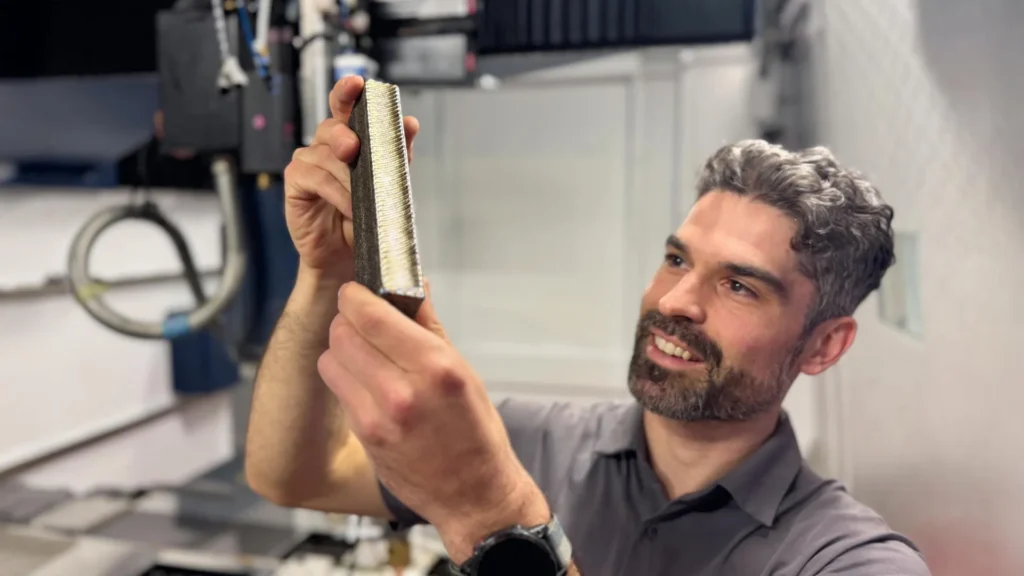
Engineers from RMIT University in Australia have unveiled a groundbreaking advancement in additive manufacturing with the development of a novel 3D-printed titanium alloy that promises to be approximately one-third cheaper than conventional titanium alloys currently in widespread use. This innovation, achieved by substituting expensive vanadium with more accessible and cost-effective materials, represents a significant leap forward in making high-performance titanium components more economically viable for critical sectors such as aerospace and medical device manufacturing.
A Paradigm Shift in Titanium Alloy Development
The research, spearheaded by RMIT’s Centre for Additive Manufacturing (RCAM), addresses a long-standing challenge in the adoption of 3D printing for titanium: the reliance on legacy alloys that do not fully leverage the potential of advanced manufacturing techniques. Ryan Brooke, a PhD candidate at RCAM and the lead author of the study, articulated this point with a compelling analogy: "3D printing allows faster, less wasteful and more tailorable production, yet we’re still relying on legacy alloys like Ti-6Al-4V that doesn’t allow full capitalization of this potential. It’s like we’ve created an aeroplane and are still just driving it around the streets."
This new alloy not only offers a substantial cost reduction but also demonstrates improved strength and performance characteristics when compared to standard 3D-printed titanium alloys like Ti-6Al-4V. The implications of this development are far-reaching, potentially democratizing the use of high-strength, lightweight titanium components across numerous high-stakes applications.
The Innovation Behind the Cost Reduction
The core of RMIT’s innovation lies in its strategic reformulation of the titanium alloy. Traditionally, vanadium has been a crucial alloying element in titanium, contributing to its strength and heat resistance. However, its escalating cost has been a significant barrier to broader adoption, particularly in 3D printing where material expenditure can be a substantial portion of production costs. The RMIT team has successfully identified and incorporated cheaper, readily available alternative elements that effectively replace vanadium’s functional role without compromising, and in some cases, even enhancing, the material’s properties.
This strategic material selection is underpinned by a novel framework for designing new alloys, which has been detailed in the prestigious scientific journal, Nature Communications. This framework streamlines the process of element selection for alloying, enabling researchers to more effectively harness the capabilities of emerging 3D printing technologies. A key outcome of this new design methodology is its ability to predict and control the printed grain structure of metallic alloys, a critical factor in determining the mechanical integrity and performance of the final printed part.
Addressing Key Challenges in 3D Printing
One of the most significant challenges that this new alloy addresses is the formation of undesirable microstructures during the 3D printing process. In some conventional 3D-printed titanium alloys, a columnar grain structure can develop. This structure, characterized by elongated, pillar-like grains, often leads to uneven mechanical properties across the component, creating weak points and limiting its suitability for demanding applications.
The RMIT team’s alloy, by virtue of its unique composition and the design framework used to create it, prints more evenly. This results in a more uniform grain structure, which translates directly to improved and more consistent mechanical performance. Brooke highlighted this achievement, stating, "By developing a more cost-effective formula that avoids this columnar microstructure, we have solved two key challenges preventing widespread adoption of 3D printing."
The study emphasizes that this work provides a clearer framework for predicting the printed grain structure of metallic alloys in additive manufacturing. This predictive capability is invaluable for engineers and designers, allowing them to anticipate material behavior with greater accuracy and to optimize designs for specific performance requirements.
Commercialization Prospects and Industry Validation
Recognizing the immense commercial potential of their breakthrough, RMIT has filed a provisional patent for their innovative approach. The university is actively exploring commercial opportunities to scale up the development of this low-cost, high-performance titanium alloy.
Brooke’s commitment to the commercialization of this technology is further solidified by his recent acceptance of a Research Translation Fellowship at RMIT. This fellowship will enable him to investigate the crucial next steps required to bring the alloy to market. His engagement with industry representatives has been extensive. As part of CSIRO’s ON Prime program, he conducted market validation, engaging with stakeholders in the aerospace, automotive, and MedTech sectors.
The feedback from these industry end-users has been instrumental in shaping the direction of the research. "What I heard loud and clear from end users was that to bring new alloys to market, the benefits have to not just be minor incremental steps but a full leap forward, and that’s what we have achieved here," Brooke emphasized. This sentiment underscores the disruptive nature of their innovation, which offers a significant step-change rather than an incremental improvement.
Quantifiable Benefits and Future Potential
The economic advantage of the new alloy is substantial. While not disclosed in detail for commercial reasons within the study itself, it has been confirmed that the team’s alloy is approximately 29% cheaper to produce than standard titanium. This cost saving, combined with enhanced performance, presents a compelling value proposition for industries that have historically faced high material costs for titanium components.
Beyond cost savings, the alloy exhibits a superior combination of properties. "We have been able to not only produce titanium alloys with a uniform grain structure, but with reduced costs, while also making it stronger and more ductile," explained Brooke. Increased ductility is a critical factor in many applications, allowing components to deform under stress without fracturing, thereby enhancing their resilience and safety.
A Collaborative Future for Advanced Manufacturing
Professor Mark Easton, the corresponding author of the study and a key figure at RCAM, expressed considerable enthusiasm for the future prospects of this new alloy. He stressed that realizing the full potential of this breakthrough will necessitate broad collaboration across the entire supply chain. "We are very excited about the prospects of this new alloy, but it requires a team from across the supply chain to make it successful. So, we are looking for partners to provide guidance for the next stages of development," Professor Easton stated.
The research and development of this innovative alloy were conducted at RMIT’s state-of-the-art Advanced Manufacturing Precinct, a facility equipped with cutting-edge technology for additive manufacturing and materials science research. The precinct provides an ideal environment for producing and rigorously testing new materials and manufacturing processes.
Background and Context
The development of advanced materials for 3D printing has been a focal point of research globally in recent years. Titanium alloys, renowned for their high strength-to-weight ratio, corrosion resistance, and biocompatibility, are particularly sought after for applications in aerospace, where weight reduction directly translates to fuel efficiency and improved performance, and in the medical field for implants and surgical instruments.
However, the inherent complexity and cost associated with traditional titanium manufacturing methods, coupled with the limitations of existing 3D printable alloys, have hindered their widespread adoption in these sectors. The RMIT innovation directly addresses these bottlenecks, offering a pathway to more accessible and versatile titanium additive manufacturing.
The journey from conceptualization to a patented technology typically involves several stages. Initial research and development, often conducted in academic settings, are followed by material characterization and performance testing. The development of a robust predictive framework, as achieved by the RMIT team, is a crucial step in enabling the systematic design of new alloys. The subsequent filing of a provisional patent protects the intellectual property while further development and market validation are pursued.
Broader Implications and Future Outlook
The implications of this cost-effective, high-performance 3D-printed titanium alloy extend beyond its immediate applications. It signifies a broader trend towards the democratization of advanced materials and manufacturing processes. As researchers develop more efficient methods for alloy design and 3D printing, complex and previously inaccessible components will become more feasible to produce.
For the aerospace industry, this could mean lighter, stronger, and more fuel-efficient aircraft. For the medical sector, it could lead to more affordable and customized implants, prosthetics, and surgical tools, improving patient outcomes and reducing healthcare costs. The automotive industry could also benefit from lighter, more durable components, contributing to improved vehicle efficiency and safety.
The RMIT team’s framework for predicting printed grain structures is a significant contribution to the fundamental understanding of additive manufacturing processes. This knowledge can be applied to the development of other metallic alloys, accelerating innovation across the entire additive manufacturing landscape.
As RMIT actively seeks industry partners, the path forward for this groundbreaking alloy appears promising. The successful transition from laboratory innovation to commercial reality will depend on robust collaboration, continued research into scaling up production, and rigorous testing to meet the stringent standards of the aerospace and medical industries. Nevertheless, this development represents a significant stride towards unlocking the full potential of 3D-printed titanium.