NATIONAL HARBOR, Md. – The U.S. Air Force’s ambitious Collaborative Combat Aircraft (CCA) program is poised to make its debut in a large-scale force integration exercise this December, marking a significant step forward in the development and operationalization of these advanced autonomous systems. This upcoming exercise will represent the program’s first real-world test of integrating CCAs into complex combat scenarios alongside fourth- and fifth-generation crewed fighter aircraft.
The announcement, made by Lieutenant Colonel Lyndon Bartlett, commander of the Experimental Operations Unit tasked with defining CCA operational procedures, underscores the accelerating pace of the program. Speaking on a panel at the annual Air, Space & Cyber Conference held this week in National Harbor, Maryland, Bartlett characterized the December exercise as the program’s "first tip dip of the toe in an actual force integration." This initial foray is specifically designed to test the CCAs within a "fourth- and fifth-gen combined OCA [offensive counter-air] push," a critical operational maneuver aimed at establishing air superiority.
Prior to this pivotal exercise, the Experimental Operations Unit’s testing has primarily focused on fundamental operational aspects. "Most of the unit’s CCA testing to date has been done for sortie generation, how easy they are to maintain, and how small a footprint could be operationally," Bartlett explained. These foundational elements are crucial for ensuring that the CCAs can be effectively deployed, sustained, and managed in a high-intensity conflict environment.
The "Loyal Wingman" Concept and Industry Partnerships
The CCA program is central to the Air Force’s vision for future air combat, envisioning a fleet of "loyal wingman" drones designed to operate in close coordination with manned fighter jets. These uncrewed platforms are intended to augment crewed aircraft, extending their reach, enhancing survivability, and providing increased combat capacity without exposing additional pilots to risk.
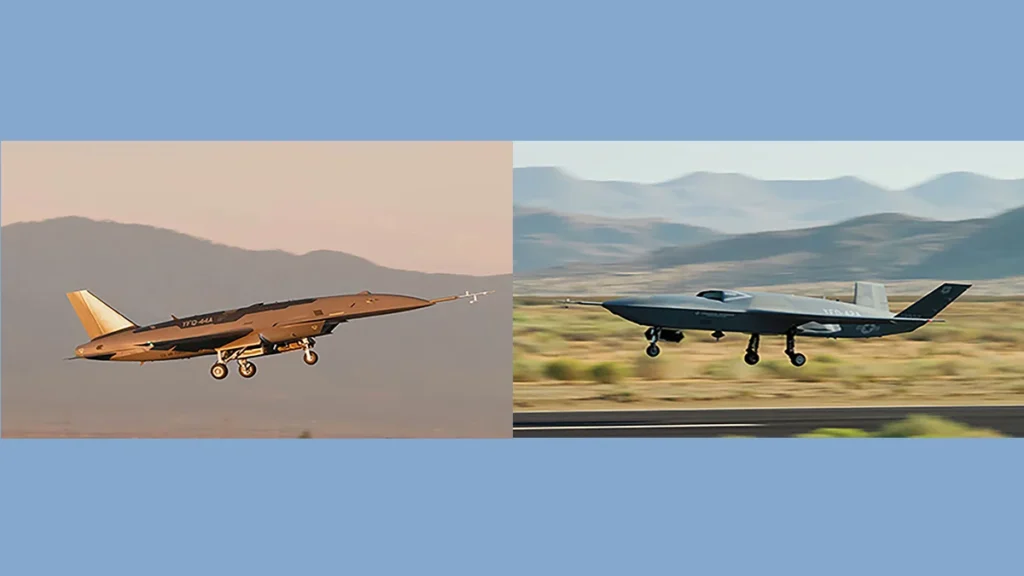
In June, the U.S. Air Force awarded Increment 1 production contracts to two key industry partners, signaling a tangible progression from concept to hardware development. General Atomics Aeronautical Systems secured a contract for the FQ-42 Vengeance, previously known as the Dark Merlin, while Anduril Industries received a contract for the FQ-44 Fury. These awards represent a significant investment in bringing these cutting-edge systems to fruition.
Accelerating Flight Testing and "Quarterback Integration"
The development of these "loyal wingman" drones is progressing rapidly, with industry leaders expressing confidence in imminent milestones. Jason Levin, senior vice president of engineering at Anduril, indicated that the first flight demonstrating a Fury drone being controlled by a fighter jet pilot is anticipated "in a matter of weeks or months." This crucial capability, often referred to as "quarterback integration," signifies the direct command and control link between a manned aircraft and its autonomous counterpart.
Levin elaborated on the progress made in achieving this integration. "We’ve already begun doing quarterback integration in our hardware-in-the-loop environments, and our software-in-the-loop environments, and even on the aircraft itself," he stated, highlighting the comprehensive testing methodologies employed.
General Atomics has also reported significant progress. The company announced on Tuesday that one of its test aircraft successfully flew in conjunction with an F-5 fighter jet in July. Michael Roberts, General Atomics’ director of advanced programs for emerging technology, described the achievement in a company release: "With this flight, we moved beyond simply flying an autonomous jet and showed how a manned fighter and an autonomous CCA can work together to find, track, and engage a target using passive sensors and shared autonomy." This demonstration of collaborative targeting and sensor data sharing is a critical aspect of the CCA’s intended operational role.
Advancing Mission Autonomy: The Software Backbone
Beyond the physical airframes, the development of sophisticated mission autonomy software is paramount to the CCA program’s success. In June, the Air Force identified a pool of six contractors for the development of this critical software component. These companies are tasked with creating the artificial intelligence and decision-making capabilities that will enable CCAs to operate effectively and independently when necessary.
The service outlined a phased approach for selecting a primary autonomy provider for Increment 1, with plans to "execute a second competitive award period" within six months. The ultimate selection of a primary provider is slated for "summer 2027." The six companies identified for this crucial software development are Anduril, General Atomics, Lockheed Martin, Northrop Grumman, Collins Aerospace (a division of RTX), and Shield AI.
Notably, three of these companies – Anduril, Collins Aerospace, and Shield AI – also received production options in June, indicating their dual roles in both hardware and software development for specific CCA variants.
Industry Perspectives on Software Development
Executives from these companies have provided insights into their specific contributions and development timelines. Ryan Bunge, president of mission systems at Collins Aerospace, emphasized the company’s focus on building "initial warfighting capability" for the autonomy software. This involves "incorporating a lot of that tactics and mission extensibility to demonstrate how you would go prosecute a real mission scenario," he explained during a roundtable discussion in early September.
Todd Wesley, an executive at Shield AI, articulated the ambitious goal of rapid iteration in software development. "We’re trying to get to the point where we fly a sortie, update overnight and fly again the next day with updated software," Wesley commented, underscoring the drive for agile development cycles. "We’re still proving that out," he added, acknowledging the ongoing challenges in achieving such rapid deployment of software updates.
Lockheed Martin is pursuing a strategy of leveraging its existing AI development for crewed aircraft. A company official revealed last week that they plan to integrate their AI pilot development, initially created for the crewed X-62A VISTA testbed, into their CCA software. Ron Fehlen, vice president and general manager of Lockheed Martin Skunk Works, detailed the progress of this initiative. He stated that a VISTA flight campaign conducted earlier this year in collaboration with the Air Force Test Pilot School was "proofing out and building trust in the artificial intelligence that we’re employing on that system that we’re getting ready for Vectis," referring to Lockheed Martin’s internal designation for both its CCA software and planned aircraft.
Fehlen also confirmed that Lockheed Martin’s self-funded Vectis aircraft is "on schedule to fly by the end of 2027." While the company received an initial CCA study contract in 2024, it was not selected for the Increment 1 production contracts.
Northrop Grumman is also progressing with its CCA platform, named Talon Blue. A spokesperson confirmed that the platform "remains on track to fly in 2026" and "continues to advance autonomy software and mission capabilities."
The Strategic Imperative of Mission Autonomy
The development of robust mission autonomy is widely recognized as the linchpin for the CCA program’s success. Brig. Gen. Timothy Helfrich, who oversees the Air Force’s Fighters and Advanced Aircraft acquisition portfolio, highlighted the vast potential for growth in this area. "There’s a huge room for growth in mission autonomy, just as you would expect a pilot to mature over their years," he observed during a discussion at the conference.
Lieutenant Colonel Bartlett echoed this sentiment, emphasizing the transformative potential of advanced AI. "Mission autonomy is going to be the secret sauce that lets these things become decisive or not," he concluded, underscoring its critical role in achieving air dominance in future conflicts.
Broader Context and Implications
The U.S. Air Force’s pursuit of Collaborative Combat Aircraft is part of a broader strategic shift across global militaries towards leveraging artificial intelligence and autonomous systems in warfare. The increasing complexity of modern battlefields and the potential for peer-state adversaries to field advanced air defense systems necessitate new operational concepts that enhance survivability and expand combat reach.
The CCA program aligns with the Air Force’s "Air Superiority 2030" roadmap, which emphasizes the need for a distributed, resilient, and technologically advanced air force. By integrating CCAs with existing and future crewed platforms, the Air Force aims to create a more potent and adaptable combat airpower, capable of overwhelming adversaries through numbers, speed, and intelligent coordination.
The December exercise will provide crucial data points on how effectively these nascent systems can be integrated into existing command and control structures and operational doctrines. Success in this exercise could accelerate the timeline for fielding operational CCAs, while challenges encountered will inform further development and refinement.
The substantial investment in multiple contractors for both airframe production and autonomy software development reflects a deliberate strategy to foster competition and innovation, ensuring the Air Force has access to the best available technologies. This approach mitigates program risk and allows for parallel development paths, increasing the likelihood of a successful outcome.
The implications of the CCA program extend beyond immediate combat capabilities. The development of advanced AI and autonomous systems for military applications has the potential to drive innovation in related civilian sectors. Furthermore, the successful integration of CCAs could fundamentally alter the character of air warfare, potentially leading to a significant shift in the balance of power in the skies. The coming months and years will be critical in observing the maturation of this transformative program.