Rhode Island-based aerospace startup Regent Craft is charting a course for the skies, targeting 2027 as the year it aims to commence manufacturing of its groundbreaking all-electric seagliders. These innovative aircraft are set to be the first commercial vehicles to harness the aerodynamic phenomenon known as "wing-in-ground-effect" (WIG), promising a new era of efficient and eco-friendly waterborne transportation. The company’s flagship design, dubbed the Viceroy, has already completed its inaugural human-crewed flight, signaling significant progress in its ambitious development timeline.
The Viceroy: A New Breed of Flying Boat
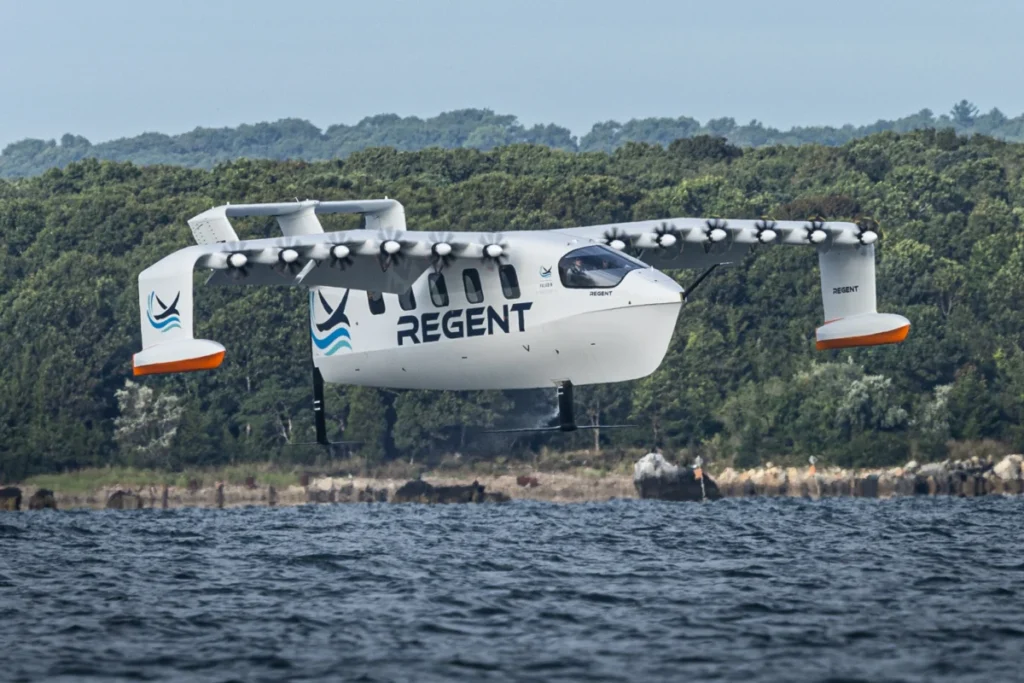
The Viceroy, designed by Regent Craft, falls under U.S. regulations as a flying boat. Its operational profile is characterized by its ability to fly at altitudes of approximately 10 meters (about 33 feet) above the water’s surface. This unique flight characteristic is made possible by the wing-in-ground-effect principle, which creates a cushion of air beneath the aircraft’s wings, significantly reducing drag and enhancing lift. Regulatory oversight for this novel craft will be handled by the U.S. Coast Guard, reflecting its maritime operational capabilities.
Milestone Flight Signals Promising Future
Earlier this month, a pivotal moment occurred when a two-person crew successfully conducted the first human-crewed flight of the full-size Viceroy prototype. The historic 30-second flight took place over the waters of Narragansett Bay, near the company’s headquarters in Rhode Island. This successful test flight serves as a crucial validation of Regent’s design and engineering efforts, demonstrating the tangible progress the startup has made since its inception.
Billy Thalheimer, CEO and co-founder of Regent Craft, expressed optimism and a sense of urgency regarding the company’s trajectory. "We’ve been moving quickly," Thalheimer stated in a recent interview. "We’re expecting our first vehicles to come off our manufacturing line by the end of next year, and we’ve been working really diligently with the Coast Guard to support that timeline. And certainly, we expect the FAA will be involved in a technical advisory role on the certification process." This timeline suggests an aggressive production schedule, aiming to have the first seagliders rolling off the assembly line by the close of 2025, with a broader manufacturing launch in 2027.
A Decade of Innovation and Investment
Founded in 2020, Regent Craft has rapidly emerged as a significant player in the advanced air mobility sector. The company has successfully raised a substantial $340 million in funding, a testament to the investor confidence in its innovative technology and vision. This capital infusion has fueled the development and testing of several smaller prototypes, leading up to the current full-size Viceroy demonstrator.
Unpacking the Wing-in-Ground-Effect Technology
The operational mechanics of the Viceroy are key to its revolutionary potential. Initially, the craft behaves like a conventional boat, moving across the water’s surface. As it accelerates, the hull begins to lift, while two submerged stabilizers, known as hydrofoils, provide initial stability. Once sufficient speed is achieved, these hydrofoils retract into the hull, and the aircraft ascends to its WIG-flight altitude. At this height, the air cushion generated beneath the wings becomes the primary support, allowing for low-altitude, efficient flight.
This effect is further augmented by the "blown-lift" generated by 12 propellers strategically positioned along the wings. This combination of WIG and blown lift significantly enhances the Viceroy’s fuel efficiency compared to traditional boats, while also extending its operational range on battery power, according to Thalheimer.
A Legacy of Wing-in-Ground-Effect Research
The concept of wing-in-ground-effect vehicles is not entirely new, with research and demonstrations dating back to the Cold War era. The Soviet Union pioneered several ekranoplans, massive WIG craft designed for military purposes. More recently, the concept has seen renewed interest. Howard Hughes’ iconic Spruce Goose, though only flying once briefly, was designed to leverage WIG principles for parts of its flight. In a more contemporary context, DARPA had initiated the Liberty Lifter program with Aurora Flight Sciences to develop a WIG seaplane. However, DARPA concluded this program in 2025 before a demonstrator could be flown, highlighting the complexities and challenges inherent in developing such advanced technologies. Regent Craft’s success with the Viceroy prototype marks a significant step forward in realizing the practical application of WIG technology for commercial use.
Charting New Routes: Commercial and Defense Applications
Regent Craft envisions the Viceroy playing a transformative role in coastal transportation. The company aims to "replace or supplement traditional coastal ferry operations" and offer an alternative to existing airline services for "coastal routes such as Boston to Nantucket or Miami to the Bahamas," as detailed on their website and in press releases. This application addresses the growing demand for efficient and environmentally conscious regional travel, particularly in island and coastal communities.
Beyond its commercial ambitions, Regent Craft is also actively developing a hybrid-electric variant of its seaglider technology for military applications. This smaller, unmanned drone variant, named Squire, is currently undergoing testing and development. Thalheimer highlighted a key advantage of the Squire’s low-altitude flight profile: its ability to evade radar detection, a critical capability for modern defense operations.
One compelling potential application for the Squire is in medical evacuation (medevac) for deployed troops. The company has already secured $15 million in contracts from the U.S. Marine Corps Warfighting Lab to test and demonstrate its all-electric seaglider technology for defense operations, underscoring the military’s interest in this innovative platform.
Regulatory Pathways and Market Potential
The path to certification for new aviation technologies can be complex. Analyst Sergio Cecutta of SMG Consulting, which produces the AAM Reality Index of electric aircraft rankings, noted that Regent’s collaboration with the Coast Guard might expedite the certification process. "Given that the FAA already has a long line of electric aircraft in the certification process, working with the Coast Guard might help Viceroy get certified more quickly," Cecutta observed.
Cecutta further elaborated on the market outlook for WIG craft. "We think there is a market for wing-in-ground craft," he stated. "We see an interest from the defense sector, especially for their drone. The size of the commercial market will be limited as these vehicles will supplement ferries and replace some island helicopter routes. I think more opportunities – and consequently the size of the market – will open up once much larger vehicles are available." This perspective suggests that while initial commercial applications will focus on niche routes, the long-term potential for larger WIG craft could significantly expand the market.
The development of Regent Craft’s seagliders represents a significant leap forward in aerospace innovation. By successfully integrating the wing-in-ground-effect principle with all-electric propulsion, the company is poised to redefine short-haul transportation and introduce a new class of eco-friendly aircraft. The coming years will be critical as Regent navigates the complex regulatory landscape and scales its manufacturing capabilities, with the ultimate goal of bringing its visionary seagliders to market by 2027.