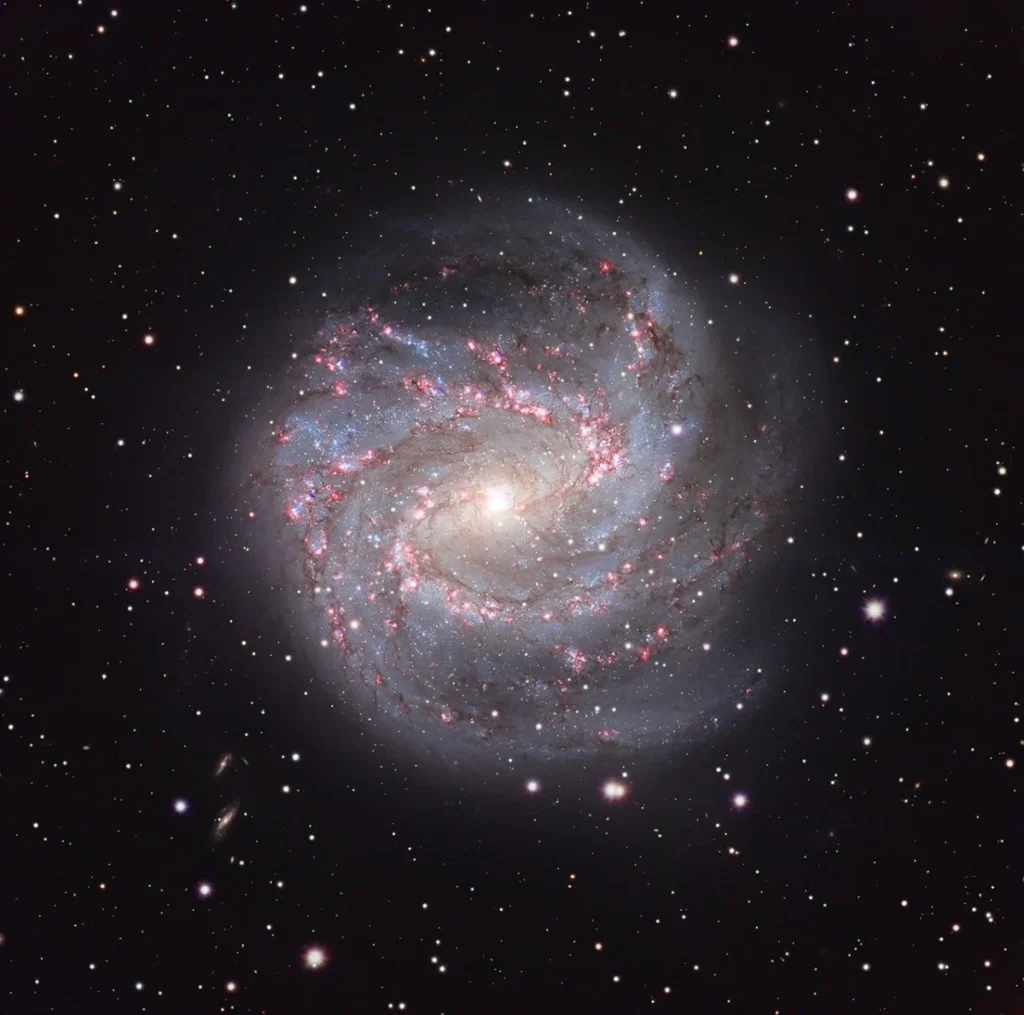
The cosmos, in its boundless expanse, offers a constant stream of celestial wonders, each day a new revelation for those who gaze upwards. Today, the Astronomy Picture of the Day (APOD) program, a venerable institution providing a daily visual and educational journey through the universe, showcases a breathtaking image of spiral galaxy Messier 83 (M83). This magnificent celestial object, affectionately nicknamed the Southern Pinwheel for its prominent spiral arms, is also known as the Thousand-Ruby Galaxy, a testament to the vibrant, star-forming regions that paint its structure with fiery hues. Located approximately twelve million light-years away in the constellation Hydra, M83 offers astronomers a unique laboratory for studying galactic evolution, intense star formation, and the remnants of energetic stellar processes.
A Glimpse into the Southern Pinwheel
The featured image captures M83 in stunning detail, highlighting its characteristic spiral arms that are clearly delineated by dark lanes of interstellar dust. These arms are further adorned with bright, blue star clusters, indicating regions where new stars are actively being born. However, it is the pervasive reddish glow emanating from numerous nebulae that truly earns M83 its "Thousand-Ruby Galaxy" moniker. These are H II regions, vast clouds of ionized hydrogen gas that glow red when energized by the ultraviolet radiation from young, hot stars embedded within them. This visual spectacle makes M83 a prime target for astronomical observation and a compelling subject for public outreach, like that provided by APOD.
M83 is a relatively compact galaxy, measuring approximately 40,000 light-years across, making it smaller than our own Milky Way galaxy, which spans about 100,000 light-years. Despite its size, M83 is a dynamic and active galaxy. It is a prominent member of the Centaurus A/M83 Group, a collection of galaxies that includes the active galaxy Centaurus A, itself a powerful source of radio waves and a subject of extensive astrophysical research. The proximity and interaction within such galactic groups provide invaluable insights into the gravitational dynamics that shape the universe on large scales.
Unveiling the Energetic Core
Beyond its visual splendor, M83 harbors a more energetic secret within its core. Observations at X-ray energies have revealed that the galactic center of M83 is exceptionally bright. This intense X-ray emission is indicative of a high concentration of compact objects, specifically neutron stars and black holes. These are the stellar corpses left behind after massive stars exhaust their nuclear fuel and undergo catastrophic supernova explosions. The abundance of such objects in M83’s core suggests a history of intense and rapid star formation, a period known as a starburst.
Supporting Data and Context:
- Distance: Approximately 12 million light-years from Earth.
- Diameter: Roughly 40,000 light-years.
- Classification: Spiral galaxy (type SBbc).
- Location: Constellation Hydra.
- Galactic Group Membership: Centaurus A/M83 Group.
- X-ray Emission: High luminosity, suggesting a population of neutron stars and black holes.
The study of these X-ray sources in M83 allows astronomers to probe the extreme environments of stellar remnants. Neutron stars are incredibly dense objects, packing more mass than the Sun into a sphere only about 20 kilometers in diameter. Black holes, even more enigmatic, are regions of spacetime where gravity is so strong that nothing, not even light, can escape. The detection of numerous high-mass X-ray binaries (systems where a massive star orbits a neutron star or black hole) in M83 provides strong evidence for its past starburst activity, as such binaries are typically formed from the remnants of very massive stars.
A Timeline of Discovery and Observation
The journey to understanding M83 is a long and ongoing one, spanning centuries of astronomical observation and technological advancement.
- 1752: French astronomer Nicolas-Louis de Lacaille first cataloged M83 during his expedition to the Cape of Good Hope, South Africa. He included it in his catalog of nebulae, though at the time, the nature of these objects was not fully understood.
- 1781: Charles Messier, the renowned French astronomer, independently observed and cataloged M83, giving it its designation in his famous catalog of deep-sky objects. Messier’s catalog was compiled to identify nebulae and star clusters that could be mistaken for comets, thus helping astronomers avoid confusion.
- 19th and 20th Centuries: As telescopes became more powerful, astronomers began to resolve M83 into its spiral structure. Observations revealed the dust lanes and star-forming regions that characterize its appearance.
- Late 20th Century – Present: The advent of space-based telescopes, such as the Hubble Space Telescope, and advanced ground-based observatories, equipped with sophisticated detectors, has revolutionized our understanding of M83. These instruments have allowed for detailed studies across the electromagnetic spectrum, from radio waves to X-rays and gamma rays. The APOD image itself is likely a composite of data from multiple telescopes, showcasing the power of modern astronomical imaging.
The ongoing observation of M83 is not merely about cataloging its features; it’s about understanding the fundamental processes that govern galaxy formation and evolution. By studying its star formation rate, its gas content, and the distribution of its stellar populations, astronomers can test and refine theoretical models of galactic dynamics.

The Significance of M83 for Galactic Studies
M83’s proximity and active nature make it an invaluable object for comparative studies with other galaxies, including our own Milky Way. The "Thousand-Ruby Galaxy" nickname highlights the prevalence of star formation, a crucial process for the chemical enrichment and structural evolution of galaxies. Understanding the triggers and cycles of star formation in M83 can shed light on similar processes that have occurred throughout the history of the Milky Way and other galaxies.
The intense X-ray emission from M83’s core is particularly significant. It provides a natural laboratory for studying the end stages of massive stellar evolution and the behavior of matter under extreme gravitational conditions. The high density of neutron stars and black holes suggests that M83 has experienced periods of intense star formation in its past, likely leading to a higher rate of supernova explosions and the subsequent formation of these compact objects. Studying the properties and interactions of these objects in M83 can provide crucial data for understanding phenomena such as supernova remnants, pulsar emission, and the formation of accretion disks around black holes.
Furthermore, M83’s membership in the Centaurus A/M83 Group allows for the study of galaxy interactions and mergers. While M83 itself is not currently undergoing a major merger, its gravitational influence on other members of the group, and vice versa, can shape their evolution over cosmic timescales. Understanding these intergalactic dynamics is key to building a comprehensive picture of the large-scale structure of the universe.
APOD: A Daily Dose of Cosmic Wonder
The Astronomy Picture of the Day (APOD) program, a joint initiative of NASA and Michigan Technological University, has been a cornerstone of public astronomical outreach since its inception. Each day, APOD features a different image or photograph of the universe, accompanied by a concise explanation written by a professional astronomer. This daily offering serves to demystify complex astronomical concepts and inspire awe and curiosity about our place in the cosmos.
The program’s transition to the new domain, science.nasa.gov/apod, signifies a continued commitment to providing accessible and engaging astronomical content. This move ensures that APOD remains at the forefront of NASA’s digital outreach efforts, leveraging the latest web technologies to deliver its content to a global audience.
Broader Impact and Implications:
The continuous study of objects like M83 has profound implications for our understanding of the universe. It helps answer fundamental questions about:
- The formation and evolution of galaxies: How do galaxies form, grow, and change over billions of years?
- The life cycle of stars: What happens to stars when they run out of fuel? What are the end products of massive stars?
- The nature of extreme physics: How do gravity, matter, and energy behave in the most extreme environments, such as near black holes?
- The search for extraterrestrial life: Understanding the conditions necessary for star formation and planetary system development is crucial for assessing the potential for life elsewhere in the universe.
The image of M83, shared through APOD and other scientific channels, not only provides a visual feast but also serves as a powerful reminder of the vastness and complexity of the universe we inhabit. It fuels scientific inquiry, inspires future generations of astronomers and scientists, and fosters a deeper appreciation for the wonders of the cosmos. The "Thousand-Ruby Galaxy" continues to offer its fiery beauty, inviting us to explore its secrets and expand our cosmic horizons.