Engineers at RMIT University in Melbourne, Australia, have achieved a significant breakthrough in additive manufacturing with the development of a novel 3D-printable titanium alloy that promises to be approximately one-third cheaper than conventional titanium alloys currently in widespread use. This innovation, born from a strategic reimagining of alloy composition, not only addresses cost barriers but also delivers enhanced mechanical properties, positioning it for transformative applications across the aerospace, medical device, and other high-demand industries.
A Paradigm Shift in Titanium Alloying
The cornerstone of this advancement lies in the RMIT team’s ingenious approach to alloy formulation. Recognizing the escalating cost and supply chain complexities associated with vanadium, a key element in standard titanium alloys like Ti-6Al-4V, the researchers explored and successfully integrated more readily available and economical alternative elements. This strategic substitution has yielded a titanium alloy that maintains, and in some critical aspects surpasses, the performance benchmarks of its predecessors, all while significantly reducing production expenses.
The implications of this cost reduction are far-reaching. For industries that rely heavily on titanium for its exceptional strength-to-weight ratio, biocompatibility, and corrosion resistance, such as aerospace and medical implants, the ability to source high-quality 3D-printed titanium at a lower price point could unlock new design possibilities and accelerate the adoption of additive manufacturing. This could translate into lighter, more fuel-efficient aircraft, more affordable and customized prosthetic devices, and a broader range of complex engineered components previously deemed too expensive to produce.
The Innovation Pipeline: From Lab to Patent
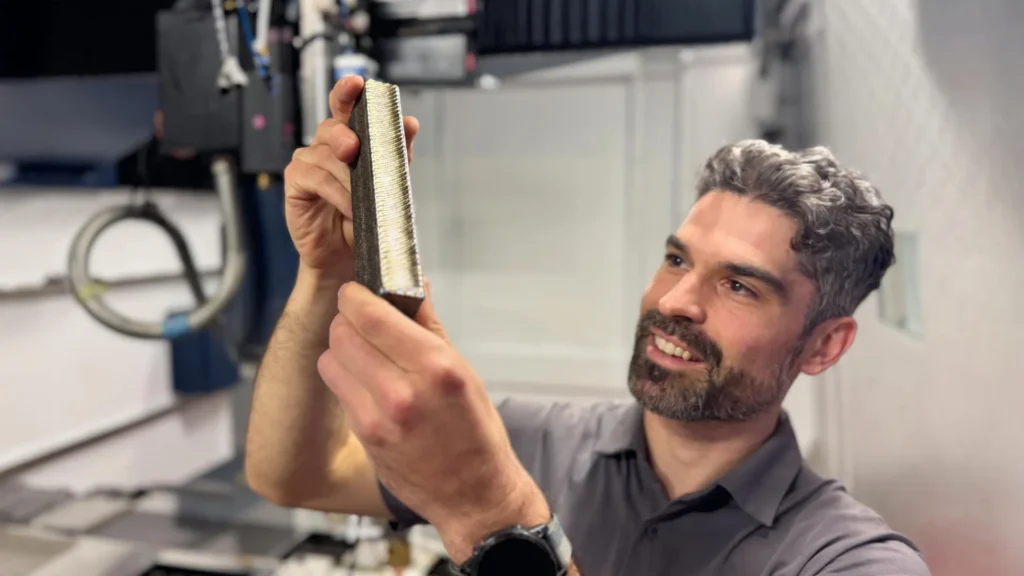
The development of this groundbreaking alloy is the culmination of dedicated research and development at RMIT’s Centre for Additive Manufacturing (RCAM). The team, led by PhD candidate and study lead author Ryan Brooke, has not only demonstrated the alloy’s superior performance but has also taken proactive steps to secure its intellectual property. RMIT has filed a provisional patent for their innovative approach, underscoring the perceived commercial value and potential of this new material.
The scientific underpinnings of this breakthrough have been meticulously documented and published in the prestigious journal Nature Communications. This peer-reviewed publication not only validates the research but also provides a detailed roadmap for the scientific community, fostering further exploration and innovation in the field of additive manufacturing. The publication in such a high-impact journal signals the significance of the discovery and its potential to influence future material science research.
Performance Metrics: Strength, Ductility, and Uniformity
Crucially, testing of the new RMIT alloy has revealed impressive improvements in both strength and overall performance when compared to standard 3D-printed titanium alloys. Ryan Brooke highlighted that the alloy exhibits enhanced ductility, a measure of a material’s ability to deform under tensile stress before fracturing. This improved ductility is vital for components that experience dynamic loading and stress, common in aerospace applications.
Beyond enhanced mechanical properties, the new alloy addresses a persistent challenge in 3D printing: the formation of undesirable microstructures. Conventional 3D-printed titanium alloys can sometimes exhibit columnar microstructures, characterized by elongated, column-shaped grains. These structures can lead to uneven mechanical properties across a printed part, compromising its integrity and performance. The RMIT team’s innovative design framework, however, facilitates more uniform printing, effectively mitigating the formation of these problematic columnar grains. This results in a more consistent and reliable printed component, a critical factor for safety-critical applications.
"By developing a more cost-effective formula that avoids this columnar microstructure, we have solved two key challenges preventing widespread adoption of 3D printing," explained Brooke. His extensive market validation, conducted as part of CSIRO’s ON Prime program, involved direct engagement with industry representatives from the aerospace, automotive, and MedTech sectors. "What I heard loud and clear from end users was that to bring new alloys to market, the benefits have to not just be minor incremental steps but a full leap forward, and that’s what we have achieved here," he emphasized. This direct feedback from potential end-users reinforces the transformative nature of their discovery.
A Framework for Future Alloy Design
The study published in Nature Communications not only details the new alloy but also outlines a novel methodology for selecting elements for alloying. This framework is designed to be time- and cost-saving, specifically leveraging the capabilities of emerging 3D-printing technologies. It provides a clearer predictive model for the printed grain structure of metallic alloys in additive manufacturing, a crucial aspect for controlling material properties.
This systematic approach to alloy design represents a significant step forward. It moves beyond serendipitous discovery and provides a more rational, data-driven path to developing new materials tailored for additive manufacturing. The framework enables researchers and engineers to anticipate and control the microstructural outcomes of the printing process, leading to more predictable and reliable material performance.
Commercialization Pathways and Industry Engagement
With the provisional patent secured and the scientific foundation firmly established, RMIT is actively exploring commercial opportunities for its low-cost titanium alloy. The university is keen to collaborate with industry partners to further develop and scale the technology. Professor Mark Easton, the corresponding author of the study and a key figure at RCAM, expressed enthusiasm for the alloy’s prospects but stressed the necessity of collaborative efforts.
"We are very excited about the prospects of this new alloy, but it requires a team from across the supply chain to make it successful. So, we are looking for partners to provide guidance for the next stages of development," Professor Easton stated. This call for collaboration highlights RMIT’s commitment to ensuring the successful translation of their research from the laboratory to industrial application.
The development process has been supported by RMIT’s cutting-edge Advanced Manufacturing Precinct, where samples of the new alloy were produced and rigorously tested. This state-of-the-art facility provides the ideal environment for innovation in additive manufacturing, offering access to advanced 3D printing equipment and sophisticated characterization tools.
The "Aeroplane on the Streets" Analogy: Unlocking 3D Printing’s Full Potential
Ryan Brooke drew a compelling analogy to illustrate the untapped potential of 3D printing with legacy alloys. He described the current situation as having "created an aeroplane and are still just driving it around the streets." This vivid imagery underscores his belief that while 3D printing offers inherent advantages in speed, waste reduction, and customizability, the reliance on older, less optimized alloys prevents the full realization of these benefits.
"New types of titanium and other alloys will allow us to really push the boundaries of what’s possible with 3D printing and the framework for designing new alloys outlined in our study is a significant step in that direction," Brooke remarked. His sentiment is echoed by many in the additive manufacturing field who see the development of advanced materials as the next frontier in unlocking the technology’s transformative power.
The potential applications for this new alloy are vast. In the aerospace sector, it could lead to the production of lighter structural components, engine parts, and interior elements, contributing to improved fuel efficiency and reduced emissions. For the medical device industry, the lower cost and enhanced properties could enable the creation of more affordable and sophisticated implants, surgical tools, and prosthetics, improving patient outcomes and accessibility to advanced medical technologies. Furthermore, the automotive industry could benefit from lighter, stronger components for vehicles, contributing to fuel economy and performance.
A Strategic Timeline of Innovation
The journey to this revolutionary alloy likely began several years ago, with the initial conceptualization and exploration of alternative alloying elements. Research and development in materials science are often iterative, involving numerous experiments, simulations, and material characterizations. The RMIT team’s publication in Nature Communications signifies a mature stage in this process, indicating that the core principles and efficacy of the alloy have been rigorously tested and validated.
The provisional patent filing, a relatively recent event, signals the team’s confidence in the commercial viability of their innovation and their intent to protect their intellectual property as they move towards industrial partnerships. The ongoing market validation and calls for collaboration suggest that the university and the research team are actively engaging with potential end-users and manufacturing partners to chart a clear path for commercialization. This phase typically involves pilot projects, scale-up studies, and regulatory approvals, which can take several years to complete, depending on the specific industry and application.
Broader Implications for Additive Manufacturing
The RMIT breakthrough is more than just a new titanium alloy; it represents a significant leap forward in the broader field of additive manufacturing materials. The development of a systematic framework for designing new alloys, coupled with the successful creation of a cost-effective and high-performance material, sets a precedent for future research and development.
This work could inspire similar innovations in other metal alloys, accelerating the discovery and adoption of advanced materials tailored for 3D printing. As additive manufacturing continues to evolve, the demand for specialized materials that can fully leverage the technology’s unique capabilities will only increase. The RMIT team’s approach provides a blueprint for how to meet this demand, paving the way for a new generation of advanced materials that are both functional and economically viable.
The ability to print complex geometries with high precision, combined with the availability of advanced, cost-effective materials, will undoubtedly reshape manufacturing landscapes across the globe. The RMIT University’s pioneering work in 3D-printable titanium alloy stands as a testament to the power of innovative research and its potential to drive significant industrial and societal progress.