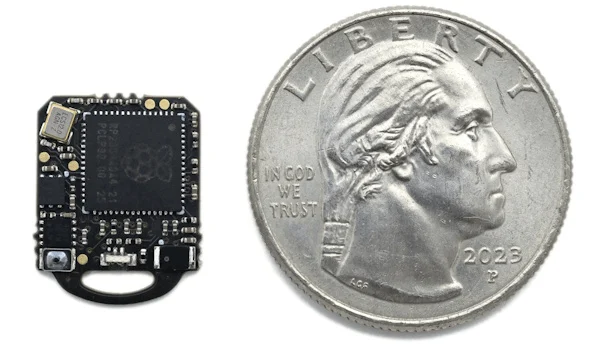
The landscape of micro-development hardware has witnessed a significant shift toward extreme miniaturization, a trend exemplified by the recent unveiling of Romu, a remarkably compact development board powered by the Raspberry Pi RP2354A microcontroller. Developed by Bitmerse, the engineering firm previously recognized for its innovative WiSer and bUniProbe projects, Romu represents a convergence of high-performance silicon and minimalist circuit design. Measuring just 15.5 by 12 millimeters, the board is engineered to be marginally larger than the microcontroller it hosts, allowing it to reside almost entirely within a standard USB-A port. This development marks a pivotal moment for the maker community and professional engineers alike, as it brings the advanced capabilities of the Raspberry Pi RP2350 series into a form factor that prioritizes portability and "stealth" integration.
The Evolution of the RP2350 Ecosystem
To understand the significance of Romu, one must examine the context of its core component: the Raspberry Pi RP2350. Launched in August 2024 at the Defcon 32 hacking conference, the RP2350 series is the successor to the wildly successful RP2040. Unlike its predecessor, the RP2350 features a unique "Dual-Architecture" design, incorporating two ARM Cortex-M33 cores and two Hazard3 RISC-V cores. Users can choose which architecture to boot into, offering unprecedented flexibility for developers experimenting with RISC-V or requiring the established ecosystem of ARM.
The specific variant used in Romu, the RP2354A, is particularly noteworthy for this form factor. The "4" in the model number signifies 4MB of integrated, stacked QSPI flash memory. In traditional development board designs, the flash memory chip is a separate component that occupies valuable PCB real estate. By utilizing the RP2354A, Bitmerse has eliminated the need for an external flash chip, which was a critical requirement for achieving the 15.5 x 12 mm dimensions. Furthermore, the RP2350 series introduces robust security features, including ARM TrustZone for microcontroller-scale security, signed boot, and 8KB of anti-fuse One-Time Programmable (OTP) memory for storing sensitive keys. These features elevate Romu from a simple hobbyist tool to a viable platform for secure hardware applications.
Engineering Challenges and Design Philosophy
The design of Romu is an exercise in extreme spatial efficiency. At 12mm wide, the PCB is precisely sized to fit the interior dimensions of a USB-A male connector. Bitmerse opted for a "PCB-as-connector" approach, where the traces on the board itself act as the USB contacts. This eliminates the bulk of a metal USB housing, reducing the total length of the device significantly.

Despite the lack of space for traditional headers or peripheral components, the Bitmerse team successfully integrated two key interface elements: a side-mounted RGB LED and a capacitive touch button. The inclusion of a capacitive sensor is a strategic engineering choice; traditional tactile switches require mechanical clearance and height that would interfere with the board’s ability to slide into a USB port. By using a touch-sensitive area on the PCB, the developers maintained a flat profile while providing a necessary input method for user interaction.
The transition from prototype to final product also highlights the iterative nature of hardware development. Early prototypes featured a standard green solder mask, while the refined version destined for consumers utilizes a sleek black PCB with high-contrast markings. This aesthetic choice reflects a broader trend in the boutique hardware market, where visual design is increasingly weighted alongside technical specifications.
Practical Applications and Use Cases
The utility of a device as small as Romu extends beyond its novelty. The Bitmerse team and the wider developer community have identified several high-impact applications that leverage the board’s size and the RP2350’s security features:
Hardware Security and Authentication
One of the most prominent use cases for Romu is as a Universal 2nd Factor (U2F) hardware token. By utilizing open-source software such as Pico FIDO, Romu can be transformed into a security key for two-factor authentication (2FA). When plugged into a computer, the device can securely authorize logins to services like Google, GitHub, or corporate VPNs. The capacitive touch button serves as the physical "presence check" required by FIDO standards, ensuring that a remote attacker cannot trigger the authentication without physical interaction from the user.
Human Interface Device (HID) Emulation
The RP2350’s native USB support allows Romu to act as an HID, mimicking a keyboard or mouse. This opens the door for:

- Custom Macro Keys: Programming the capacitive button to execute complex keyboard shortcuts, such as muting a microphone during a video conference or launching a specific set of applications.
- Password Injectors: Acting as a secure vault that types out long, complex passwords with a single touch, reducing the risk of keyloggers on the host system.
- Mouse Jigglers: For IT professionals or system administrators needing to prevent a computer from entering sleep mode during long data transfers or software updates, Romu can be programmed to move the cursor by a single pixel at regular intervals.
System Monitoring and Notifications
The integrated RGB LED allows Romu to serve as a discrete status indicator. By writing simple scripts in MicroPython, users can configure the LED to change color based on system events, such as receiving an unread email, a change in server status, or high CPU temperature. Its small profile means it can remain plugged into a laptop or hub without obstructing adjacent ports or creating a visual distraction.
Software Ecosystem and Accessibility
A critical factor in the potential success of Romu is its support for MicroPython. As an interpreted language, MicroPython allows developers to write and test code in real-time without the need for complex compilation toolchains. This makes Romu accessible to a broad demographic, from professional engineers prototyping a quick solution to students learning the basics of embedded systems.
The Raspberry Pi Foundation’s robust support for the RP2350 means that Romu benefits from a massive library of existing code, tutorials, and community support. Beyond MicroPython, the board is compatible with the C/C++ SDK and is expected to see support from the CircuitPython community, further expanding its versatility.
Bitmerse: A History of Innovation
Bitmerse is not a newcomer to the hardware scene. The firm has built a reputation for creating specialized tools that solve niche problems for the maker and engineering communities. Their previous project, WiSer, provided a solution for wireless serial communication, enabling developers to debug hardware without being tethered by cables. Another project, bUniProbe, offered a universal probe system for circuit testing.
The development of Romu follows this trajectory of creating "utilitarian" hardware—tools that are designed to be used daily rather than sit on a shelf. The team’s presence on the Make Discord and other community platforms suggests a developer-centric approach, where feedback from end-users directly influences the final design and feature set of the hardware.

Market Context and Broader Implications
The release of Romu occurs within a competitive market for "tiny" development boards. Competitors such as the Seeed Studio XIAO series and the Adafruit Trinkey line have long dominated this space. However, Romu distinguishes itself by being one of the first to market with the RP2354A variant, offering more processing power and memory than many existing small-form-factor boards.
The shift toward the RP2350 series also signals a broader industry move toward more secure IoT (Internet of Things) devices. By providing a low-cost, tiny platform that supports Secure Boot and TrustZone, Bitmerse is enabling developers to build security into their projects from the ground up, rather than treating it as an afterthought. This is particularly relevant as regulatory bodies worldwide begin to implement stricter security requirements for connected hardware.
Launch Timeline and Availability
As of late 2024, Romu is positioned for a formal launch on Crowd Supply, a popular crowdfunding platform known for its focus on high-quality professional and enthusiast hardware. The choice of Crowd Supply provides a level of vetting and reliability for backers, as the platform requires projects to have working prototypes and a clear path to manufacturing before they can go live.
While the exact pricing has not yet been finalized, the use of the RP2350 series suggests that the board will remain affordable, likely falling within the $10 to $20 range common for premium miniature dev boards. The "coming soon" status on Crowd Supply has already generated significant interest within the maker community, with many anticipating its use as a highly portable, "everyday carry" (EDC) piece of technology.
Conclusion
Romu is more than just a diminutive development board; it is a testament to the current state of semiconductor and PCB engineering. By packing the dual-architecture power of the RP2350 into a footprint smaller than a postage stamp, Bitmerse has created a tool that is as powerful as it is portable. Whether used as a security token, a productivity enhancer, or a platform for learning, Romu exemplifies the "just-in-case" philosophy of modern engineering—a device small enough to be forgotten on a keychain, but capable enough to solve complex problems at a moment’s notice. As the project moves toward its crowdfunding phase, it stands as a benchmark for what is possible in the ever-shrinking world of embedded electronics.