This groundbreaking research marks a significant step towards understanding the fundamental nature of the universe, offering a potential first direct detection of ‘vacuum birefringence’ – a phenomenon first theorized almost 90 years ago. The findings, published recently in the prestigious journal Nature, leverage observations of a magnetar, a celestial object boasting the most intense magnetic fields known to exist. If definitively confirmed, this discovery would not only validate a long-standing prediction of quantum electrodynamics but also open new avenues for investigating the quantum universe under conditions far exceeding those achievable in any terrestrial laboratory.
The Quantum Vacuum: A Frothing Sea of Virtual Particles
The concept of vacuum birefringence stems from the pioneering work of Werner Heisenberg, one of the architects of quantum mechanics, in the 1930s. His theoretical framework suggested that a perfect vacuum is far from empty; instead, it is a dynamic realm teeming with ‘virtual particles.’ These ephemeral particles, constantly flickering into and out of existence, represent fleeting excitations of quantum fields. According to quantum field theory, the vacuum is not a void but a "frothing sea" of these subatomic entities, appearing and disappearing too quickly to be directly observed but capable of exerting subtle influences on the fabric of spacetime and the propagation of light.
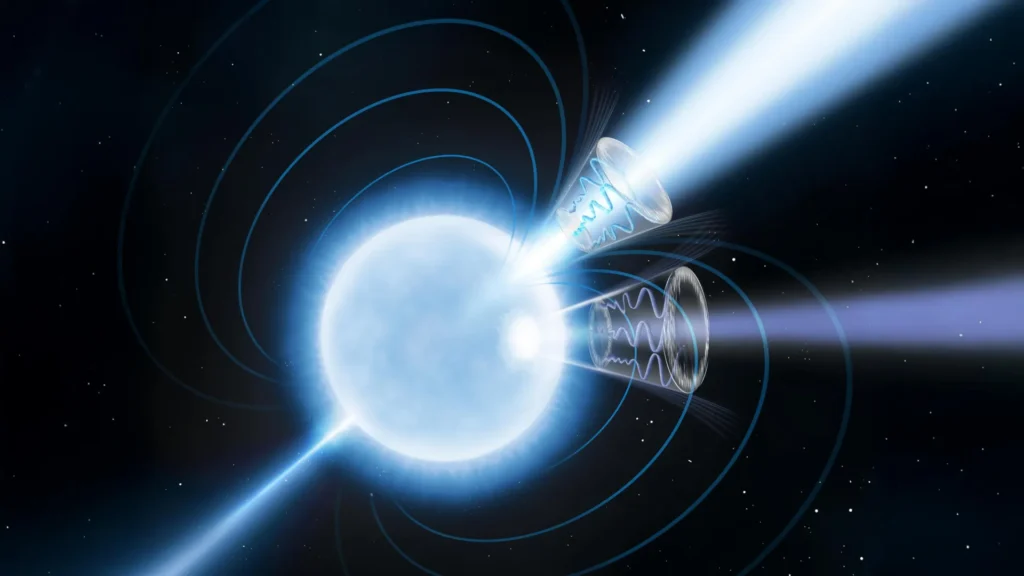
Quantum electrodynamics (QED), the quantum field theory describing how light and matter interact, elaborates on this prediction. QED posits that an extremely strong magnetic field can polarize this sea of virtual particles, causing them to align in a specific direction. When this occurs, the vacuum itself effectively becomes birefringent – meaning it affects light differently depending on the light’s polarization and its orientation relative to the magnetic field. This is analogous to how certain crystals, like calcite, split unpolarized light into two polarized beams, but in this case, the "medium" is the quantum vacuum itself. The effect is incredibly subtle and requires magnetic fields of unimaginable strength to become observable, making it a formidable challenge for experimental verification.
Magnetars: Cosmic Laboratories for Extreme Physics
The immense challenge of observing vacuum birefringence lies in the colossal magnetic field strengths required. On Earth, even the most powerful pulsed magnets can only generate fields in the range of tens of Tesla, which translates to a few million Gauss. This is orders of magnitude too weak to induce a measurable vacuum birefringence effect. Nature, however, provides far more extreme environments.
This is where magnetars come into play. Magnetars are a rare and exotic type of neutron star, themselves the incredibly dense remnants of massive stars that have undergone supernova explosions. Typically only a few tens of kilometers in diameter, a neutron star packs more mass than our Sun into a sphere the size of a city. This extreme density gives rise to extraordinary properties, including incredibly rapid rotation and, crucially, magnetic fields that dwarf anything else in the cosmos. Magnetars distinguish themselves even among neutron stars by possessing magnetic fields that are exceptionally powerful, reaching strengths of 10^14 to 10^15 Gauss – a quadrillion times stronger than Earth’s magnetic field and over 100 million times stronger than the most powerful fields ever produced in a laboratory.
These unparalleled magnetic fields make magnetars the ultimate "cosmic laboratories" for probing fundamental physics under conditions that cannot be replicated on Earth. Researchers, including Dr. Marcus Lower from Swinburne University of Technology, recognized that if vacuum birefringence were to be detected anywhere, it would most likely be in the vicinity of such an extreme object. The powerful magnetic fields of a magnetar are theoretically strong enough to sufficiently influence the virtual particles in the quantum vacuum, leading to a detectable refraction of light that passes through them.
The Observational Campaign: A Multi-Wavelength Approach
The international research team embarked on an ambitious observational campaign, focusing on the magnetar 1E 1547.0-5408, often referred to simply as 1E1547. This particular magnetar was chosen for its ideal characteristics, which, as the observations would later confirm, provided an unusually favorable geometry for detecting the elusive quantum effect.
The investigation employed a sophisticated array of astronomical instruments, each contributing unique capabilities to paint a comprehensive picture of the magnetar’s environment and the light emanating from it:
- NASA’s Imaging X-ray Polarimetry Explorer (IXPE): This cutting-edge space telescope, launched in December 2021, is specifically designed to measure the polarization of X-rays from cosmic sources. Polarization refers to the orientation of the electric field oscillations in an electromagnetic wave. By detecting polarized X-rays, IXPE can provide crucial insights into the physical processes and magnetic fields in extreme environments like those around magnetars. For this study, IXPE was instrumental in detecting extremely high levels of X-ray polarization from 1E1547.
- NICER (Neutron star Interior Composition Explorer): Mounted on the International Space Station, NICER is an X-ray telescope dedicated to studying neutron stars. It provided complementary X-ray observations, supporting IXPE’s findings and offering additional data on the magnetar’s X-ray emission profile.
- Murriyang (CSIRO’s Parkes radio telescope): Located in Australia, Murriyang is a 64-meter radio telescope renowned for its precision in detecting faint radio signals from distant cosmic objects. Dr. Lower utilized Murriyang to collect critical radio observations of 1E1547. Radio waves, like X-rays, can also be polarized, and tracking the changes in their polarization state as the magnetar rotated proved vital for understanding the orientation of its magnetic field and its influence on light. The subsequent analysis of these complex radio data was performed on Swinburne’s Ngarrgu Tindebeek supercomputer, highlighting the role of advanced computational power in modern astrophysics.
This multi-wavelength approach, combining X-ray polarimetry with radio observations, allowed the researchers to cross-reference and validate their findings, providing a robust dataset for analysis.
Unpacking the Evidence: Ideal Geometry and Consistent Polarization
The success of the observation hinged on two critical factors: the unique properties of 1E1547 and the specific data gathered by the telescopes.
Firstly, the researchers meticulously tracked how the polarization state of the radio waves emitted by the magnetar changed as it rotated. From these precise measurements, they were able to deduce that the magnetic axis and the rotational axis of 1E1547 are almost perfectly aligned. Furthermore, the magnetar is observed from Earth from a nearly "pole-on" perspective. This rare combination of characteristics – aligned axes and a direct viewing angle – provided scientists with an unusually favorable geometric setup for searching for vacuum birefringence. As Dr. Lower explained, "Detecting vacuum birefringence requires a magnetic field that is over 100 million times stronger than any we’ve ever made on Earth. Thankfully, nature has provided us with magnetars, which are the perfect cosmic laboratories to go looking for this effect." The ideal geometry ensured that the light from the magnetar would travel through a consistent orientation of its powerful magnetic field, simplifying the interpretation of any observed polarization changes.
With this understanding of the magnetar’s orientation, the team then focused on the polarization data. They found two compelling pieces of evidence pointing towards the quantum effect:
- Extremely High X-ray Polarization: The X-rays generated by the magnetar and detected by IXPE exhibited exceptionally high levels of polarization. This is a crucial indicator, as vacuum birefringence is predicted to significantly affect the polarization of light passing through such extreme magnetic fields.
- Consistent Polarization Direction: Even more significantly, the direction of this X-ray polarization remained consistently tied to the magnetic field of 1E1547, precisely mirroring the behavior observed in the radio data. This consistency across different wavelengths and its correlation with the magnetar’s rotation strongly suggest an underlying physical process that is directly influenced by the magnetar’s magnetic field.
Dr. Lower elaborated on this crucial finding: "Because of the magnetic field’s strength, Heisenberg’s virtual particles become aligned with the direction the field is pointing. By carefully tracking the direction the radio waves and X-rays oscillate as the magnetar rotates, the team found that the alignment of 1E1547’s magnetic and rotational poles were ideal for detecting vacuum birefringence." The synchronized behavior of polarization across X-ray and radio wavelengths, coupled with the magnetar’s favorable viewing geometry, provides the strongest evidence to date for this long-theorized quantum phenomenon.
The 90-Year Quest: Implications for Fundamental Physics
If this interpretation is definitively confirmed, the result would represent a monumental achievement in physics, validating a fundamental prediction of quantum electrodynamics that has eluded direct observation for nearly a century. The implications are profound, extending across several domains of physics:
- Validation of QED under Extreme Conditions: QED is one of the most rigorously tested and successful theories in physics, underpinning our understanding of light and matter. However, its predictions concerning the behavior of the vacuum under ultra-strong magnetic fields have remained largely unverified. This detection would demonstrate that QED holds true even in the most extreme environments found in the universe, far beyond the reach of terrestrial experiments. It pushes the boundaries of our understanding of fundamental interactions.
- A New Window into the Quantum Vacuum: The quantum vacuum is a rich and complex entity, yet its direct probing has been incredibly challenging. A confirmed detection of vacuum birefringence would provide a novel experimental method to study the properties of this quantum vacuum, potentially revealing new insights into its structure and dynamics. It moves the concept of virtual particles from a purely theoretical construct to an observable phenomenon with tangible effects on light.
- Understanding Extreme Astrophysical Environments: Beyond fundamental physics, this discovery could offer new tools for astrophysicists. Vacuum birefringence could become a diagnostic tool for characterizing the magnetic fields of magnetars and other extreme objects with unprecedented precision. It might help unravel mysteries surrounding magnetar outbursts, their emission mechanisms, and the processes occurring within their powerful magnetospheres.
- The Path to New Physics: While vacuum birefringence is a standard QED prediction, observing it precisely could also highlight any subtle deviations from the theory, potentially hinting at new physics beyond the Standard Model. Such deviations, if found, would be even more revolutionary, guiding physicists towards a more complete understanding of the universe.
The scientific community, while cautiously optimistic, recognizes the significance of this potential breakthrough. Dr. Lower himself emphasized the need for further validation: "With these future data on hand and our updated simulations, we may finally be able to complete the quest started by Heisenberg nearly 90 years ago."
Future Endeavors and Confirmations
The journey to definitively confirm vacuum birefringence is ongoing. The research team and the broader scientific community are calling for additional observations and more advanced computer simulations. These improvements are crucial for several reasons:
- Distinguishing from Other Phenomena: While the current evidence is compelling, researchers need to ensure that the observed polarization signature is uniquely attributable to vacuum birefringence and not to other complex physical processes that can occur around magnetars, such as plasma effects or specific emission mechanisms. More sophisticated simulations will help model these alternative explanations and isolate the quantum signature.
- Refining Measurements: Future observations, potentially with next-generation X-ray polarimeters or more sensitive radio telescopes, could provide even more precise measurements of polarization, further strengthening the statistical significance of the detection.
- Studying Other Magnetars: Applying the same observational techniques to a wider sample of magnetars could help confirm the universality of the effect and provide more data points for theoretical models. Each magnetar offers a slightly different "cosmic laboratory" with varying magnetic field strengths, rotation rates, and viewing geometries.
This collaborative effort, spanning multiple institutions and utilizing advanced instrumentation, exemplifies the frontier of modern astrophysics. The potential confirmation of vacuum birefringence stands as a testament to the enduring power of theoretical predictions and the relentless pursuit of observational evidence. It signifies a pivotal moment in our quest to understand the most fundamental laws governing our universe, bridging the gap between the abstract realm of quantum mechanics and the observable cosmos. The paper, "Vacuum birefringence and the polarized X-ray emission of a radio magnetar," stands as a landmark publication in this ongoing scientific odyssey.