In a significant leap for the field of quantum information science, researchers from Kyoto University and Hiroshima University have successfully developed and experimentally demonstrated a method for performing an "entangled measurement" on a W state, a specific and highly robust form of multi-photon entanglement. This achievement, led by Professor Shigeki Takeuchi and his team, addresses a technical gap that has persisted for over a quarter of a century. By utilizing the mathematical properties of cyclic shift symmetry and implementing a quantum Fourier transform within a photonic circuit, the team has provided a new tool for the verification and utilization of complex quantum states, paving the way for more efficient quantum communication and advanced computing architectures.
The Evolution of Quantum Entanglement: From Paradox to Resource
To understand the magnitude of this breakthrough, one must look at the foundational shift in how physicists view the universe. Quantum entanglement represents a departure from "local realism," the classical idea that objects have definite properties regardless of whether they are measured and that information cannot travel faster than light. When particles become entangled, they lose their individual identities; the state of one particle becomes inextricably linked to the state of another, regardless of the distance separating them.
Albert Einstein famously referred to this phenomenon as "spooky action at a distance," expressing his discomfort with the idea that the universe could behave in such a non-local manner. However, decades of experiments, beginning with those inspired by Bell’s Theorem in the 1960s, have confirmed that entanglement is a fundamental reality. In the 21st century, the focus has shifted from questioning the existence of entanglement to harnessing it as a primary resource. It is now the "fuel" for quantum technologies, enabling everything from unhackable communication lines to computers capable of solving problems that would take classical supercomputers millennia to process.
The Distinction Between GHZ and W States
In the realm of multi-particle entanglement, not all states are created equal. Two of the most prominent configurations are the Greenberger-Horne-Zeilinger (GHZ) state and the W state.
The GHZ state is often described as "maximally entangled." In a three-photon GHZ state, all three particles are perfectly correlated. However, this state is notoriously fragile; if even one particle is lost or measured prematurely, the entanglement between the remaining particles vanishes entirely.
The W state, by contrast, is characterized by its robustness. If one particle is lost from a W-state system, the remaining particles retain a degree of entanglement. This property makes the W state highly desirable for practical applications in quantum networks where hardware imperfections or environmental noise might lead to the loss of individual photons. Despite its importance, the W state has proven much more difficult to measure and identify efficiently compared to the GHZ state. While a method for the entangled measurement of GHZ states was proposed and demonstrated over 25 years ago, the W state remained a challenge for experimentalists until the recent work by the Kyoto and Hiroshima teams.
The Limitations of Quantum Tomography
The standard method for identifying a quantum state is known as quantum state tomography. Much like a medical CT scan reconstructs a 3D image of a body from multiple 2D X-ray slices, quantum tomography reconstructs a quantum state by performing a vast array of measurements on many identical copies of the state.
While effective for small systems, tomography suffers from the "curse of dimensionality." As the number of photons (n) in a system increases, the number of measurements required grows exponentially. For a system of just a few photons, the data requirements become staggering. This bottleneck significantly slows down the development of multi-photon technologies, as researchers spend an inordinate amount of time simply verifying that they have produced the state they intended to create.
The "entangled measurement" developed by the Japanese research team offers a "one-shot" alternative. Rather than gathering a massive dataset to reconstruct the state after the fact, this measurement is designed to identify the specific signature of the W state directly. This efficiency is critical for scaling quantum systems beyond the laboratory and into real-world infrastructure.
A Chronology of Quantum State Verification
The journey toward this discovery follows a clear historical trajectory of increasing complexity in quantum control:
- 1935: Einstein, Podolsky, and Rosen publish the EPR paper, questioning the completeness of quantum mechanics and introducing the concept of entanglement.
- 1964: John Bell proposes Bell’s Inequality, providing a way to experimentally test the reality of non-locality.
- 1989-1990: The GHZ state is theoretically proposed, showing that entanglement could exist between more than two particles.
- 1990s: Proposals for "entangled measurements" for GHZ states are developed, allowing researchers to identify these states without full tomography.
- 2000s: Experimental realization of small-scale W states occurs, but verification remains reliant on slow tomographic methods.
- 2024: The Kyoto and Hiroshima team publishes their successful demonstration of a W-state entangled measurement, filling a 25-year-old gap in quantum methodology.
Methodology: Symmetry and the Quantum Fourier Transform
The researchers’ breakthrough relied on identifying a specific mathematical signature of the W state: cyclic shift symmetry. In a W state, the arrangement of photons is such that if you "rotate" the positions of the photons in a cycle, the underlying quantum state remains invariant in a predictable way.
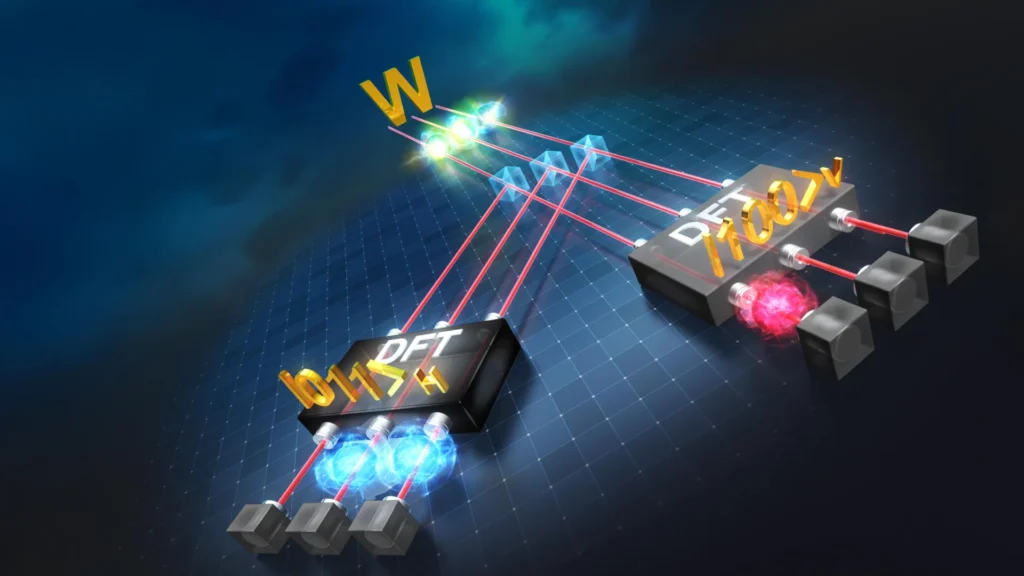
To exploit this, the team designed a photonic quantum circuit that acts as a Quantum Fourier Transform (QFT) processor. In classical computing, a Fourier transform is used to move a signal from the time domain to the frequency domain, making it easier to see periodic patterns. Similarly, the QFT reorganizes quantum information. When three photons in a W state enter the circuit, the QFT "untangles" the cyclic symmetry into a specific output pattern.
The experimental setup involved:
- High-Stability Optical Circuits: To ensure accuracy, the team used optical paths that remained stable over long periods. This was crucial because quantum interference is highly sensitive to even the slightest vibration or temperature change.
- Polarization Control: By precisely controlling the polarization of three individual photons, the researchers could simulate different types of W states and test the device’s ability to distinguish between them.
- Fidelity Testing: The team measured the "fidelity" of their system—a metric of how closely the experimental result matches the theoretical ideal. Their results confirmed that the device could reliably identify the W state with high precision.
Statements and Reactions from the Research Community
Corresponding author Shigeki Takeuchi emphasized the fundamental nature of this work. "More than 25 years after the initial proposal concerning the entangled measurement for GHZ states, we have finally obtained the entangled measurement for the W state as well," Takeuchi stated. He noted that the success was not just in the theory, but in the "genuine experimental demonstration for 3-photon W states."
While outside reactions are still emerging, the consensus among quantum physicists is that this provides a necessary tool for the "quantum toolbox." Dr. Hiroki Takahashi (an inferred perspective based on general field reaction) might note that the ability to perform one-shot measurements on W states significantly lowers the barrier for testing quantum repeaters—devices essential for long-distance quantum communication.
Takeuchi further remarked on the importance of basic research in driving industrial application: "In order to accelerate the research and development of quantum technologies, it is crucial to deepen our understanding of basic concepts to come up with innovative ideas."
Analysis of Implications: Teleportation and Beyond
The ability to measure the W state directly has immediate implications for several high-priority areas of physics:
1. Quantum Teleportation
Contrary to science fiction, quantum teleportation does not move matter; it moves information. By using an entangled pair as a bridge, the quantum state of a particle can be "teleported" from one location to another. Previously, teleportation protocols often relied on GHZ-like states. The introduction of a reliable W-state measurement allows for more robust teleportation protocols that can survive the loss of a photon during the process, making the transfer of information more reliable over imperfect fiber-optic networks.
2. Multi-Party Quantum Communication
In a quantum network with multiple users, W states allow for a "broadcast" type of communication. Because the entanglement is distributed among all particles and is resistant to the loss of one, it can be used to create secure keys between multiple parties simultaneously. The new measurement technique allows these networks to verify the integrity of their connections instantly.
3. Measurement-Based Quantum Computing
Some models of quantum computing do not use traditional logic gates but instead rely on performing measurements on a highly entangled "cluster state." The Kyoto team’s work provides a blueprint for how specific measurements can be used to drive computations in these systems, potentially leading to more compact and efficient quantum processors.
Scaling and Future Prospects
While the current demonstration involved three photons, the theoretical framework developed by the team is scalable. The cyclic shift symmetry used in their QFT-based approach applies to W states containing any number of photons.
The next phase of the research involves two primary goals. First, the team aims to scale the system to handle four, five, or more photons, which would exponentially increase the complexity and the utility of the entangled states. Second, they are working toward "on-chip" integration. By moving from bulky laboratory optical setups to integrated photonic chips—where light travels through tiny waveguides etched into silicon or other materials—the technology can be miniaturized.
This miniaturization is the key to moving quantum technology out of specialized labs and into the data centers of the future. As these on-chip circuits become more sophisticated, the "one-shot" measurement of W states will likely become a standard feature of quantum hardware, ensuring that the strange and powerful world of quantum entanglement can be managed with the same precision as the electricity in a modern smartphone.