The vast, silent reaches of the cosmos are home to phenomena that defy human engineering and challenge the very foundations of particle physics. Among the most elusive of these phenomena are ultrahigh-energy cosmic rays (UHECRs)—subatomic particles that traverse intergalactic distances at speeds nearly indistinguishable from the speed of light. For over sixty years, scientists have struggled to identify the sources of these particles, which arrive at Earth with energies far exceeding those produced by the most powerful human-made accelerators. However, a new study led by researchers at Pennsylvania State University suggests that the answer may lie in "ultraheavy" nuclei—atomic centers heavier than iron—that possess the unique ability to survive the treacherous journey across the universe.
This research, published in the journal Physical Review Letters, provides a potential solution to the mystery of the "Amaterasu particle." Detected in 2021 by the Telescope Array in Utah, the Amaterasu particle is one of the most energetic cosmic rays ever recorded, yet its origin remains a profound enigma. By utilizing sophisticated computer simulations and theoretical modeling, the Penn State team has demonstrated that ultraheavy nuclei lose energy more slowly than their lighter counterparts, allowing them to travel from distant, violent cosmic events to our planet while maintaining their extreme kinetic energy.
The Magnitude of the Cosmic Ray Mystery
To understand the significance of the Amaterasu particle, one must first grasp the scale of energy involved. In the realm of particle physics, energy is measured in electron volts (eV). The Large Hadron Collider (LHC), located at CERN near Geneva, is the pinnacle of human achievement in particle acceleration, reaching energies of approximately 13.6 tera-electron volts (TeV). In contrast, ultrahigh-energy cosmic rays like Amaterasu reach levels exceeding 100 exa-electron volts (EeV)—roughly 10 million times the energy of particles in the LHC.
The Amaterasu particle, named after the sun goddess in Japanese mythology, was measured at an astounding 240 EeV. To put this in perspective, a single subatomic particle possessed the kinetic energy equivalent to a professional tennis ball served at 95 miles per hour. Such energy is so concentrated that it challenges the Greisen-Zatsepin-Kuzmin (GZK) limit—a theoretical ceiling on the energy of cosmic rays traveling long distances. According to the GZK limit, high-energy particles should interact with the cosmic microwave background radiation (the afterglow of the Big Bang), losing energy and slowing down as they travel through space. This implies that any particle arriving at Earth with 240 EeV must have originated from a relatively "nearby" source, within approximately 50 to 100 million light-years.
A Chronology of Discovery: From Oh-My-God to Amaterasu
The history of UHECR detection is a timeline of rare, high-stakes observations that have consistently baffled the scientific community.
- 1962: The first ultrahigh-energy cosmic ray was detected at the Volcano Ranch experiment in New Mexico. It marked the beginning of a six-decade-long quest to understand how the universe accelerates matter to such extremes.
- October 15, 1991: The High Resolution Fly’s Eye Cosmic Ray Detector in Utah recorded the "Oh-My-God particle." With an energy of 320 EeV, it remains the highest-energy cosmic ray ever detected. Its arrival sparked immediate debate, as no known astrophysical object seemed capable of producing such power.
- 2004–Present: The Pierre Auger Observatory in Argentina and the Telescope Array in Utah began operations, providing more consistent data on UHECRs. These facilities use massive grids of surface detectors and fluorescence telescopes to catch the "air showers" created when cosmic rays collide with Earth’s atmosphere.
- May 27, 2021: The Telescope Array detected the Amaterasu particle. Upon tracing its arrival direction back into space, astronomers found themselves looking at the "Local Void"—an expansive, nearly empty region of space bordering our Milky Way galaxy.
The fact that the Amaterasu particle appeared to come from a void, where there are no obvious galaxies, black holes, or nebulae, created a paradox. If the particle was a proton (a hydrogen nucleus), its path should have been relatively straight, pointing directly back to its source. The void offered no candidates.
The Ultraheavy Nuclei Hypothesis
The research led by Kohta Murase, a professor of physics and of astronomy and astrophysics at Penn State, suggests that the "missing" source problem might be a matter of mistaken identity. Most previous models assumed that UHECRs were primarily protons or helium nuclei. However, the Penn State team, working with collaborators from the Yukawa Institute for Theoretical Physics in Japan and Virginia Tech, shifted the focus to ultraheavy nuclei—elements heavier than iron on the periodic table.
Atomic nuclei are the dense cores of atoms, containing protons and neutrons. While they are incredibly small, they contain nearly all of an atom’s mass. The researchers’ calculations indicated that at energies around 200–300 EeV, these ultraheavy nuclei are more "durable" than lighter particles.
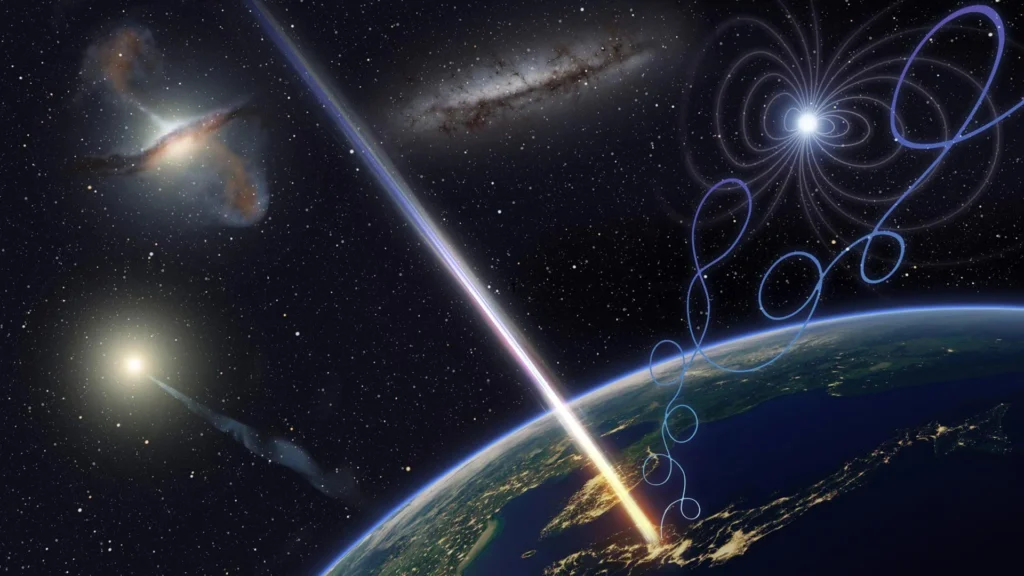
"Our research showed that at energies comparable to that of the Amaterasu particle, ultraheavy nuclei lose energy more slowly than protons or intermediate-mass nuclei," Murase explained. This slower rate of energy loss means these particles can survive much longer journeys through the intergalactic medium. Furthermore, because these nuclei have a higher electric charge than protons, they are more susceptible to being deflected by galactic and intergalactic magnetic fields. This deflection means that the direction from which the particle arrives at Earth may not point directly back to its source, potentially explaining why the Amaterasu particle seemed to emerge from an empty void.
Simulating the Extreme: Methodology and Findings
To reach these conclusions, the research team employed advanced computer simulations that modeled the propagation of various nuclei through the universe. They accounted for several factors:
- Photo-disintegration: The process by which a nucleus is stripped of its protons or neutrons after colliding with low-energy photons in space.
- Pair Production: The loss of energy through the creation of electron-positron pairs.
- Magnetic Deflection: The "bending" of a particle’s path as it moves through the magnetic fields that permeate the space between galaxies.
The simulations revealed that while protons are decimated by interactions with the cosmic microwave background at extreme energies, ultraheavy nuclei can bypass some of these interactions. The team’s data suggests that if a significant fraction of UHECRs are ultraheavy, the observed energy spectrum and the arrival patterns seen in the northern and southern hemispheres begin to make more sense.
There is a noted discrepancy between the cosmic ray data collected in the Northern Hemisphere (by the Telescope Array) and the Southern Hemisphere (by the Pierre Auger Observatory). The Penn State study indicates that a composition of ultraheavy nuclei could help reconcile these differences, as their distribution and propagation would be influenced differently by the magnetic structures of the local universe.
Potential Cosmic Cradles: Where Are They Born?
If these ultraheavy particles exist, what kind of cosmic engine is powerful enough to create them? The research points toward the most violent and energetic events known to science.
"The most promising sites for producing and accelerating such ultraheavy nuclei are massive star deaths involving explosive collapse into black holes or strongly magnetized neutron stars," Murase stated. These "magnetars"—neutron stars with magnetic fields trillions of times stronger than Earth’s—are capable of acting as massive particle accelerators.
Another candidate is the binary neutron-star merger. These events, which were first confirmed via gravitational waves in 2017 (the GW170817 event), are known to be factories for heavy elements. During the merger, r-process nucleosynthesis occurs, creating elements like gold, platinum, and potentially even heavier nuclei. If these mergers also produce the shockwaves necessary for particle acceleration, they could be the primary source of the ultraheavy UHECRs detected on Earth.
Gamma-ray bursts (GRBs), the brightest electromagnetic events in the universe, are also linked to these processes. The Penn State research suggests a "multi-messenger" approach, where scientists look for gravitational waves, gamma rays, and ultrahigh-energy cosmic rays simultaneously to pin down the exact origins of these particles.
Future Implications and Global Observatories
The findings from the Penn State team provide a roadmap for the next generation of astrophysical research. If the highest-energy cosmic rays are indeed ultraheavy nuclei, then future detectors must be designed to distinguish between different types of nuclei with greater precision.
Several international projects are currently in development to test these theories:
- AugerPrime: An upgrade to the Pierre Auger Observatory in Argentina specifically designed to improve the measurement of cosmic ray composition. By better identifying the mass of the particles hitting the atmosphere, AugerPrime will be able to confirm if the "ultraheavy" signature is present.
- Global Cosmic Ray Observatory (GCOS): A proposed next-generation facility that would provide unprecedented coverage of the sky, allowing for a more statistical approach to identifying source regions.
- Space-based Detectors: Missions like the proposed POEMMA (Probe of Extreme Multi-Messenger Astrophysics) aim to detect cosmic ray air showers from orbit, providing a much larger "target" area than any ground-based array.
Conclusion: Solving a Sixty-Year Puzzle
The study led by Kohta Murase and his colleagues represents a significant leap forward in the field of high-energy astrophysics. By suggesting that the most energetic particles in the universe are not simple protons but complex, ultraheavy nuclei, the researchers have provided a viable mechanism for how these particles can traverse the cosmos and reach our detectors.
While the Amaterasu particle and its predecessor, the Oh-My-God particle, remain outliers in the history of science, they are no longer inexplicable. They are clues to a more complex and violent universe than previously imagined—a universe where the deaths of massive stars and the collisions of neutron stars launch heavy fragments of matter across the void at impossible speeds.
As data continues to pour in from the Telescope Array and the Pierre Auger Observatory, and as new facilities come online, the mystery of the cosmic rays may finally be solved. If the "ultraheavy" theory holds, it will not only explain where these particles come from but also provide a new way to study the most extreme environments in the cosmos, using the very nuclei that survive the journey to tell the story of their violent birth.