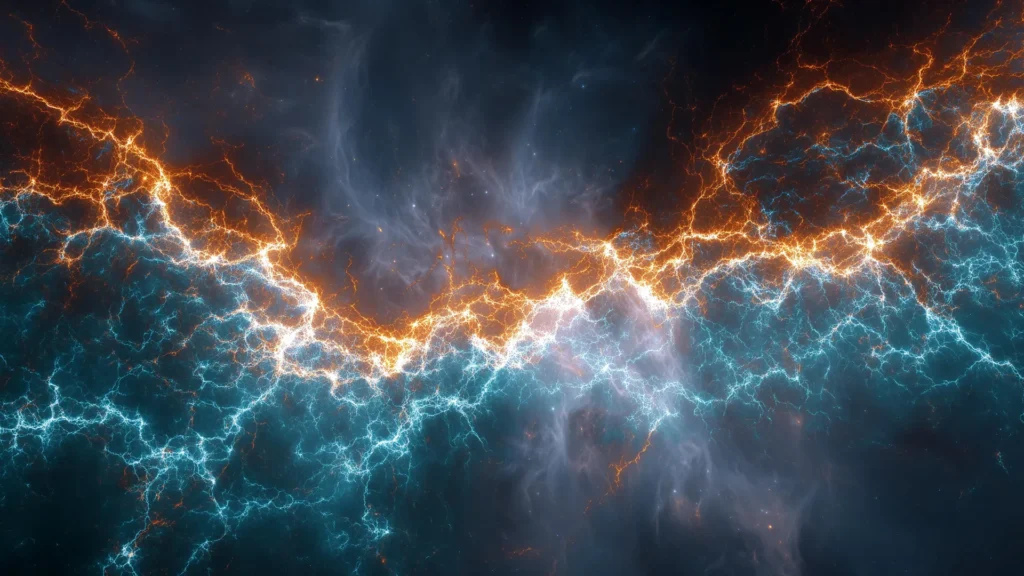
The universe is permeated by an invisible web of magnetic fields, stretching from the localized environments of planets and stars to the vast, intergalactic reaches of entire galaxy clusters. These magnetic forces serve as the primary architects of cosmic evolution, dictating the behavior of solar storms, the trajectories of high-energy cosmic rays, and the structural formation of galaxies. However, for more than seven decades, a fundamental paradox has perplexed the scientific community: how do these vast, highly organized magnetic structures emerge from the inherently chaotic and turbulent plasma that fills the vacuum of space? While turbulence is traditionally viewed as a destructive force that breaks down order, the cosmos consistently displays large-scale magnetic alignment that defies simple explanation.
Now, a breakthrough study led by researchers at the University of Wisconsin-Madison, published in the prestigious journal Nature, may have finally identified the missing mechanism responsible for this cosmic order. By utilizing some of the world’s most powerful supercomputers to model plasma dynamics in unprecedented detail, the team has demonstrated that large-scale magnetic fields are not formed in spite of turbulence, but rather because of a specific type of organized movement within that turbulence. The discovery of "jet-like flows" driven by velocity gradients provides a transformative framework for understanding the magnetic life cycles of black holes, neutron stars, and the space weather that impacts Earth.
The 70-Year Mystery of the Cosmic Dynamo
To understand the significance of this discovery, one must look back at the history of plasma physics and the "dynamo theory." Since the mid-20th century, physicists have known that the motion of electrically conducting fluids—such as the molten iron in Earth’s core or the ionized gas (plasma) in stars—can generate magnetic fields. This process is known as a dynamo. However, theoretical models have historically struggled to bridge the gap between small-scale fluctuations and large-scale structures.
In most simulations conducted over the last 70 years, the magnetic fields generated by turbulent motion remained localized and disordered. While they could explain small "pockets" of magnetism, they failed to account for the massive, coherent magnetic fields observed by astronomers in the spiral arms of galaxies or the consistent dipolar fields of stars. This discrepancy led to a long-standing frustration in the field of astrophysics. If the universe is dominated by entropy and chaotic motion, why is its magnetic signature so remarkably well-organized?
"Magnetic field generation via dynamos has been extensively studied for 70 years, with the frustrating result that the generated fields almost always end up at small scales and highly disordered, unlike observations," explained Paul Terry, a professor of physics at UW-Madison and the senior author of the study. The new research addresses this "scale problem" by identifying the specific conditions under which chaos yields to construction.
The Role of Velocity Gradients and Jet-Like Flows
The breakthrough centered on the work of Bindesh Tripathi, the study’s lead author and a former UW-Madison graduate student now serving as a postdoctoral researcher at Columbia University. Tripathi’s investigation began by looking at the relationship between fluid dynamics and electromagnetism. While previous studies often simplified magnetic problems into two-dimensional models to save on computational costs, Tripathi recognized that the true nature of the universe is inherently three-dimensional (3D).
The team’s hypothesis rested on the influence of "velocity gradients." In physics, a velocity gradient occurs when different layers of a fluid or plasma move at different speeds relative to one another. A common terrestrial example is a river where the water near the banks moves slowly due to friction, while the water in the center flows rapidly. In the cosmos, these gradients are ubiquitous; they are found in the differential rotation of stars, the accretion disks surrounding black holes, and the violent aftermath of neutron star mergers.
By introducing a "constantly renewed velocity gradient" into their simulations, the researchers observed a dramatic shift in behavior. Instead of the plasma moving in random, circular eddies, it began to form organized, jet-like flows. These jets acted as a scaffold, allowing small-scale magnetic perturbations to link together and grow into large-scale, ordered fields.
"Initially, these perturbations lead to turbulent flows and magnetic fields in small-scale structures," Tripathi noted. "Then, over time, they emerge into larger, ordered structures. The key is to have a steady, large-scale gradient in velocity."
Computational Mastery: 100 Million CPU Hours
The scale of the research required a level of computational power that was unavailable to previous generations of scientists. To test their theory, the UW-Madison team utilized the Anvil supercomputer at Purdue University, a high-performance computing cluster supported by the National Science Foundation (NSF).
The statistics of the simulation are staggering:
- Grid Points: The researchers used 137 billion grid points in a 3D space to map the plasma interactions.
- Data Volume: The project generated approximately 0.25 petabytes (250 terabytes) of raw data.
- Computing Time: The study consumed nearly 100 million CPU hours.
- Iteration: The team performed roughly 90 individual simulations to ensure the consistency of their results across different variables.
This high-resolution approach allowed the team to see "under the hood" of cosmic turbulence. By starting with infinitesimal perturbations—essentially moving a single fluid particle a tiny distance—they could watch as that small change propagated through the system. In simulations where the velocity gradient was absent, the system remained a chaotic mess of small magnetic "bubbles." But when the gradient was maintained, the "jet-like" structures emerged, effectively "weaving" the magnetic lines into a coherent tapestry.
Validation through Laboratory and Observational Evidence
While the study is primarily computational, its findings are bolstered by historical experimental data that had previously lacked a theoretical explanation. In 2012, researchers at the Wisconsin Plasma Physics Laboratory (WiPPL) conducted experiments that yielded puzzling magnetic behaviors. At the time, existing dynamo theories could not account for the specific patterns of magnetic growth observed in the lab’s plasma chambers.
Tripathi’s new model aligns closely with those 2012 results, providing the theoretical "missing link" that explains how the experimental plasma transitioned from disorder to order. This alignment between high-level computer modeling and physical laboratory evidence provides a high degree of confidence in the new theory’s validity.
Furthermore, the study offers a new lens through which to view astronomical observations. For instance, the massive magnetic "lobes" seen in radio galaxy images and the structured magnetic fields in the Milky Way’s interstellar medium can now be linked to the velocity gradients present in galactic rotation and jet outflows.
Broader Implications: From Black Holes to Space Weather
The implications of this research extend far beyond theoretical physics, touching on several critical areas of modern astronomy and Earth science.
1. Multi-Messenger Astronomy and Neutron Stars
When two neutron stars merge, they create a "kilonova" event that releases both gravitational waves and electromagnetic radiation. Understanding the magnetic dynamics of these mergers is crucial for "multi-messenger astronomy," a field that combines different types of signals to study the universe. The UW-Madison study provides a roadmap for how magnetic fields intensify during these mergers, potentially explaining the massive bursts of energy detected by Earth-based observatories.
2. Black Hole Accretion Disks
Black holes are surrounded by swirling disks of gas and dust known as accretion disks. The magnetic fields within these disks are responsible for launching massive jets of matter into space at near-light speeds. By showing how velocity gradients within the disk create ordered magnetic fields, this research helps explain the "launching mechanism" of these relativistic jets.
3. Space Weather and Solar Predictions
Closer to home, the Sun’s magnetic field is a source of constant concern. Solar flares and coronal mass ejections (CMEs) can hurl billions of tons of charged particles toward Earth, threatening satellite communications, GPS systems, and power grids. "It may help better understand stellar magnetic fields and predict gas ejections from the Sun toward the Earth," Tripathi stated. By modeling the velocity gradients within the Sun’s convective zone, scientists may eventually be able to predict solar storms with much higher accuracy.
A New Era for Plasma Physics
The study, supported by the National Science Foundation and the U.S. Department of Energy, marks a turning point in the study of basic plasma science. For decades, the "destructive" nature of turbulence was seen as an obstacle to be overcome. This new research suggests that turbulence, when guided by the natural gradients of cosmic motion, is actually the engine of creation.
As researchers continue to analyze the 0.25 petabytes of data generated by the Anvil supercomputer, the scientific community expects further insights into the fine-grained details of magnetic reconnection and energy dissipation. For now, the work of Tripathi, Terry, and their colleagues has provided a definitive answer to a 70-year-old question, proving that even in the most chaotic corners of the universe, there is a fundamental blueprint for order.
The successful resolution of this long-standing issue highlights the indispensable role of supercomputing in modern science. Without the ability to simulate 137 billion points of interaction, the subtle emergence of jet-like flows within the chaos of plasma might have remained hidden for another seventy years. As we look to the stars, we now have a much clearer understanding of the invisible forces that shape them.