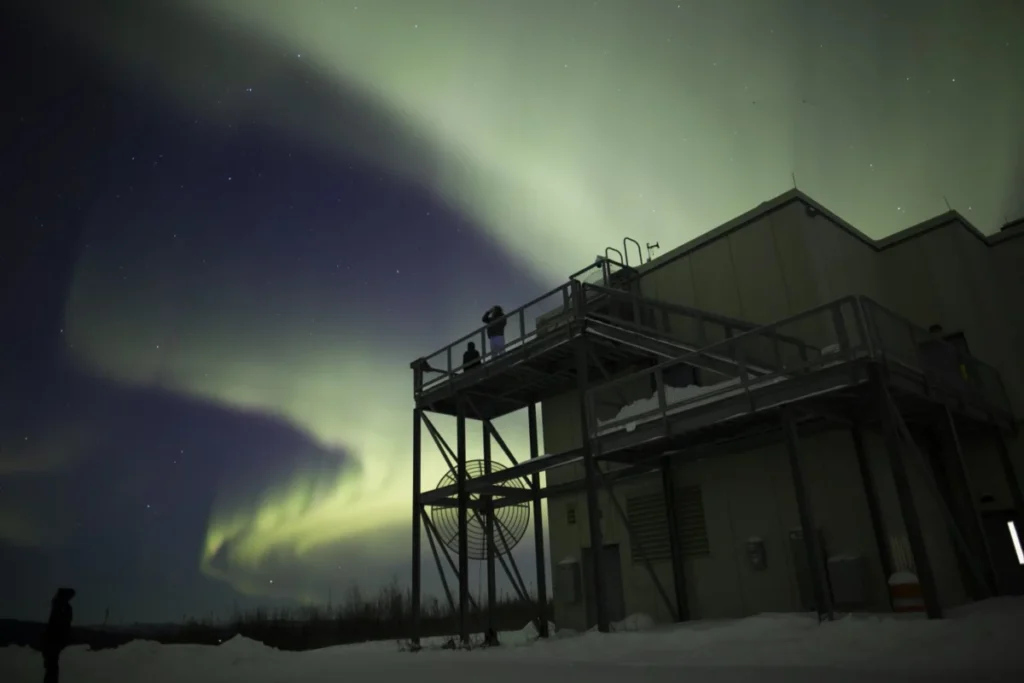
For many graduate students, a 4 a.m. bedtime followed by a noon wake-up call might suggest a typical night of late-night studying or social activity. However, for a dedicated group of researchers from the Massachusetts Institute of Technology (MIT), this nocturnal schedule was the essential heartbeat of a rigorous scientific expedition. Their workday was not dictated by the rising sun, but by the shimmering appearance of the aurora borealis. Operating in the deep freeze of Fairbanks, Alaska, these students sought to transform the night sky into a natural laboratory, using the Earth’s most spectacular light show to unlock the fundamental secrets of plasma physics.
The expedition, known as the Geophysical Plasma Observation Expedition (GPOE), represents a unique intersection of high-level academic research and grueling field work. While plasma—the fourth state of matter consisting of charged particles—is often studied in the controlled, sterile environments of multi-million-dollar fusion reactors at the MIT Plasma Science and Fusion Center (PSFC), the aurora offers a rare opportunity to observe these phenomena on a planetary scale. By studying how charged particles from the sun interact with the Earth’s magnetic field, the team aims to better understand the complex dynamics of space weather, which has direct implications for global communication systems, satellite stability, and power grid security.
The Harsh Realities of Field Science in the Arctic
Conducting high-level physics experiments in the Alaskan interior during the winter months is an exercise in extreme endurance. The team, primarily composed of PhD students from MIT’s PSFC and collaborating departments, faced environmental conditions that would stymie most conventional research efforts. With the sun setting before 3 p.m. and temperatures plummeting as low as -25 degrees Fahrenheit, the physical environment became as much a variable in their experiments as the plasma itself.
The cold was not merely a matter of personal discomfort; it was a significant technical hurdle. Leonardo Corsaro, a PhD student in physics at the PSFC, noted that the extreme temperatures fundamentally altered the performance of their equipment. Lithium-ion batteries, which power the laptops and sensitive recording devices used by the team, are notoriously inefficient in subzero temperatures. "Our laptops went from full battery to nearly empty in 10 minutes because of the cold," Corsaro recalled. This created a high-stakes "race against time" where researchers had to capture and transfer data to more stable storage before their hardware succumbed to the freeze.
Logistical movement also presented a significant challenge. To avoid light pollution and capture the aurora from multiple perspectives, the team had to deploy cameras in remote locations far from established roads. Leon Nichols, another PhD student at the PSFC, explained that while the cold can be managed with proper gear, the physical exertion of navigating the terrain is immense. Walking through thick, uncompacted snow can burn up to 900 calories per hour. To mitigate this, the team utilized cross-country skis to access remote sites that would otherwise have been unreachable within their tight operational windows.
A Historic Solar Cycle and the Search for Pulsating Aurora
The timing of the 2024 expedition was particularly fortuitous. The sun is currently approaching the peak of Solar Cycle 25, a period of heightened solar activity that results in more frequent and intense auroral displays. During their tenure in Fairbanks, the MIT team witnessed the strongest solar storm recorded in the past two decades. This G5-level geomagnetic storm provided a surplus of data, as the aurora expanded in intensity and geographic reach, surrounding the researchers in a 360-degree immersion of glowing plasma.
The scientific focus of this year’s campaign went beyond simply photographing the lights. The team was specifically interested in "pulsating aurora," a relatively rare and poorly understood phenomenon where patches of light blink on and off with rhythmic precision, sometimes multiple times per second. Unlike the flowing, curtain-like structures of a standard aurora, pulsating auroras are thought to be caused by complex wave-particle interactions in the Earth’s magnetosphere.
To capture these events, the team utilized a distributed network of all-sky camera systems. By spreading these cameras across a 100-mile radius, they could perform "stereoscopic" observations, allowing for the potential three-dimensional reconstruction of auroral structures. These visual records were synchronized with magnetometers—devices that measure minute fluctuations in the Earth’s magnetic field—to correlate the visual movement of the plasma with the underlying electromagnetic forces at play.
Technical Innovation and Novel Detection Methods
A hallmark of the GPOE is its reliance on student-designed and student-built instrumentation. This year, the team expanded their diagnostic suite to include muon detectors. Muons are subatomic particles produced when high-energy cosmic rays enter the Earth’s atmosphere. By deploying these detectors alongside their optical and magnetic sensors, the MIT researchers are exploring whether there is a measurable correlation between high-energy particle detection and specific auroral features. This multi-modal approach offers a more holistic view of the upper atmosphere’s response to solar activity than traditional imaging alone.
The team operated out of the Poker Flat Research Range, a facility managed by the University of Alaska Fairbanks Geophysical Institute. As the world’s only scientific rocket range owned by a university, Poker Flat provided the infrastructure necessary for the team to coordinate their multi-site deployments. The data collected here is intended to bridge the gap between theoretical plasma simulations and the chaotic reality of natural phenomena.
For many of the students, seeing the plasma in person was a transformative academic experience. In the lab, plasma is often reduced to "colorful plots and simulations," as Corsaro described it. However, standing under a shifting sky of electric currents served as a vivid reminder that real-world plasmas are far less "neat" than the mathematical models used to describe them.
The Evolution of the GPOE: From a "Cool" Idea to a Global Collaboration
The Geophysical Plasma Observation Expedition is a relatively young initiative, having launched in 2023. Its origin story is a testament to the "hacker" culture and initiative-driven environment of MIT. Graduate student Shon Mackie, recognizing the upcoming solar maximum and the lack of hands-on field opportunities for plasma students, proposed the idea to the PSFC leadership. The response from then-Director Dennis Whyte was famously brief: "Sounds cool, literally! PSFC will fund this."
Since that initial approval, the program has scaled rapidly. What began as a single-camera pilot project has evolved into a sophisticated research operation involving multiple MIT departments, including the Department of Nuclear Science and Engineering and the Kavli Institute for Astrophysics and Space Research. This year’s cohort was accompanied by Professor Matthew Evans, a faculty member affiliated with the LIGO Laboratory, highlighting the interdisciplinary appeal of the mission.
The program has also expanded its reach through a unique outreach collaboration. In 2024, the GPOE partnered with the MIT Museum and the MIT Nord Anglia Collaboration to involve high school students from around the world. Approximately 65 students from 20 different schools contributed to the design and construction of the all-sky camera housings. Working within strict technical constraints, these high schoolers produced 13 of the camera units used in the Alaskan field, providing them with a direct connection to a frontline scientific mission.
Broader Implications for Space Weather and Earth Systems
The data gathered by the MIT team has implications that reach far beyond the walls of the physics lab. As human society becomes increasingly reliant on satellite technology for GPS, telecommunications, and weather forecasting, understanding "space weather" has become a matter of national security and economic stability.
Large-scale solar storms can induce currents in power lines that lead to transformer failures and widespread blackouts. They can also increase atmospheric drag on low-Earth-orbit satellites, shortening their lifespans or causing them to fall out of orbit entirely. By improving the characterization of how plasma behaves in the near-Earth environment, the GPOE contributes to the development of more accurate predictive models for these events.
The scientific community has already begun to take note of the GPOE’s contributions. Students from the expedition have presented their findings at the American Geophysical Union (AGU) meetings and published their work in peer-reviewed journals such as Earth and Space Science. Furthermore, the low-cost, high-efficiency designs for their all-sky cameras and magnetometers are being shared with other research institutions and community science initiatives, democratizing access to high-quality auroral data.
A Compressed Research Cycle as an Educational Model
One of the most significant aspects of the GPOE is the "compressed scientific cycle" it offers students. In the world of high-stakes experimental physics, it is common for a PhD student to spend years designing a single component of a massive experiment, such as a fusion reactor or a particle accelerator, without ever seeing the final data.
In contrast, the GPOE requires students to move from conceptual design to instrument fabrication, field deployment, data collection, and analysis within just a few months. John Ball, a PhD student in nuclear science and engineering, noted that this kind of rapid turnaround is incredibly rare in the field. It teaches students not only the physics of plasma but also the logistics of project management, the engineering of robust hardware, and the resilience required for field operations.
As the program looks toward the future, there are plans to establish more permanent instrumentation in Alaska and expand the scope of their measurements. The ultimate goal is to create a long-term data set that spans the entirety of a solar cycle, providing a comprehensive look at how our planet’s "natural laboratory" responds to the sun’s varying moods.
Beyond the data and the publications, the expedition leaves a lasting mark on the researchers themselves. "Standing outside at midnight in Alaska, staring up at sheets of glowing plasma stretching thousands of kilometers across the sky, really brings home just how small and delicate our own place in the universe is," Ball remarked. For these MIT scientists, the aurora is more than just a beautiful light show; it is a profound reminder of the scale of the forces they study and the adventurous spirit that drives scientific discovery.