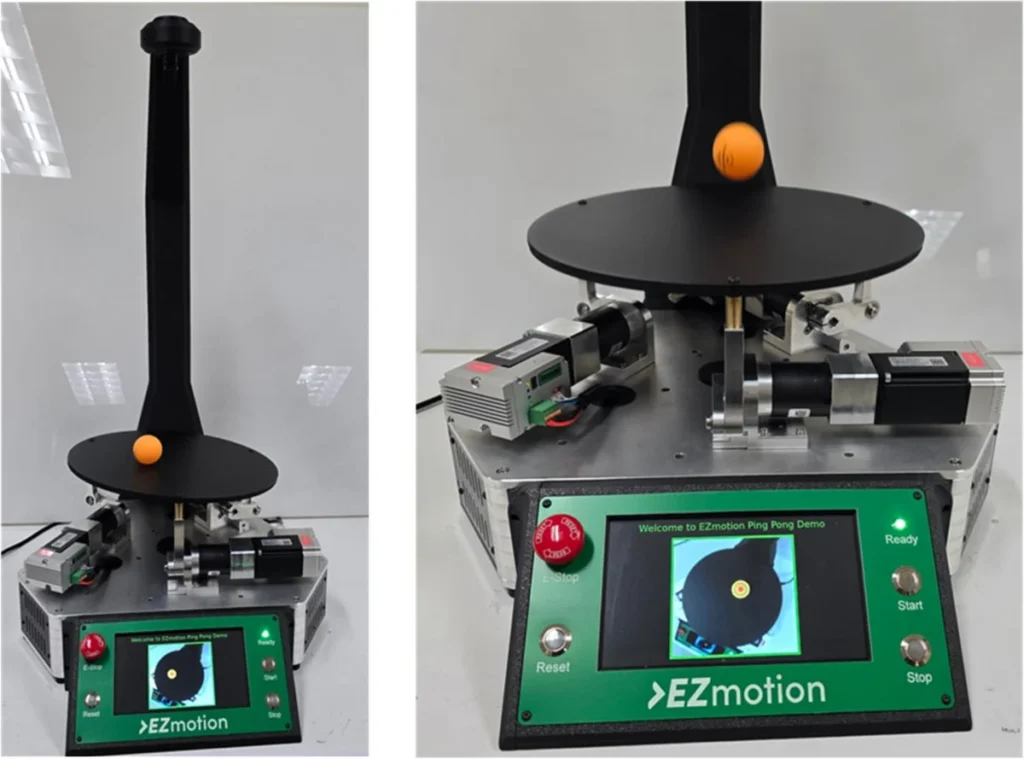
A cutting-edge demonstration has unveiled the capabilities of advanced servomotor technology in achieving real-time, high-precision motion control through a parallel-kinematics platform. Developed by Monolithic Power Systems (MPS) in collaboration with EZmotion, the system adeptly manages the dynamic, often chaotic, motion of a ping-pong ball, showcasing a fusion of synchronized servo actuation, visual feedback, and real-time kinematic computation. This innovative setup serves as a robust testbed, addressing critical challenges such as visual-feedback latency, multi-axis synchronization, and the execution of real-time inverse kinematics and proportional-integral-derivative (PID) control on embedded hardware. The implications of this development extend far beyond a mere tabletop experiment, pointing towards significant advancements in fields requiring meticulous control, from medical robotics to advanced industrial automation.

The Parallel-Kinematics Platform: A Benchmark for Precision Motion
At the core of this demonstration is a three-axis parallel platform engineered to showcase the dynamic balancing, swirling, and bouncing of a lightweight ping-pong ball. The choice of a ping-pong ball is deliberate; its minimal mass and high susceptibility to environmental disturbances make it an ideal, albeit challenging, object to control with precision. The platform’s ability to manipulate such an unwieldy object in real-time underscores the exceptional performance of the integrated servomotors. These motors, featuring onboard drivers, high-resolution angle sensors, and CANopen support, deliver critical capabilities including high-resolution motion, rapid real-time response, and tight multi-axis synchronization.

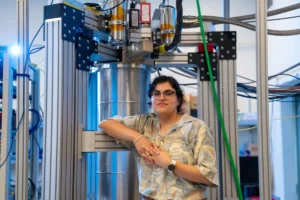
According to Charan Bhamra, a Mechatronics Engineer at Monolithic Power Systems, the project aims to demonstrate how integrated smart motors can overcome complex control challenges inherent in high-performance robotic systems. "Our objective was to build a system that not only illustrates the raw power and precision of our servomotors but also highlights their seamless integration capabilities," Bhamra states. "The parallel platform serves as a microcosm for real-world applications where visual data must inform rapid, multi-axis coordination with unwavering accuracy."
Integrated Servomotors: The Brains and Brawn

The performance of the demonstration platform hinges on a specific line of integrated servomotors, exemplified by the EZmotion MMS740100-24-C2-1. These 40-mm smart motors represent a paradigm shift in motion control component design, integrating a permanent-magnet synchronous motor with its driver module into a single, compact unit. This integration is crucial for simplifying system architecture and reducing wiring complexity, which are often significant hurdles in sophisticated robotic designs.
Each servomotor houses a built-in servo driver that efficiently supplies power to the motor windings, alongside an embedded motion controller that runs a nested control loop. This controller meticulously regulates current, velocity, and position in real-time, ensuring optimal performance. Furthermore, an onboard CAN transceiver facilitates direct integration into the CANopen network, a standard communication protocol widely adopted in industrial automation for its robustness and deterministic capabilities. A dedicated power management solution within each motor guarantees stable internal voltages, contributing to safe and reliable operation.

The MMS740100-24-C2-1 motor, for instance, boasts a 14-bit resolution magnetic position sensor, enabling sub-degree accuracy in tracking the shaft’s position. This level of precision is paramount for applications demanding the fine-tuned movements demonstrated by the parallel platform. By combining the sensor, driver, controller, communication interface, and power management into a single device, these servomotors offer a "plug-and-play" solution that significantly streamlines the design and deployment of advanced motion control systems.
System Architecture: A Coordinated Digital Ecosystem

The operational prowess of the platform is a testament to its intelligently designed system architecture, which judiciously separates computational roles between a Raspberry Pi 5 device and a Cortex M4 microcontroller unit (MCU). This distributed processing approach optimizes performance by assigning tasks to the most suitable hardware.
The Raspberry Pi 5, a powerful single-board computer, is tasked with handling the visual feedback and image processing. It runs a lightweight Python script leveraging the OpenCV computer vision library to process video frames from a top-mounted USB camera at a moderate frame rate of 40 frames per second (fps). The initial processing involves applying a Gaussian blur to the frames, followed by a conversion to the hue, saturation, and value (HSV) color space.

To facilitate robust tracking, the ping-pong ball is distinguished by an orange color mask. Contour filtering is then applied to identify the ball’s boundaries accurately, and its center coordinates are extracted from the smallest circle that completely encloses the largest detected contours. These coordinates provide the ball’s real-time position in the XY plane. A critical innovation in this setup is the determination of the ball’s Z-position (height) by its apparent diameter. As the ball moves closer to the camera, its detected diameter in pixel units increases, and this pixel information is precisely translated into a real-world Z-position in millimeters. The Raspberry Pi also features an HDMI connection to a local display, offering live rendering of the camera feed with post-processed ball tracking frames, providing immediate visual confirmation of the system’s performance. The meticulously calculated position and height data of the ball are then transmitted to the Cortex M4 MCU via a Serial Peripheral Interface (SPI) communication link.
The Cortex M4 MCU, acting as the motors’ initiator controller, is the operational heart of the platform. It manages the core control loop and executes the kinematic model. The core control is built around a robust PID-based algorithm that converts the detected ball position error into a precise platform tilt angle. This tilt angle information is then fed into the kinematic model, which translates it into specific position targets for each of the three servomotors. The motors, operating in CANopen Cyclic Synchronous Position (CSP) mode, receive these position setpoints, ensuring synchronized and deterministic motion across all three axes. This highly coordinated movement is essential for stabilizing the platform and enabling precise control even during rapid and dynamic inputs.

Mastering Motion: Kinematic Modeling and PID Control
The platform’s sophisticated motion control is underpinned by an inverse kinematic approach, where the motor crank angle is computed to achieve a desired platform tilt angle and Z-axis translation. This involves several critical steps:

- Defining Joint Positions: The global positions of the fixed-base joints and the local positions of the moving platform joints (distributed on a circle of a given radius) are precisely defined using vector mathematics.
- Rotation Matrices: Rotation matrices are employed to define how the platform moves in 3D space. These matrices calculate the rotation of a point around the X, Y, and Z axes by specified angles ($Theta_x, Theta_y, Theta_z$). The combined rotation matrix then describes the overall rotation of the platform’s axes relative to the base’s axes.
- Actual Platform Joint Positions: Using the combined rotation matrix, the actual positions of each platform joint in global coordinates are determined.
- Limb Length Calculation: The required length of each limb is calculated as the straight-line distance between its corresponding base joint and the transformed platform joint.
- Motor Crank Angle: Finally, based on the calculated limb lengths and the known lengths of the crank arm and connecting rod, the precise motor crank angle for each servomotor is computed. These calculations are crucial for translating a desired platform pose into individual motor commands.
The MCU’s PID-based control system is a continuously active feedback loop that adjusts the platform’s tilt and Z-translation in real-time to control the ball’s motion. Depending on the selected operational mode—balancing, circular swirling, or bouncing—an independent PID controller computes the target platform orientation and translation, which is then converted into absolute motor positions via inverse kinematics.
- Balancing Mode: In this mode, the objective is to keep the ball stationary at the platform’s center. The PID controller continuously minimizes the positional error by adjusting the platform’s tilt angles ($Theta_x$ and $Theta_y$).
- Circular Swirling Mode: Here, the platform guides the ball along a predefined circular trajectory. The target is set by a two-dimensional array of time-varying reference points, forming a circle with a 100mm radius in the XY plane.
- Bouncing Mode: This is arguably the most complex mode. The target is a specific height in millimeters, with the ball centered on the platform. To initiate bouncing, the system first enters an oscillation phase, executing rapid vertical movements to impart sufficient energy to lift the ball. Once a predefined energy threshold is met (indicating consistent bouncing), the controller transitions to a sustain mode. In this phase, minimal synchronized vertical motion is applied to maintain the ball’s height with optimal energy efficiency, rather than driving it higher. The ball’s total energy is estimated using both kinetic and potential energy components, and its velocity is computed from the difference between current and previous ball heights over a given timestep.
Synchronized Motion with CANopen CSP Mode

The seamless, coordinated motion of the three platform limbs is a direct result of utilizing the Cyclic Synchronous Position (CSP) mode within the CANopen protocol. CANopen is a highly efficient and deterministic communication standard widely used in automation and embedded systems. While other CANopen modes, such as Cyclic Synchronous Velocity (CSV) and Cyclic Synchronous Torque (CST), are optimized for velocity and torque-driven applications, CSP mode is specifically designed for deterministic, position-based multi-axis control, making it ideal for the parallel platform.
In CSP mode, the MCU, acting as the network initiator, sends precise position setpoints to each motor at a fixed and deterministic update rate. Critically, each motor internally performs linear interpolation between consecutive setpoints. This ensures continuity and smoothness in motion even though position targets are sampled at discrete intervals. The motor controllers do not generate their own complex trajectories; instead, they rely on the initiator (the MCU) to continuously feed them updated position targets.

From a communication standpoint, CSP mode involves the transmission of Process Data Object (PDO) messages containing absolute target positions. These PDOs can be mapped, configured, and stored in the motor’s non-volatile memory, allowing the motor shaft to follow a seamless trajectory. The calculated crank angle values derived from the inverse kinematics are converted into these CSP position targets and broadcast synchronously across the CAN bus. This architecture guarantees highly coordinated and jitter-free motion across all three limbs, essential for the platform’s delicate ball manipulation tasks.
Operational Sequence: A Smooth, Automated Start

The operational sequence of the parallel platform is meticulously choreographed to ensure reliability and user-friendliness. The system initiates with a torque-based homing routine for all servomotors. During this process, each of the three limbs retracts inward at a controlled speed until it reaches its mechanical hard stop. This procedure establishes a repeatable zero position for each motor, crucial for accurate subsequent movements. Upon successful completion of homing, the platform automatically rises to a predefined mid-height along the Z-axis. A green status LED illuminates, indicating successful initialization and signaling to the user that a ping-pong ball can now be placed on the platform.
Once initialized, the manipulator enters its active sequence, beginning with the balancing mode. This is followed by a circular swirl mode, which runs for a duration of 30 seconds, and then transitions into the bouncing mode for another 30 seconds. This sequence continuously loops, providing an ongoing demonstration of the system’s versatility and robustness as long as the platform remains active. Throughout the demonstration, a 7-inch screen provides real-time visual feedback, displaying the ball’s motion and tracking data, enhancing the user’s understanding of the system’s precise control.

Beyond Ping Pong: Real-World Implications and Applications
While the ping-pong ball demonstration is compelling, its true significance lies in the broader implications for real-world engineering and industrial design. The capabilities showcased—high-resolution motion, real-time response, and tight multi-axis synchronization—are foundational for numerous advanced applications.

In medical robotics, architectures akin to this demonstration are critical for developing next-generation surgical and diagnostic tools. Such systems can stabilize endoscopic instruments, guide surgical tools with sub-millimeter precision, and assist in minimally invasive procedures where even the slightest tremor can have severe consequences. The jitter-free motion and fine resolution offered by these servomotors are indispensable in these life-critical applications, enabling surgeons to operate with enhanced dexterity and control.
For industrial automation, the integrated servomotors detailed here are poised to transform various manufacturing and assembly processes. They are ideal for imparting motion to optical alignment stages, where micron-level accuracy is essential for positioning lenses or sensors. Similarly, in pick-and-place machines and micro-assembly manipulators, the speed, precision, and compact form factor of these motors allow for faster cycle times and more accurate placement of components. The simplified wiring and plug-and-play nature of integrated servomotors significantly reduce installation time and maintenance costs in complex automated factories.

Furthermore, delta 3D printers and consumer-grade delta pick-and-place machines are already benefiting from servo-driven parallel kinematic structures. The inherent advantages of delta robots—their speed and large workspace-to-footprint ratio—are amplified when paired with high-performance, integrated servomotors. These motors enable faster print speeds, greater accuracy in material deposition, and more agile component handling, pushing the boundaries of what is achievable in rapid prototyping and light manufacturing.
The demonstration by Monolithic Power Systems and EZmotion is more than just an impressive display of engineering prowess; it is a clear indicator of the direction advanced motion control technology is heading. By integrating multiple functionalities into a single, intelligent component, these servomotors simplify complex system designs while simultaneously elevating performance standards. This innovation promises to drive efficiency, precision, and reliability across a diverse range of industries, from the operating room to the factory floor, marking a significant step forward in the quest for truly autonomous and highly precise robotic systems. The work of engineers like Charan Bhamra continues to push the boundaries of what’s possible in mechatronics, offering compact, powerful solutions for the challenges of tomorrow.