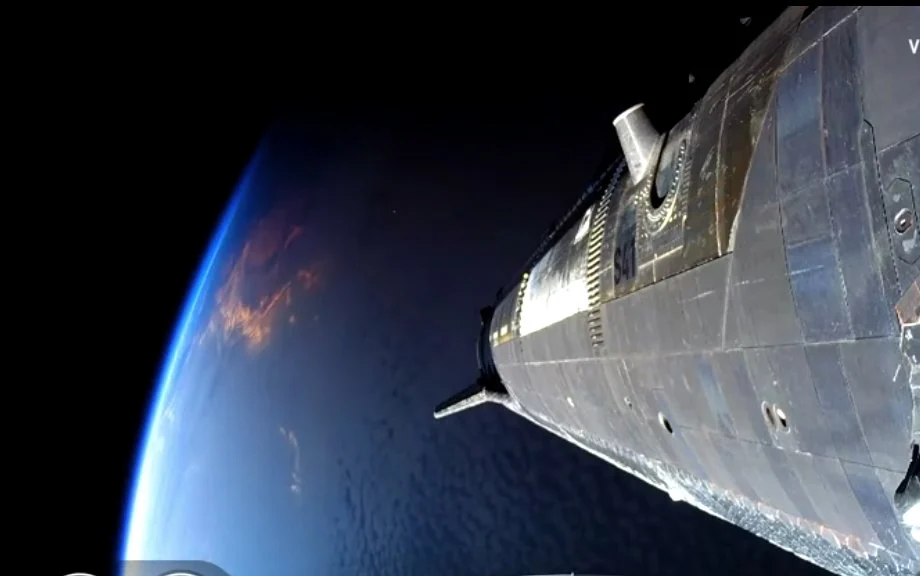
The colossal SpaceX Starship rocket successfully completed its first-ever orbital flight on Monday, culminating in a controlled splashdown near Hawaii at 10:58 a.m. Central Time. This landmark mission, Flight 14, represents the longest duration for the Starship program to date, pushing the boundaries of reusable rocket technology and demonstrating significant progress towards the company’s ambitious interplanetary goals. The approximately three-hour journey began at 7:48 a.m. Central from SpaceX’s Starbase facility in Boca Chica, Texas.
A Mission of Firsts: Orbital Insertion and Satellite Deployment
The initial phase of the mission saw the Super Heavy booster successfully separate and splash down in the Gulf of Mexico just seven minutes after launch, a crucial step in testing the booster’s reusability capabilities. Meanwhile, the Starship upper stage, or "ship," continued its ascent, achieving Earth orbit and successfully deploying the first batch of V3 Starlink satellites. These new satellites are designed to significantly enhance the operational constellation’s capacity.
Dan Huot, SpaceX’s communications manager, described the flight as a "pretty cool milestone" during the company’s livestream. He emphasized, "Starship’s first orbital flight, the first of many." This statement underscores the transformative nature of this achievement, positioning it as a foundational step for future, more complex missions.
Navigating Challenges: Engine Anomaly and Strategic Adaptations
While the mission achieved its primary objectives, it was not without its challenges. SpaceX had originally envisioned a 10-hour flight profile. However, an unexpected anomaly occurred when a Raptor Vacuum engine on the upper stage experienced an early shutdown shortly after launch. This development necessitated a rapid reassessment of the mission plan. Mission controllers considered a suborbital trajectory, but ultimately opted for the more ambitious orbital path, recognizing the opportunity to deploy the Starlink satellites.
This critical decision was made after a thorough evaluation of the remaining engines’ health. Huot explained, "technicians looked at all indicators of health on those remaining engines, particularly the three center sea-level engines that we need for the orbital insertion burn and for the deorbit burn." The successful management of this engine issue highlights the robust engineering and rapid problem-solving capabilities within SpaceX.
A Phased Approach to Reusability and Learning
Since 2023, SpaceX has undertaken a methodical approach to developing Starship, conducting 13 suborbital flights of integrated Starships. The company stated in its Flight 14 mission description that this strategy was designed "to maximize public safety while allowing for maximum learning" about the new design. These earlier flights, typically lasting no more than 65 minutes, provided invaluable data on the vehicle’s performance and handling characteristics in various atmospheric conditions.
Flight 14 marked a significant departure from these suborbital tests. The core objectives of this orbital mission included:
- Achieving Earth Orbit: Successfully reaching and maintaining a stable orbit around the planet.
- Starlink Satellite Deployment: Releasing the next generation of Starlink satellites into orbit.
- Deorbit Burn: Executing a deorbit burn using a single Raptor engine to initiate the return trajectory.
- Controlled Reentry and Splashdown: Managing the vehicle’s descent through the atmosphere and executing a controlled splashdown in the Pacific Ocean.
The successful completion of these objectives signifies a pivotal shift. As SpaceX stated, "the next phase of developing Starship to be fully and rapidly reusable can begin." This implies a move towards more frequent flights and a greater emphasis on operational readiness.
Performance Metrics and Satellite Success
SpaceX’s published flight plan aimed for the Starship to travel approximately 275 kilometers above Earth. Data from the livestream’s altitude indicator confirmed that the ship achieved this target altitude, further validating the vehicle’s orbital insertion capabilities.
The deployment of the 26 Starlink satellites was also deemed "wildly successful" by Huot. He confirmed that the satellites were transmitting as planned, indicating a smooth integration into the existing Starlink network. The V3 satellites represent a significant upgrade, boasting "10x the capacity compared to a single launch of V2 mini Starlink satellites on Falcon 9," according to SpaceX. This substantial increase in capacity will be crucial for expanding the global reach and improving the performance of SpaceX’s satellite internet service.
Broader Implications: Lunar Missions and Future Constellations
The success of Flight 14 has far-reaching implications for both SpaceX’s commercial ventures and its government contracts. The Starship program is central to NASA’s Artemis program, with SpaceX holding $2.9 billion in contracts to develop lunar lander variants of Starship. These landers are slated to transport astronauts to the lunar surface starting in 2028. The ability of Starship to reach orbit and deploy payloads reliably is a foundational requirement for these complex lunar missions.
Beyond lunar exploration, Starship is integral to SpaceX’s ongoing expansion of its Starlink broadband constellation. The increased capacity of the V3 satellites, enabled by Starship’s launch capabilities, will accelerate the deployment of this global internet network, potentially reaching underserved populations and enabling new applications for satellite-based communication.
Innovative Technologies Under Scrutiny: Heatshield Assessment
A unique aspect of this mission involved three of the deployed Starlink satellites equipped with specialized cameras. Their purpose was to "scan Starship’s heatshield" during the reentry phase. This data is invaluable for engineers to "assess potential improvements for future missions." Specifically, the cameras focused on:
- New Tile Designs: Examining the performance of newly designed heatshield tiles, including their attachment mechanisms.
- Curved Tiles: Assessing areas equipped with curved tiles, designed "to reduce heating in gaps between tiles."
This meticulous post-flight analysis of the heatshield is critical for ensuring the long-term durability and reusability of Starship. The extreme temperatures and pressures experienced during atmospheric reentry pose significant engineering challenges, and detailed data on heat shield performance is essential for refining materials and designs. The insights gained from these cameras will directly inform future iterations of Starship, aiming for increased resilience and reduced refurbishment needs between flights.
A New Era of Spaceflight
Flight 14 represents more than just a successful mission; it signifies the dawn of a new era in spaceflight. By demonstrating orbital capability and the successful deployment of advanced satellites, SpaceX has taken a monumental leap towards realizing its vision of a fully reusable super heavy-lift launch system. The data gathered from this mission will fuel further development, bringing humanity closer to ambitious goals such as lunar colonization and eventual missions to Mars. The consistent progress and iterative design approach employed by SpaceX, evidenced by the transition from suborbital tests to orbital achievements, positions Starship as a transformative technology with the potential to reshape humanity’s presence in space. The coming years will undoubtedly reveal the full impact of this groundbreaking achievement.