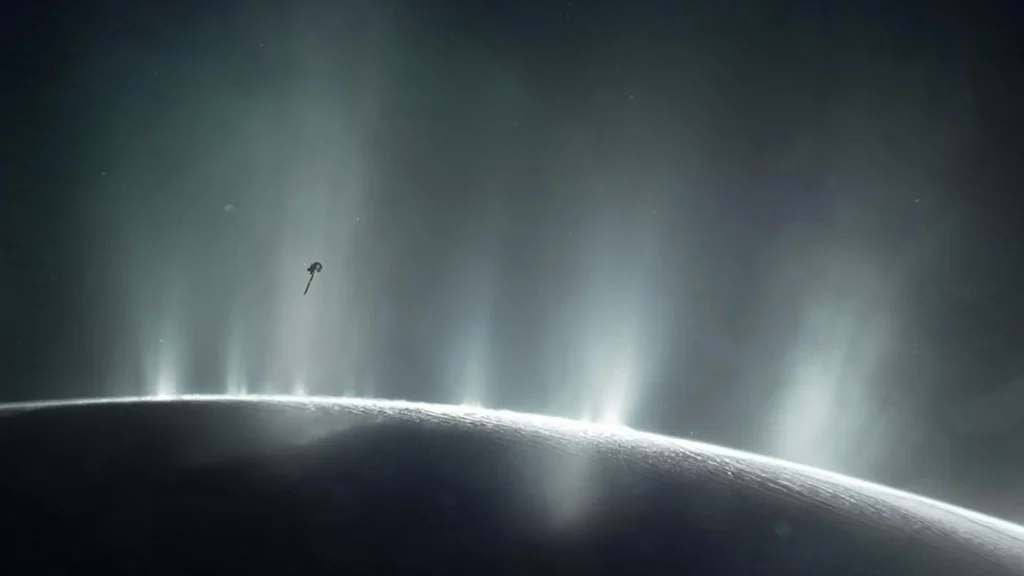
Saturn’s enigmatic moon Enceladus, a world encased in a shimmering shell of ice, harbors a profound secret: a vast, global ocean churning beneath its frozen exterior. Near the moon’s frigid south pole, dramatic fractures in this icy crust act as natural geysers, spewing plumes of water vapor and ice particles into the vacuum of space. This celestial phenomenon offers scientists an extraordinary, albeit indirect, pathway to investigate an alien ocean, bypassing the daunting challenge of drilling through miles of solid ice. Now, an international consortium of researchers, including key contributors from the Earth-Life Science Institute (ELSI) at the Institute of Science Tokyo, has embarked on a groundbreaking investigation to unravel the complex journey of this ocean water as it transitions from its subterranean domain to the microscopic ice grains detected in orbit.
The Enigmatic Symphony of Enceladus’s Ice Grains
The revelation of Enceladus’s subsurface ocean by the Cassini spacecraft between 2004 and 2017 marked a pivotal moment in planetary science. During its extensive mission, Cassini’s Cosmic Dust Analyzer meticulously sampled and analyzed the composition of individual ice particles within Saturn’s E-ring, a diffuse ring system perpetually replenished by the material erupting from Enceladus. These analyses revealed a startling diversity in the chemical makeup of these ejected ice grains, a finding that initially presented a significant scientific puzzle.
A dedicated team, spearheaded by Professor Frank Postberg of Freie Universität Berlin, delved into 961 mass spectra obtained from salt-rich ice particles, specifically classified as Type 3 particles. The prevailing scientific assumption was that these grains were merely minute fragments of the same ocean water, and therefore, their salt compositions should exhibit a degree of uniformity. However, the Cassini data painted a far more intricate picture. The analyzed grains displayed remarkable variations, with some exhibiting an exceptional abundance of sodium chloride, while others were notably richer in carbonates, phosphates, or potassium chloride. A particularly intriguing pattern emerged: chloride and carbonate ions rarely coexisted within the same sodium-rich particle. This striking chemical heterogeneity raised a fundamental question: if all these particles originated from the same interconnected ocean, why did their chemical signatures diverge so dramatically?
Recreating the Genesis of Enceladus’s Ocean Droplets in the Laboratory
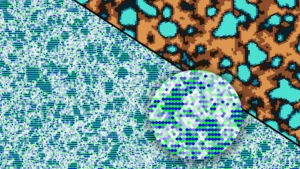
To address this perplexing anomaly, Professor Yasuhito Sekine and his colleagues at ELSI embarked on an ambitious laboratory endeavor. They meticulously recreated droplets designed to mimic the primary salts believed to be present in Enceladus’s ocean. These artificial droplets, varying in size, were subjected to a range of controlled cooling conditions, allowing the researchers to observe and document the distribution of chemical elements as the droplets solidified.
The experiments yielded a crucial insight: the rate at which these droplets froze played a pivotal role in determining the final chemical segregation. In droplets approximately 200 micrometers in diameter, a slower freezing process, occurring at rates of around 10 Kelvin per minute or less, led to a distinct separation of salts into different regions within the solidified droplet. In contrast, when the droplets froze more rapidly, their constituent chemical ingredients remained remarkably, and uniformly, mixed.
"What surprised us was that the diversity seen by Cassini could emerge from droplets originating from essentially the same ocean water," stated Professor Sekine in a press release. "Our experiments show that when relatively large ocean droplets freeze slowly, different salts can separate within them. If those frozen droplets are later broken apart, they can produce much smaller ice grains, each with very different chemical compositions." This experimental evidence provided a compelling hypothesis for the observed chemical variability in the Cassini data, suggesting that the journey from ocean to space was far from a simple, direct process.
A Tortuous Passage: Unraveling the Slow Journey Through Enceladus’s Icy Crust
The implications of these laboratory findings extend beyond explaining the composition of the ice grains; they also offer profound insights into the processes occurring within Enceladus’s icy crust. Previous scientific models generally posited that seawater ejected from Enceladus would freeze rapidly and swiftly accelerate towards space shortly after its eruption from the ocean. However, the new experimental results suggest a more nuanced and protracted scenario.
The researchers propose that the ejected ocean droplets may initially traverse the moon’s subsurface vent system at a considerably slower pace. They likely follow intricate pathways through the complex network of fractures within the ice before approaching the surface. According to the study’s authors, the initial ocean spray likely forms droplets ranging from tens to hundreds of micrometers in size. As these droplets slowly migrate through the deeper sections of the vents, they gradually freeze. This extended period of freezing allows ample time for the various salts to segregate into distinct chemical domains within the nascent ice structure.
As these partially frozen droplets ascend closer to the surface, the environmental conditions likely change dramatically. The flow of gas within the vents accelerates, and the frozen droplets may experience high-speed collisions with the walls of narrower icy channels. These energetic impacts could fracture the larger frozen droplets into significantly smaller fragments. Crucially, each of these fragments could originate from a different, salt-rich region within the original frozen droplet, thereby producing individual ice grains with markedly different chemical compositions. These fragments, now carrying distinct chemical signatures, would then be propelled into space, eventually contributing to the composition of Saturn’s E-ring.
Professor Postberg elaborated on this connection: "The Cassini data showed us that these salt-rich grains are far more chemically diverse than an average ocean composition would suggest. Combining those observations with the freezing experiments gives us a physical explanation: Cassini may have sampled fragments of larger frozen ocean droplets, each preserving different components that became separated during their journey towards the surface. The abundance of each individual component in the ocean is then reflected in the number of fragments in which a particular component is found." This integrated approach, combining observational data with controlled experimentation, provides a robust framework for understanding the origins of Enceladus’s geysers.
Natural Sample Preparation: Enceladus as a Cosmic Concentration Mechanism
The discovery of this slow freezing and fragmentation process has significant implications for future astrobiological missions to Enceladus. As the ocean droplets freeze and subsequently break apart, individual chemical compounds can become naturally concentrated within specific ice grains. This process is not limited to the separation of different salts; prior research has already indicated that organic substances can also be segregated from one another and appear in elevated concentrations in certain particles.
This natural concentration mechanism could considerably simplify the analytical tasks for future missions. Compounds that are highly diluted within Enceladus’s ocean and intimately mixed with a myriad of other substances may become far more accessible for detection when they are pre-concentrated into individual ice grains. On Earth, laboratories often expend considerable effort and resources on separating and concentrating chemicals before conducting sample analysis. Enceladus, it appears, performs both of these essential "sample preparation" steps inherently: its chemical components undergo separation, and some are then concentrated within a fraction of the ejected ice particles, presenting a tantalizing prospect for the search for life.
Potential Implications for Prebiotic Chemistry and the Search for Life
The phenomenon of slow freezing on Enceladus could hold another profound consequence, particularly for the field of prebiotic chemistry. As ice crystals grow, small pockets of liquid brine can become trapped between them. Within these confined spaces, salts and organic compounds can achieve exceptionally high concentrations. This concentration effect is of paramount importance for prebiotic chemistry, which investigates the chemical processes that may have preceded the emergence of life. A major hurdle in understanding prebiotic chemistry is the challenge of bringing molecules that are typically very dilute into close proximity with one another, a condition essential for complex chemical reactions to occur.
Furthermore, given that a significant portion of the material erupted from Enceladus eventually falls back onto the moon’s surface, this cycle of freezing, concentration, and recycling could potentially repeat itself numerous times. This continuous process could foster an environment conducive to the formation and evolution of complex organic molecules.
Therefore, understanding the intricate mechanisms by which Enceladus forms its ice grains does more than simply illuminate the perplexing measurements obtained by the Cassini spacecraft. It offers invaluable new clues about the hidden chemical environment beneath the moon’s icy shell. This knowledge will be critical for future spacecraft missions, enabling them to more accurately interpret the data collected from the particles they encounter, as they embark on the vital quest to search for evidence of habitability and potential signs of life beyond Earth. The icy plumes of Enceladus, once a mystery, are now revealing themselves as a window into a potentially habitable subsurface ocean, pushing the boundaries of our understanding of where life might exist in the cosmos.