In a significant leap for STEM education, Backyard Brains, a pioneer in making neuroscience accessible, has introduced SpikerBot, an innovative educational robot designed to teach complex principles of brain function and robotics through an intuitive, neuron-based programming interface. This groundbreaking device aims to demystify the intricacies of neural networks, allowing users of all ages to program lifelike behaviors not with lines of code, but with virtual neurons and synapses, fostering a deeper understanding of how intelligence emerges from simple connections. The initiative is poised to redefine how students engage with robotics and neuroscience, addressing a critical educational gap and inspiring the next generation of scientific thinkers.
A Paradigm Shift in Robotics Education
Traditionally, learning robotics often involves grappling with complex computer logic, conditional statements, and debugging lines of code—a process that can quickly become daunting for beginners. SpikerBot fundamentally rethinks this approach. Instead of conventional programming languages like Python or Scratch, its accompanying app utilizes a visual, drag-and-drop interface where users build "sketches" entirely out of virtual neurons. This radical departure eliminates the need for prior coding experience, replacing abstract syntax with tangible neurological concepts. As articulated by the creators, "there’s no code, no LLMs, just neurons, synapses, and behavior emerging from a circuit a kid designed." This philosophy is deeply rooted in the work of Valentino Braitenberg, particularly his seminal 1984 book, Vehicles: Experiments in Synthetic Psychology. Braitenberg demonstrated how remarkably complex, seemingly intelligent behaviors could emerge from simple direct connections between sensors and motors, without any central processing unit or complex algorithms. SpikerBot embodies this principle, allowing the robot to respond directly to its sensors, with lifelike behaviors spontaneously emerging from even the simplest neural circuits designed by the user.
Backyard Brains Co-Founder & CEO Greg Gage and Designer Alex Hatch have emphasized that this approach makes the learning process not only more accessible but also more intuitive, mirroring the organic development of intelligence rather than the rigid structures of computational logic. The SpikerBot platform is designed to make the abstract world of neural networks concrete and interactive, transforming the learning experience into a journey of discovery rather than a mere exercise in command memorization.

Addressing the Neuroscience Literacy Gap
Beyond the immediate appeal of simplified robotics programming, SpikerBot tackles a profound issue in contemporary science education: the significant gap in neuroscience literacy. The current educational trajectory often introduces students to the basic concept of a single neuron in elementary school, but then largely abandons the topic until college, where advanced students might delve into the complex interplay of millions of neurons. This creates a vast chasm in understanding, akin to learning what a transistor is without any further electronics knowledge before being expected to master Python programming. This discontinuity leaves many without a foundational grasp of how the brain—the very organ that defines our experience—actually works.
Backyard Brains aims to bridge this critical gap, ensuring that students develop an intermediate understanding of how small networks of neurons interact to produce behavior. This is not merely an academic exercise; an estimated one in five people worldwide experiences a neurological condition, ranging from depression and anxiety to Alzheimer’s and Parkinson’s disease. A shared language and fundamental understanding of brain patterns can significantly demystify these conditions, fostering empathy, reducing stigma, and empowering individuals and their families to better understand what is happening within the brain. By making neuroscience approachable at an earlier age, SpikerBot has the potential to cultivate a generation more informed about mental health, neurological disorders, and the very essence of human cognition.
A New Language of Thought and Experimentation
The programming interface for SpikerBot represents a literal re-envisioning of how we "think" about programming. Instead of scrolling through pages of code, users interact with a visual representation of a brain on screen, dragging and connecting virtual neurons and axons. This interface more closely resembles the intuitive, immediate feedback loop of a modular synthesizer’s patch bay, where physical cables connect different components, and changes are instantly audible. In SpikerBot’s world, everything happens at once; the entire neural circuit is visible in a pulled-back overview, allowing for holistic design and immediate comprehension of the system’s dynamics.

This direct, visual manipulation of neural connections facilitates an unparalleled speed of experimentation. As soon as a user changes a neuron from excitatory to inhibitory, or modifies the strength of a synapse, the robot’s behavior reflects that change instantaneously. There’s no compilation time, no waiting for code to upload, just a seamless, real-time connection between thought, design, and physical manifestation. This "pace of thought and experimentation" is crucial for fostering genuine curiosity and encouraging iterative design, a core principle in scientific discovery and engineering.
One of the most fascinating aspects of this neural-network programming paradigm is what the creators describe as a "funny inversion." Behaviors that are typically complex and require extensive coding in traditional robotics, such as following a person or chasing objects, become surprisingly simple to achieve with SpikerBot. A creature that chases objects, for instance, can be designed with as few as two neurons. Conversely, tasks that are trivial for conventional computer logic, like counting in binary, become an intricate web of connections within the neural programming environment. This inversion highlights the fundamental differences between algorithmic, symbolic AI and biologically inspired, emergent intelligence, offering profound lessons in different computational paradigms. This intuitive approach is expected to keep users engaged longer, allowing them to build naturally evolving behaviors from the outset, rather than being bogged down by abstract coding fundamentals.
Grounded in Scientific Pedagogy and Collaborative Design
The SpikerBot is not merely a clever toy; it is a meticulously designed educational tool grounded in robust scientific pedagogy. Its development involved extensive feedback and collaboration from both experienced child educators and professional neuroscientists. This interdisciplinary approach ensures that while the robot is engaging and accessible for younger learners, the underlying principles and patterns it teaches are scientifically accurate and align with real-world neuroscience.
Users can explore and discover fundamental neurological patterns such as recurrent pairs (where neurons feed back into each other, creating sustained activity), lateral inhibition (where the activation of one neuron suppresses the activity of its neighbors, crucial for sensory processing), and the basic mechanisms of working memory. The app includes a comprehensive library of sample brain models, allowing users to deconstruct, edit, and learn from pre-designed circuits. This scaffolding approach enables learners to progress from simple explorations to more complex designs, gradually internalizing core neuroscience concepts through active experimentation.

The ability to directly observe live spiking activity within the app as the robot senses and moves provides an unparalleled learning experience. This visual feedback loop directly connects abstract neural concepts to concrete robotic behaviors, making the learning process highly effective. Furthermore, SpikerBot supports peripherals, including Backyard Brains’ existing Spiker:bit board. This integration allows users to build a lifelike brain robot and then control it using muscle signals from their own arm, blurring the lines between human biology and artificial intelligence, and offering a compelling exploration of bio-integrated systems.
The Physical Manifestation: A Brain on Wheels
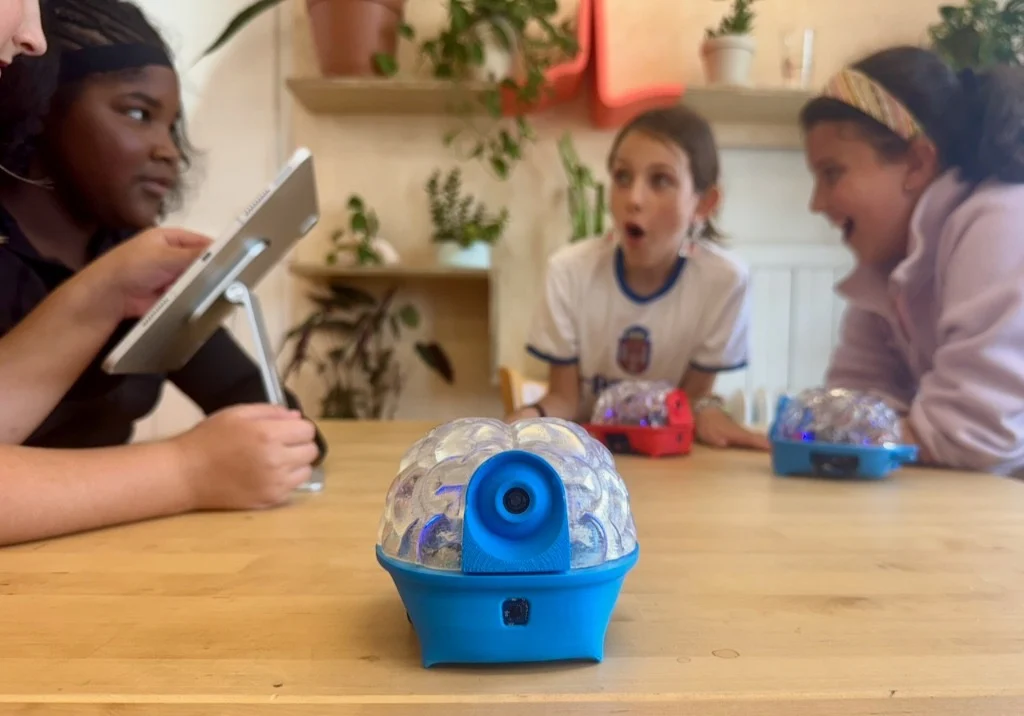
The hardware itself is a testament to thoughtful design. The SpikerBot chassis is distinctively brain-shaped, echoing Backyard Brains’ logo, and is engineered to recognize and react to its environment in the real world. It is equipped with a suite of sensors, including a camera for visual input, a microphone for auditory perception, and a distance sensor for spatial awareness. Beyond sensing, it also features lights and sounds, both meticulously crafted to react more naturally than typical machine interfaces. The lights pop on and fade out with a bioluminescent quality, while the sound effects are described as charming and quirky, contributing to the robot’s endearing personality and reinforcing its "lifelike" quality.
Customization is also a key feature. Connection points on the chassis enable users to attach 3D-printed components, allowing owners to personalize their bot and give it a unique personality. This encourages creativity, design thinking, and practical engineering skills, transforming the robot from a mere learning tool into a canvas for personal expression. The robust design also reflects a commitment to longevity. Unlike many modern electronic devices, SpikerBot runs on easily swappable AA batteries, consciously avoiding the planned obsolescence associated with non-replaceable lithium cells. Backyard Brains even offers its own custom, high-performance NiMh AA batteries, promoting sustainable and long-term use. The app itself is free and does not require cloud-based authentication, ensuring accessibility and independence from ongoing subscriptions or internet connectivity.
Broader Impact and Future Horizons

The implications of SpikerBot extend far beyond the classroom or hobbyist’s workbench. By democratizing access to neuroscience and artificial intelligence principles, it cultivates a generation that is not only proficient in STEM but also possesses a deeper, more empathetic understanding of biological intelligence. In an era where AI is increasingly integrated into daily life, understanding the fundamental differences and similarities between artificial neural networks and biological brains is paramount. SpikerBot provides a tangible, interactive platform for this critical exploration.
The project is currently garnering significant attention through its Kickstarter campaign, which is scheduled to conclude on June 14. While the robot is slated to retail at $299, early pledges offered a more accessible entry point at $219. Backyard Brains has a well-established track record of successfully delivering innovative educational tools, inspiring confidence in the project’s realization. Previous successful endeavors, such as the SpikerBox, which allows users to record electrical activity from neurons, underscore the team’s expertise and commitment to making complex biological concepts tangible.
The creators envision SpikerBot as an evolving platform. While a robust library of existing behaviors and sample brain models is provided, a significant part of the development trajectory involves learning how the general public will interact with and innovate upon the system. As Alex Hatch aptly puts it, "a lot we haven’t seen because you guys haven’t built anything yet." This open-ended invitation to the community suggests a future where users contribute to the platform’s expansion, discovering new emergent behaviors and applications, further cementing SpikerBot’s role as a catalyst for creative scientific exploration. This collaborative future promises a dynamic evolution of the platform, driven by the collective ingenuity of its users, truly embodying the spirit of discovery that SpikerBot seeks to instill. The journey of understanding the brain, both biological and artificial, has just received a powerful new vehicle.