Octopuses, cuttlefish, and other cephalopods have long captivated scientists with their extraordinary ability to disappear into their surroundings, seamlessly altering both the color and texture of their skin with astonishing speed and precision. This remarkable biological feat, a masterclass in natural camouflage, has been a holy grail for material scientists striving to replicate such dynamic adaptability in man-made systems. Now, researchers at Stanford University have reported a significant breakthrough, detailing in a study published in Nature a flexible material capable of rapidly shifting its surface patterns and colors, forming intricate features smaller than a human hair. This innovation represents a monumental leap in biomimetic engineering, promising a new generation of smart materials with applications ranging from advanced camouflage and flexible displays to cutting-edge nanophotonics and robotics.
Nature’s Master Disguisers: The Cephalopod Blueprint
The fascination with cephalopod camouflage stems from its unparalleled sophistication. Unlike many animals that rely on static patterns or slow physiological changes, octopuses, cuttlefish, and squids can instantly transform their appearance to match their environment, whether it’s a rocky seafloor, a coral reef, or open water. This capability is rooted in specialized skin organs: chromatophores, iridophores, and leucophores. Chromatophores are sacs of pigment that can be rapidly expanded or contracted by muscle fibers, controlling color intensity. Iridophores reflect light to produce iridescent blues, greens, and golds, while leucophores scatter all wavelengths of light, creating white and contributing to background matching. Crucially, these animals can also manipulate dermal papillae, small muscular bumps on their skin, to change their texture from smooth to spiky, further enhancing their disguise. This multi-modal control—over color, pattern, and texture—is regulated by their highly developed nervous systems, allowing for near-instantaneous, context-aware adaptation.
For decades, engineers and scientists have sought to emulate this biological marvel. Early attempts at artificial camouflage focused on static patterns or slow-changing thermochromic or electrochromic materials, which, while useful, lacked the speed, flexibility, and multi-dimensional control seen in nature. The challenge has always been to integrate rapid color change with dynamic texture manipulation in a soft, flexible, and scalable material. Previous smart materials often suffered from rigidity, slow response times, or the inability to simultaneously alter both visual and tactile properties at the microscopic scale. This Stanford research directly addresses these limitations, pushing the boundaries of what is possible in soft material engineering.
A Serendipitous Discovery Paves the Way for Innovation
The core of Stanford’s innovation lies in a novel approach that combines established microfabrication techniques with a responsive polymer. Siddharth Doshi, a doctoral student in materials science and engineering at Stanford and the lead author of the Nature paper, highlighted the significance of texture. "Textures are crucial to the way we experience objects, both in how they look and how they feel," Doshi explained. "These animals can physically change their bodies at close to the micron scale, and now we can dynamically control the topography of a material—and the visual properties linked to it—at this same scale." This micron-scale control, where a micron is one-millionth of a meter, is critical, as it is roughly the scale at which many biological interactions and optical phenomena occur, and it is also the scale at which a human hair’s thickness is measured (typically 50-100 microns).
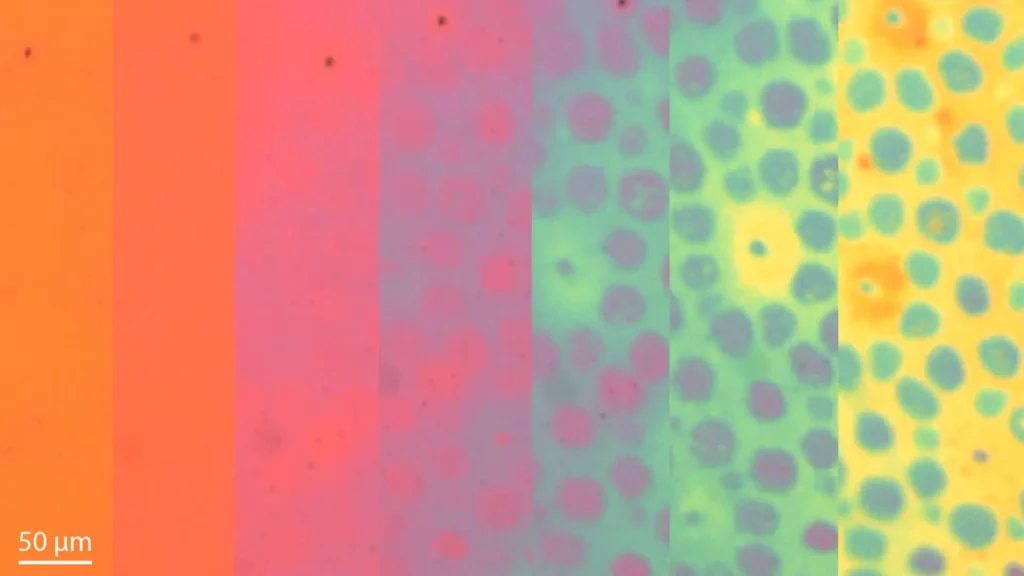
The genesis of this breakthrough was, as often happens in science, partly serendipitous. The research team developed their dynamic patterning capability by combining electron-beam lithography, a high-precision technique commonly used in semiconductor manufacturing for creating nanoscale patterns, with a water-responsive polymer film. When specific regions of the polymer film are exposed to a focused beam of electrons, their properties are altered, making them more or less absorbent to water. As the material then absorbs water, these regions swell differentially, creating intricate, three-dimensional patterns that only become visible when the film is hydrated.
Doshi recounted the pivotal moment: "In an earlier experiment, I used a scanning electron microscope to examine nanostructures on a polymer film. Instead of discarding the samples afterward, I reused them. During later tests, the areas previously exposed to the electron beam behaved differently and displayed distinct colors." This unexpected observation provided the crucial insight. "We realized that we could use these electron beams to control topography at very fine scales," Doshi added. "It was definitely serendipitous." This accidental discovery underscores the importance of curiosity and keen observation in scientific exploration, transforming what might have been considered experimental waste into a foundational principle for a new technology. Nicholas Melosh, a professor of materials science and engineering and a senior author on the paper, emphasized the uniqueness of the new material: "There’s just no other system that can be this soft and swellable, and that you can pattern at the nanoscale. You can imagine all kinds of different applications."
Unpacking the Technology: Precision at the Nanoscale
The technical elegance of this new material lies in its ability to achieve precise, multi-dimensional control over its surface. Electron-beam lithography, by its nature, allows for patterning at resolutions far beyond conventional optical lithography, making it ideal for creating features at the nanoscale (one-billionth of a meter). This precision is what enables the Stanford team to create structures with remarkable detail and complexity. For instance, the researchers demonstrated this capability by fabricating a tiny, three-dimensional rendition of Yosemite’s iconic El Capitan. When dry, the material’s surface remains perfectly flat and featureless. However, upon the addition of water, the patterned regions swell, causing the miniature El Capitan to rise from the film, transforming a two-dimensional surface into a dynamic three-dimensional landscape.
Beyond merely creating shapes, the team can also manipulate how the material interacts with light. By carefully adjusting the degree of swelling, they can control the material’s surface roughness and geometry, thereby influencing its reflective properties. This allows for a dynamic switch between glossy and matte finishes, an effect that surpasses the capabilities of current static display technologies. Such a feature could revolutionize displays, offering tactile feedback and visual depth currently unimaginable in flat screens. The process is fully reversible: adding an alcohol-like solvent removes the absorbed water, causing the material to return to its original flat, unpatterned state.
The innovation extends to dynamic color generation as well. The researchers achieved complex color patterns by integrating thin metal layers on both sides of the polymer film, creating structures known as Fabry-Pérot resonators. These optical devices selectively transmit or reflect specific wavelengths of light based on the distance between their reflective surfaces. As the polymer film expands or contracts with the addition or removal of water, this critical distance changes, causing the resonators to display different colors. This mechanism allows a plain, featureless surface to transform into a vibrant array of patterns and hues simply by modulating its hydration level. Mark Brongersma, a professor of materials science and engineering and another senior author on the paper, lauded this aspect: "By dynamically controlling the thickness and topography of a polymer film, you can realize a very large variety of beautiful colors and textures. The introduction of soft materials that can expand, contract, and alter their shape opens up an entirely new toolbox in the world of optics to manipulate how things look."
Future Horizons: From Military Camouflage to Soft Robotics and Beyond
The immediate and most captivating application of this technology lies in advanced camouflage systems. When multiple layers of these dynamic films are combined, researchers can independently adjust both color and texture, allowing the material to blend into its surroundings with an unprecedented level of fidelity, mirroring the adaptive prowess of an octopus. While the current process requires manual tuning of water and solvent levels to match a specific background, the team’s vision extends to full automation. They plan to integrate computer vision and artificial intelligence (AI) systems that can analyze ambient surroundings in real-time and automatically adjust the material’s properties to achieve seamless integration. "We want to be able to control this with neural networks—basically an AI-based system—that could compare the skin and its background, then automatically modulate it to match in real time, without human intervention," Doshi stated. Such a system would represent a paradigm shift for military stealth and reconnaissance, offering dynamic concealment for personnel, vehicles, and robots that can adapt to changing environments instantly.
The implications for robotics are equally profound. Fine control over surface texture could enable small robots to dynamically regulate friction. This means a robot could develop a highly adhesive, grippy surface to climb vertical walls or navigate rough terrain, and then instantly switch to a smooth, low-friction surface to slide effortlessly across a flat plane. This adaptability is crucial for soft robotics, which aims to create robots that can interact safely and flexibly with their environment, mimicking biological organisms.
Beyond camouflage and robotics, the technology opens doors to entirely new fields. In nanophotonics, the ability to dynamically control light at very small scales has vast potential for next-generation electronics, high-speed data encryption, and advanced biological sensing and imaging. For instance, sensors built with this material could change color or texture in response to specific chemical or biological agents, providing immediate visual cues. In bioengineering, changes in surface structure at the nanoscale can influence how cells behave, offering new avenues for research into tissue regeneration, drug delivery, and diagnostic tools. By creating dynamic topographies, researchers could guide cell growth or differentiation in specific ways, leading to novel biomedical applications. The team is even exploring creative uses for the material in collaboration with artists, highlighting its potential for dynamic architectural surfaces, interactive art installations, or even fashion. "Small changes in the properties of soft materials over micron distances are finally possible, which will open up all sorts of possibilities," Melosh concluded, signaling a future ripe with innovation.
Industry Reactions and Broader Implications
The announcement of this breakthrough has generated considerable interest across multiple industries, with experts quickly recognizing its transformative potential. In the defense sector, analysts suggest that dynamic camouflage represents the next frontier in stealth technology. Dr. Anya Sharma, a defense technology expert, noted, "The ability to achieve real-time, multi-spectral camouflage, adapting to both visual and infrared signatures, could fundamentally alter battlefield dynamics, enhancing troop survivability and making assets virtually undetectable." The U.S. Department of Defense, through its various research arms like the Air Force Office of Sponsored Research (a funding body for this Stanford project), has long invested in advanced materials for stealth and protection, underscoring the strategic importance of such developments.
The smart textiles and wearable technology market, projected to reach over $7 billion by 2028, is another area poised for disruption. Imagine clothing that can change color and pattern on demand, adapting to mood, occasion, or environment. Fashion designers and tech innovators foresee a future where clothing is not just static fabric but an interactive, dynamic display. Ms. Lena Petrova, a creative director at a leading wearable tech firm, commented, "This Stanford material could be the missing link for truly adaptive fashion. Beyond aesthetics, think about medical textiles that change properties to aid healing or smart athletic wear that visually indicates performance metrics."
In robotics, particularly the emerging field of soft robotics, the material’s ability to control friction is a game-changer. Dr. Kenji Tanaka, a professor of robotics engineering, stated, "Giving robots the ability to actively grip or slide on surfaces, adapting to unforeseen conditions, vastly expands their operational capabilities in complex, unstructured environments. This is crucial for exploration, search and rescue, and delicate manipulation tasks." The global robotics market, already valued in hundreds of billions, will benefit from materials that enhance dexterity and environmental interaction.
The interdisciplinary nature of this research—bridging materials science, optics, computer science (for AI), and biology—highlights a growing trend in scientific discovery. The integration of fields is accelerating innovation, leading to solutions that were previously unattainable within single disciplines. The economic implications are substantial, potentially fostering new industries and creating significant market value in areas like advanced manufacturing, specialized defense applications, and personalized consumer electronics. While the immediate focus is on research and development, the long-term commercialization prospects are immense, with intellectual property potentially leading to licensing agreements and startup ventures.
The Road Ahead: Automation and Commercialization
The Stanford team acknowledges that transitioning from a laboratory breakthrough to widespread application requires further development. A primary goal is the full automation of the material’s adaptive capabilities. Integrating AI and computer vision will be crucial for enabling the material to "sense" its environment and autonomously adjust its properties in real-time. This involves training neural networks on vast datasets of environmental conditions and corresponding optimal material responses. This step will move the technology beyond a manually controlled system to one that truly mimics the biological intelligence of cephalopods.
Further research will also focus on scaling up production, improving durability, and optimizing the energy efficiency of the system. While the current prototype demonstrates the core principle, real-world applications will demand materials that can withstand various environmental stresses, operate reliably over extended periods, and consume minimal power. The collaboration with artists and other unconventional partners also signals a commitment to exploring the full spectrum of the material’s potential, pushing boundaries beyond purely scientific or industrial applications. The journey from this groundbreaking publication to ubiquitous application will be challenging but promises to redefine the landscape of smart materials and how humans interact with their environment.
This groundbreaking work was supported by a diverse array of institutions, reflecting the collaborative nature of advanced scientific research. Key funding came from a Stanford Graduate Fellowship, a Meta PhD Fellowship, the Wu Tsai Human Performance Alliance at Stanford University and the Joe and Clara Tsai Foundation, the German National Academy of Sciences Leopoldina, the Department of Energy, the Air Force Office of Sponsored Research, and the National Science Foundation. The extensive research team included additional Stanford co-authors: Alberto Salleo (Hong She and Vivian W. M. Lim Professor and professor of photon science), Associate Professor Polly Fordyce, postdoctoral researchers Nicholas A. Güsken and Gerwin Dijk, Stanford Microfluidics Foundry director Jennifer E. Ortiz-Cárdenas, and graduate students Johan Carlström, Peter Suzuki, and Bohan Li. Professor Brongersma holds courtesy appointments in applied physics and is affiliated with Stanford Bio-X, the Wu Tsai Human Performance Alliance, the Wu Tsai Neurosciences Institute, and the Precourt Institute for Energy. Professor Melosh is also a member of Stanford Bio-X and the Wu Tsai Neurosciences Institute, an affiliate of the Precourt Institute for Energy, and a faculty fellow of Sarafan ChEM-H. Their collective expertise and interdisciplinary collaboration were instrumental in bringing this revolutionary material to fruition.