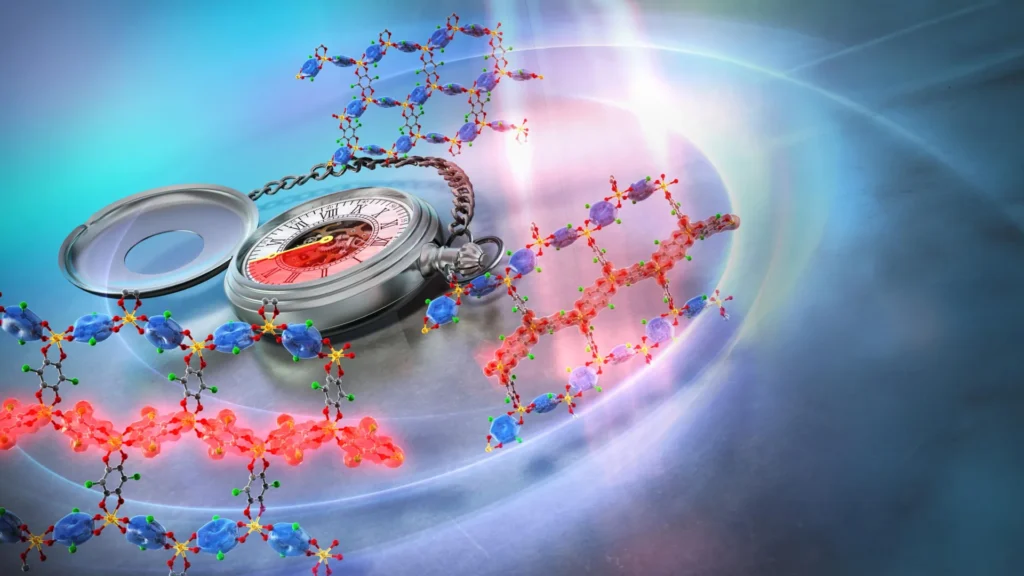
In a landmark achievement for the field of condensed matter physics and materials science, a collaborative research team in Japan has successfully observed an electronic transformation occurring at the staggering speed of 30 femtoseconds. By utilizing cutting-edge ultrafast laser spectroscopy and sophisticated theoretical modeling, the researchers from the Institute of Science Tokyo (Science Tokyo), Tohoku University, and the Nagoya Institute of Technology have documented a "hidden" electronic state within a metal-organic framework (MOF). This discovery identifies a previously invisible intermediate phase that serves as the bridge between the initial absorption of light and the final transformation of the material’s properties. The findings, recently published in the prestigious journal Physical Review Letters, represent a significant leap forward in our understanding of how light-matter interactions can be harnessed to create the next generation of high-speed optical and electronic devices.
The Frontier of Photoinduced Phase Transitions
The study of how materials react to light is not merely academic; it is the foundation of modern technology, from fiber-optic communications to solar energy harvesting. Typically, materials change their state—such as melting or shifting from a conductor to an insulator—through thermal processes like heating or cooling. However, light offers a different pathway. When a material absorbs a photon, it can be propelled into a "photoinduced state." These states often possess physical, electrical, or magnetic properties that are fundamentally different from those the material exhibits under equilibrium conditions.
The primary hurdle in mastering these states is their ephemeral nature. The initial triggers of a photoinduced transformation occur on the femtosecond (fs) timescale—where one femtosecond is a millionth of a billionth of a second. To put this in perspective, a femtosecond is to a second what a second is to approximately 31.7 million years. Observing these changes requires not only the world’s fastest "cameras" in the form of ultrashort laser pulses but also a deep theoretical framework to interpret the data captured during these fleeting moments.
Exploring the Versatility of Metal-Organic Frameworks
The research team focused their efforts on metal-organic frameworks, a class of materials that has gained immense popularity over the last two decades. MOFs are crystalline compounds consisting of metal ions or clusters coordinated to organic molecules (ligands) to form one-, two-, or three-dimensional structures. They are often compared to molecular "tinkertoys" because scientists can precisely swap out different metals or organic connectors to tailor the material’s porosity, surface area, and electronic behavior.
While MOFs are widely known for their applications in gas storage and carbon capture, their electronic properties are equally fascinating. Because they combine the rigid structure of inorganic crystals with the flexible electronic configurations of organic molecules, they serve as an ideal playground for studying ultrafast electronic dynamics. The team, led by Assistant Professor Tadahiko Ishikawa from the Department of Chemistry at Science Tokyo, alongside former doctoral student Samiran Banu (now at RIKEN), sought to understand how these complex lattices respond when hit by a sudden burst of intense light.
A Chronology of the 30-Femtosecond Transformation
To capture the transformation, the researchers employed time-resolved reflectance spectroscopy. This technique functions like a high-speed strobe light, using a "pump" pulse to initiate the change in the material and a "probe" pulse to measure the resulting shift in how the material reflects light. The laser pulses used in this experiment were a mere six femtoseconds in duration, providing the temporal resolution necessary to see the "invisible."
The sequence of events as uncovered by the researchers follows a precise and rapid chronology:
- Pulse Absorption (0-6 fs): The MOF material absorbs the energy from the ultrashort laser pulse. This injects energy into the electronic system, exciting electrons across the bandgap of the material.
- Emergence of the Intermediate State (approx. 10-20 fs): Almost immediately, the material enters a fleeting intermediate electronic state. The research team identified this as a "bond-order wave state." In this phase, the electronic bonds between neighboring sites in the lattice begin to alternate between stronger and weaker configurations in a rhythmic, repeating pattern.
- Structural Relaxation and Atomic Shift (20-30 fs): The change in electronic distribution creates a force on the atoms themselves. Small movements in the positions of the metal ions and organic ligands occur, stabilizing the new electronic configuration.
- Formation of the Hidden State (30 fs): By the 30-femtosecond mark, the material has fully transitioned into a stable "photoinduced hidden state." This state is characterized by a dramatic shift in the reflectance spectrum and the emergence of a new optical absorption band that did not exist before the light hit the sample.
Identifying the "Missing Link": The Bond-Order Wave
The most significant contribution of this study is the identification of the intermediate bond-order wave state. Previously, scientists could observe the "before" and "after" of a light-induced change but lacked the resolution to see the steps in between. By combining experimental data with theoretical calculations, Ishikawa and his colleagues were able to reconstruct the electronic landscape of the MOF during those middle ten femtoseconds.
"We found that the photoinduced hidden state forms within 30 fs through a previously unknown intermediate electronic state," Assistant Professor Ishikawa noted. This intermediate state acts as the catalyst for the entire transformation. Without the formation of the bond-order wave, the material would likely dissipate the energy as heat rather than shifting into a new functional state.
The theoretical component of the research was vital. Because reflectance spectra at such high speeds are incredibly complex, the team used quantum mechanical models to simulate how electrons move within the MOF lattice. These simulations confirmed that the bond-order wave is the "missing link" that allows the material to transition from a standard ground state to a hidden, light-induced state.
Implications for Polarity and Future Electronics
One of the most intriguing findings of the theoretical analysis is that the final photoinduced hidden state may be polar. In physics, a polar state is one where positive and negative electrical charges are distributed unevenly across the material. This creates a dipole moment, which is the fundamental requirement for ferroelectricity—a property used extensively in digital memory and sensors.
If researchers can use light to "switch" a material into a polar state in just 30 femtoseconds, it opens the door to optical switching speeds that are orders of magnitude faster than current silicon-based electronics. Current computer processors operate on the gigahertz scale (billions of cycles per second); a 30-femtosecond switch would operate on the terahertz or even petahertz scale (trillions to quadrillions of cycles per second).
"By revealing intermediate states, our method could help design materials that can be efficiently controlled using light," Ishikawa explained. This suggests a shift in materials science from observing phenomena to "engineering" phenomena. If scientists know exactly which intermediate states lead to a desired property, they can synthesize new MOFs specifically designed to favor those pathways.
Scientific and Industrial Impact
The collaboration between Science Tokyo, Tohoku University, and the Nagoya Institute of Technology highlights the importance of multi-disciplinary approaches in modern science. By blending chemistry, physics, and advanced computational modeling, the team has provided a blueprint for future studies in ultrafast dynamics.
The broader implications of this research extend into several key areas of technology:
- Optoelectronics: The ability to manipulate material properties with light pulses could lead to new types of photodetectors, modulators, and light-emitting devices that respond faster than any currently in existence.
- Quantum Computing: Understanding and controlling hidden states is a prerequisite for developing materials that can maintain quantum coherence or serve as ultrafast quantum gates.
- Information Storage: Creating stable, light-induced polar states could lead to a new generation of non-volatile optical memory, where data is written and read at the speed of light.
- Energy Efficiency: Because these transitions occur via direct electronic excitation rather than thermal heating, they are potentially much more energy-efficient than traditional electronic switching, which generates significant waste heat.
Moving Toward a Light-Driven Future
The research conducted by the Japanese team is a definitive step toward a future where light is the primary tool for controlling the behavior of matter. While the 30-femtosecond transformation was observed in a specific metal-organic framework, the methodology—combining 6-fs laser pulses with rigorous theoretical modeling—can be applied to a vast array of other materials, including superconductors, polymers, and 2D materials like graphene.
As the scientific community continues to peel back the layers of what happens in the "dark" intervals of molecular transformations, the potential for innovation grows. The discovery of the bond-order wave state in MOFs proves that there is still much to learn about the hidden lives of electrons. By exposing these previously invisible steps, researchers are no longer just spectators of the subatomic world; they are becoming its architects, designing a world where the speed of light is the only limit to technological progress.