For more than a century, the field of theoretical physics has been anchored by two pillars that, while individually successful, remain fundamentally incompatible. Albert Einstein’s general relativity provides a masterclass in the macroscopic, describing gravity not as a force but as the geometric curvature of space and time. Conversely, quantum mechanics serves as the definitive manual for the subatomic world, governing the probabilistic behavior of particles and fields. While both theories have passed every experimental test devised by humanity, they clash violently when applied to the universe’s most extreme environments, such as the singularities of black holes or the initial moments of the Big Bang.
To bridge this century-old divide, a team of researchers has proposed a radical shift in perspective known as the Quantum Memory Matrix (QMM). This framework suggests that the most fundamental constituent of reality is neither matter nor energy, nor even the fabric of spacetime itself. Instead, the universe is built upon information. Under the QMM model, spacetime is reimagined as a discrete, informational structure—a "memory bank" that records every interaction that occurs within the cosmos. This shift from a continuous geometric manifold to a quantized, data-driven architecture offers potential solutions to some of the most persistent mysteries in modern science, including the nature of dark matter, the acceleration of cosmic expansion, and the ultimate fate of the universe.
The Architecture of Discrete Spacetime
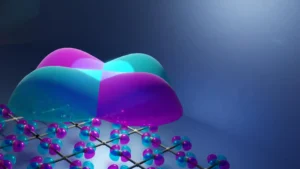
The core premise of the Quantum Memory Matrix is that spacetime is not a smooth, infinitely divisible background. Instead, it is composed of discrete, microscopic "cells." This concept aligns with the broader goals of quantum gravity, which seeks to find a "pixelated" version of reality at the Planck scale—the smallest possible unit of measurement. In the QMM framework, each of these cells acts as a local storage unit for quantum information.
When a particle moves through a cell or a force like electromagnetism exerts an influence, it leaves behind a "quantum imprint." This process is governed by what researchers call the "imprint operator," a mathematical rule that ensures the interaction is recorded within the local quantum state of the spacetime cell. This suggests that the universe does not simply exist in a series of fleeting moments; it possesses a fundamental memory. Every event in cosmic history, from the vibration of a string to the collision of galaxies, is written into the very fabric of the vacuum.
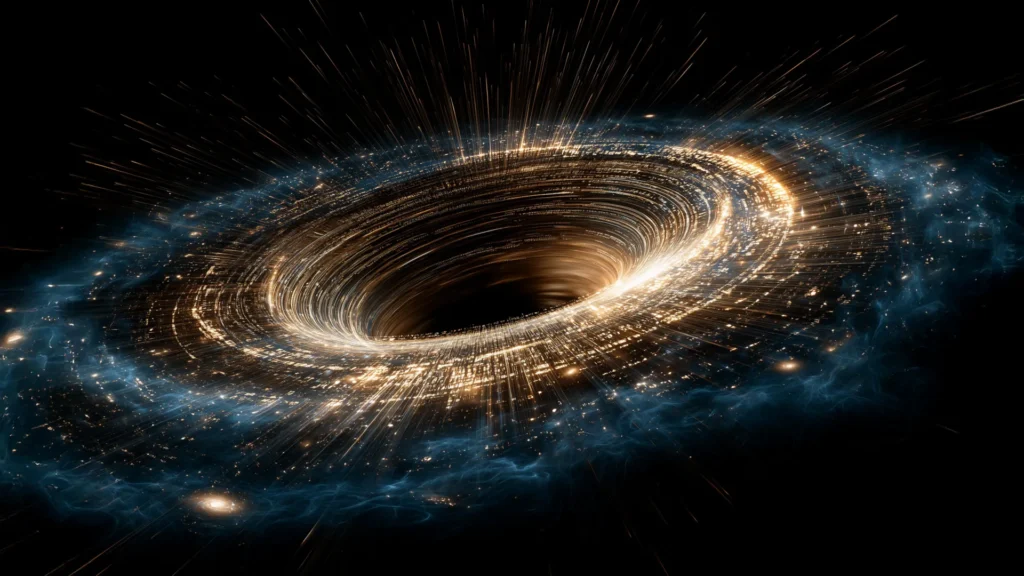
This informational approach addresses the "Black Hole Information Paradox," a problem that has plagued physics since Stephen Hawking’s work in the 1970s. According to general relativity, anything entering a black hole is lost to the external universe. However, quantum mechanics dictates that information can never be destroyed. The QMM offers a resolution: as matter approaches and enters a black hole, the surrounding spacetime cells record its quantum signature. Even if the black hole eventually evaporates through Hawking radiation, the information is not lost; it remains encoded in the "memory" of the discrete spacetime cells that once occupied that region.
The Chronology of the QMM Development
The development of the Quantum Memory Matrix has followed a systematic path, moving from gravitational theory to the integration of the other fundamental forces of nature. The research began with the application of informational imprinting to gravity, seeking to reconcile Einstein’s equations with quantum discrete states.
Once the gravitational model showed promise, the research team expanded their scope to the nuclear forces. In studies published in journals such as Entropy, the team demonstrated that the strong and weak nuclear forces—responsible for holding atomic nuclei together and governing radioactive decay—also leave distinct traces in the local spacetime matrix. By 2024, the framework was extended to include electromagnetism. Recent peer-reviewed manuscripts indicate that even a simple electric field alters the memory state of the cells it passes through, suggesting a universal mechanism for all physical interactions.
This progression led to the formulation of the "Geometry-Information Duality." This principle posits that the physical shape and curvature of the universe are not solely determined by the distribution of mass and energy, as Einstein proposed, but are also deeply influenced by the distribution of quantum information and entanglement. Entanglement, the phenomenon where particles become interconnected regardless of distance, is viewed in this model as a primary driver of spacetime geometry.
Reinterpreting Dark Matter and Dark Energy
Perhaps the most significant implications of the QMM framework lie in its ability to explain the "dark" components of the universe without invoking new, undiscovered particles. Currently, standard cosmology suggests that roughly 95% of the universe is composed of dark matter and dark energy—substances that have never been directly detected.
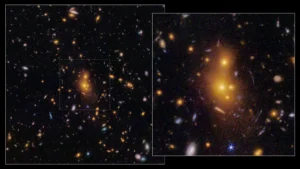
In the QMM model, what we perceive as "dark matter" may actually be clumps of quantum imprints stored within spacetime cells. These informational "residues" possess gravitational influence. Recent simulations conducted by the research team found that these clusters of imprints behave exactly like dark matter in galactic models. They provide the additional gravitational pull necessary to explain why galaxies rotate at high speeds without flying apart, potentially eliminating the need for exotic particles like WIMPs (Weakly Interacting Massive Particles).
Similarly, the QMM provides a novel origin for dark energy. The researchers propose that spacetime cells have a finite capacity for information storage. When these cells become "saturated"—meaning they can no longer record new, independent information—they contribute to a residual energy of the vacuum. This leftover energy takes the mathematical form of the "cosmological constant," the force responsible for the accelerated expansion of the universe. According to this theory, dark energy is the physical manifestation of the universe reaching its informational limit.
The Cyclic Universe and the 62 Billion Year Timeline
The introduction of finite informational capacity leads to a startling conclusion regarding the history and future of the cosmos. If spacetime has a memory limit, what happens when that limit is reached?
The team’s latest findings, set for publication in the Journal of Cosmology and Astroparticle Physics, suggest a "cyclic" or "bouncing" universe. As the universe expands and contracts, entropy—a measure of disorder and information—accumulates. When the informational capacity of the spacetime cells is fully saturated, the universe cannot continue to contract into a singularity (a point of infinite density). Instead, the stored entropy triggers a "bounce," reversing the collapse and initiating a new phase of expansion.
Based on observational data and the QMM equations, the researchers estimate that our current universe is not 13.8 billion years old in a linear sense. Instead, they suggest the cosmos has already undergone three or four cycles of expansion and contraction. This places the true "informational age" of the universe at approximately 62 billion years. Furthermore, the model predicts that fewer than ten cycles remain before the informational capacity is permanently exhausted. At that point, the universe would enter a final, permanent phase of slowing expansion, marking the end of the cosmic "bounce" era.
Empirical Validation through Quantum Computing
While the QMM framework may seem like high-level theoretical speculation, it has already been subjected to laboratory testing using modern quantum computers. In these experiments, researchers utilized qubits—the fundamental units of quantum information—to simulate discrete spacetime cells.
By applying "imprint and retrieval" protocols derived from the QMM equations, the team attempted to store and then recover quantum states within these simulated cells. The results were highly successful, with the original quantum states being recovered with over 90% accuracy. This demonstrates that the mathematical rules governing the QMM are not just theoretical constructs but are applicable to real-world quantum systems.
Beyond cosmological theory, this discovery has practical applications for the future of technology. The researchers found that by combining QMM imprinting techniques with traditional quantum error-correction codes, they could significantly reduce logical errors in quantum computations. This suggests that the same principles that explain the birth and death of universes could be used to build more stable and powerful quantum computers, bridging the gap between fundamental physics and applied engineering.
Broader Implications and Scientific Analysis
The Quantum Memory Matrix represents a paradigm shift that moves physics away from a purely materialist view of the world. For decades, the "Information-Physicality" debate has questioned whether information is a property of matter or if matter is a manifestation of information. The QMM leans heavily toward the latter, suggesting that the "bit" is more fundamental than the "atom."
From a journalistic and analytical perspective, the QMM framework is compelling because it offers a "unifying" logic. Rather than creating separate, complex theories for dark matter, dark energy, and quantum gravity, it provides a single mechanism—informational imprinting in discrete spacetime—that addresses all three.
However, the scientific community remains cautious. While the quantum computing simulations provide a "proof of concept," detecting the discrete "cells" of spacetime in the physical vacuum remains beyond current experimental reach. Critics may argue that the "geometry-information duality" requires more rigorous testing against cosmic microwave background (CMB) data to ensure it aligns with the high-precision measurements of the early universe.
Nevertheless, the QMM offers a poetic and mathematically rigorous vision of the cosmos. It reframes the universe as a self-recording entity—a cosmic archive where no event is truly forgotten. If the theory holds, it means that the "void" of space is far from empty; it is a dense, vibrating ledger of everything that has ever been. As we continue to refine our quantum technologies and peer deeper into the history of the stars, we may find that the secrets of the universe are not hidden in the stars themselves, but in the memory of the space between them.