In 1985, a forward-thinking advertisement in Scientific American by the Innovative Design Fund offered up to $10,000 for innovative prototypes across clothing, home decor, and textiles. This call to inventors captured the attention of William Freeman, then an electrical engineer at Polaroid and a graduate of MIT. Freeman, now a distinguished professor at MIT, submitted a groundbreaking concept: a three-sided zipper designed not for simple closure, but for transforming an object’s physical state from soft to rigid. His vision was a mechanism that could seamlessly transition items like chairs, tents, and purses, making them significantly easier to pack and assemble.
Freeman’s initial design, a departure from the ubiquitous two-sided zipper, featured a triangular configuration. He ingeniously constructed his prototype by attaching belts to connect narrow wooden "teeth" along each of the three sides. A slider mechanism, when moved, would encase these three strips, fastening them into a stable triangular tube. While this ambitious proposal did not secure funding from the Innovative Design Fund, Freeman’s ingenuity led him to patent his invention, storing it with the hope of future utility. This foresight, spanning nearly four decades, has now culminated in a significant revival and advancement of his concept by researchers at the MIT Computer Science and Artificial Intelligence Laboratory (CSAIL).
The Genesis of Tunable Stiffness: A Technological Reawakening
The core challenge addressed by Freeman’s original design was the ability to imbue objects with "tunable stiffness" – the capacity to shift between flexibility and rigidity on demand. Previous approaches to achieving such transformations were often cumbersome, requiring manual assembly or lacking easy reversibility. Recognizing the potential of Freeman’s nearly 40-year-old patent, the CSAIL team embarked on a project to bring this concept into the modern era of fabrication and robotics.
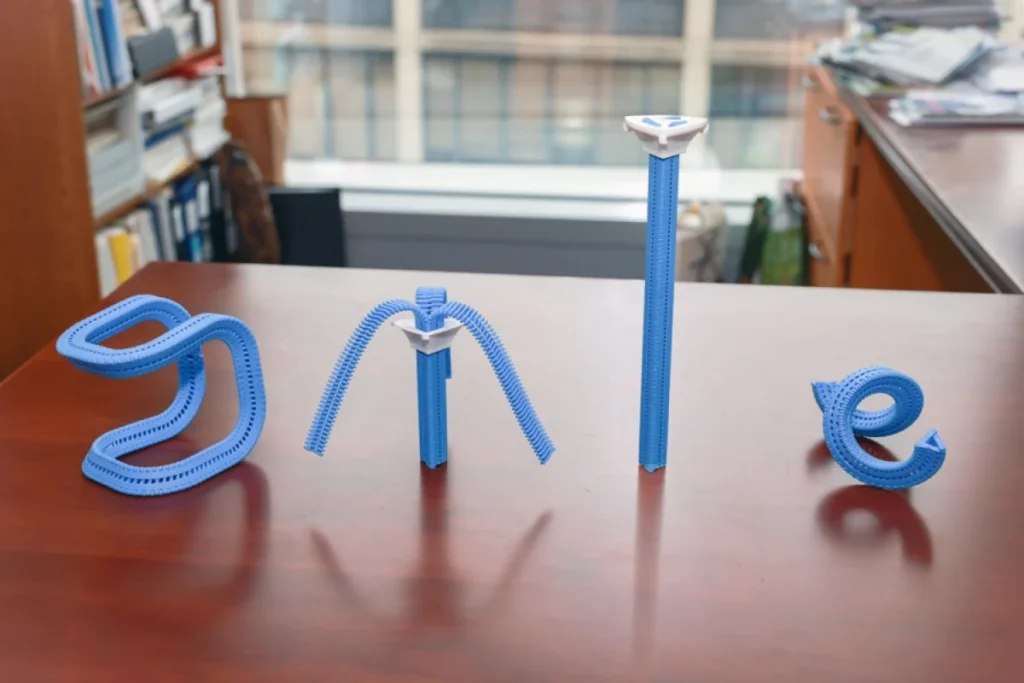
Their endeavor has resulted in the development of an automated design tool and an adaptable fastener, aptly named the "Y-zipper." This sophisticated system leverages advanced software and 3D printing technology to create customized three-sided zippers. Users can now design and generate these unique fasteners, which can then be integrated into a wide array of applications, from camping equipment and medical devices to robotic systems and intricate art installations. The primary advantage of the Y-zipper lies in its ability to facilitate more convenient and rapid assembly of complex structures, a significant leap from the limitations of traditional zippers.
Jiaji Li, an MIT postdoc and CSAIL researcher who is a lead author on the paper detailing this project, highlighted the fundamental difference between conventional zippers and Freeman’s innovation. "A regular zipper is great for closing up flat objects, like a jacket," Li explained, "but Freeman ideated something more dynamic. Using current fabrication technology, his mechanism can transform more complex items." He further elaborated on the team’s achievement: "We’ve developed a process that builds objects you can rapidly shift from flexible to rigid, and you can be confident they’ll work in the real world." This statement underscores the practical viability and engineering rigor behind the Y-zipper’s development.
Design and Functionality: A Versatile Morphing Mechanism
The flexibility and adaptability of the Y-zipper are central to its transformative potential. The CSAIL team’s software program empowers users to extensively customize the appearance and functionality of these fasteners. This includes precisely controlling the length of each of the three zipper strips and dictating the direction and angle at which they will bend when engaged. Furthermore, users can select from four distinct motion "primitives" that define the zipper’s configuration when fully fastened. These primitives offer a range of appearances: a straight, linear form; a bent, arch-like shape; a coiled, spring-like structure; and a twisted, screw-like configuration.
This sophisticated control over form allows the Y-zipper to exhibit what can be described as "shape-shifting" capabilities in real-world applications. When unzipped, the Y-zipper can unfurl into a more expansive form, reminiscent of a squid with multiple extending tentacles. Conversely, when zipped up, it consolidates into a compact, rigid structure, such as a rod. This dynamic transformation offers tangible benefits, particularly in scenarios requiring efficient deployment and storage.
A compelling example is the task of pitching a tent. Traditionally, setting up a tent can be a time-consuming process. While manual setup might take upwards of six minutes, the integration of Y-zippers could potentially reduce this to a mere one minute and 20 seconds. The envisioned application involves attaching each of the zipper’s three arms to different sections of the tent fabric, with the zipper acting as a structural support from above. As the Y-zipper is engaged, it would exert tension, effectively "popping" the tent canopy into its erected form. This streamlined assembly process is particularly valuable in situations demanding rapid deployment, such as during outdoor recreational activities or emergency response scenarios.
Medical and Robotic Applications: Expanding the Horizon of Embodied Intelligence
Beyond recreational uses, the Y-zipper’s seamless transition between states holds significant promise for wearable technology, particularly in medical contexts. The researchers demonstrated this by wrapping a Y-zipper around a wrist cast. This application allows a patient to loosen the cast for comfort during the day and then zip it up at night to provide necessary support and prevent further injury. This ability to adapt the rigidity of a device in real-time enhances patient comfort and treatment efficacy, offering a more personalized approach to medical interventions.
The Y-zipper’s potential extends further into the realm of robotics and automated systems. By attaching a motor to a fabricated Y-zipper, the zipping process can be automated, enabling the creation of dynamic and responsive robotic structures. One such application is an adaptive robotic quadruped. This robot could potentially alter the size of its legs, extending them to a taller configuration when traversing uneven terrain or retracting them to a lower profile when navigating confined spaces. Such rapid, on-the-fly adjustments could prove invaluable for robots exploring challenging environments like canyons or forests, enhancing their mobility and operational range.
The Y-zipper also opens avenues for dynamic art installations. The CSAIL team successfully created a long, winding flower sculpture that appeared to "bloom" as a static motor actuated the Y-zipper, demonstrating the artistic and expressive potential of this morphing technology. This showcases how the Y-zipper can be employed to create kinetic art that evolves and transforms, engaging audiences in novel ways.
Durability and Material Science: Rigorous Testing for Real-World Performance
While the creative and functional potential of the Y-zipper was evident, a critical question remained: its durability. Could these novel fasteners withstand the rigors of daily use and demanding applications? To address this, the CSAIL researchers conducted a series of comprehensive stress tests.
The team began by evaluating the mechanical properties of two commonly used 3D printing plastics: polylactic acid (PLA) and thermoplastic polyurethane (TPU). Using a specialized machine designed to apply bending forces, they tested the strength and flexibility of both materials. Their findings indicated that PLA could support heavier loads, while TPU offered greater pliability, suggesting that material selection is a crucial factor in tailoring the Y-zipper for specific applications.
Further testing involved subjecting the Y-zippers to continuous cycles of opening and closing using an actuator. The goal was to determine their fatigue life and identify potential failure points. After an impressive 18,000 cycles, some Y-zippers eventually broke. Analysis of 3D simulations revealed that the inherent elastic structure of the Y-zipper plays a key role in its durability, effectively distributing stress across the material and preventing premature failure. This resilience is a critical factor for the widespread adoption of the technology in practical applications.
Future Directions and Broader Implications: Paving the Way for Advanced Fabrication
Looking ahead, Jiaji Li envisions further enhancements to the Y-zipper technology. He suggests the potential for utilizing stronger materials, such as metal, to create even more durable fasteners suitable for larger-scale projects. However, the current 3D printing platform has limitations in fabricating larger zippers.
The potential applications for the Y-zipper extend far beyond current demonstrations. Li pointed to the intriguing possibility of its use in space exploration. Imagine Y-zippers integrated into spacecraft, their tentacle-like forms capable of grasping and collecting nearby rock samples. Furthermore, the technology could revolutionize rapid assembly in disaster relief and emergency response. By embedding Y-zippers into structures, relief workers could quickly erect shelters and medical tents in the aftermath of natural disasters, significantly accelerating aid delivery and saving lives.
The innovative approach of reimagining an everyday object like a zipper to achieve complex 3D morphological transitions has garnered attention from the wider scientific community. Guanyun Wang, an assistant professor at Zhejiang University who was not involved in the research, commented on the significance of the work: “Reimagining an everyday zipper to tackle 3D morphological transitions is a brilliant approach to dynamic assembly.” Wang further emphasized its impact, stating, “More importantly, it effectively bridges the gap between soft and rigid states, offering a highly scalable and innovative fabrication approach that will greatly benefit the future design of embodied intelligence.” This sentiment highlights the Y-zipper’s potential to be a foundational technology for future advancements in robotics and intelligent systems.
The research paper detailing the Y-zipper project was authored by Jiaji Li and William Freeman, alongside Tianjin University PhD student Xiang Chang and several MIT CSAIL colleagues: PhD student Maxine Perroni-Scharf, undergraduate Dingning Cao, and recent visiting researchers Mingming Li (Zhejiang University), Jeremy Mrzyglocki (Technical University of Munich), and Takumi Yamamoto (Keio University). The work was also supervised by MIT Associate Professor Stefanie Mueller, a CSAIL principal investigator and senior author on the paper. Funding for this research was partially provided by a postdoctoral research fellowship from Zhejiang University and the MIT-GIST Program.
The groundbreaking findings regarding the Y-zipper were presented at the ACM’s prestigious Computer-Human Interaction (CHI) conference on Human Factors in Computing Systems in April, marking a significant milestone in the integration of advanced design principles with practical engineering solutions. This revitalization of a nearly 40-year-old patent underscores the enduring value of innovative ideas and the power of modern technology to bring them to fruition, promising a future where objects can dynamically adapt their form and function.