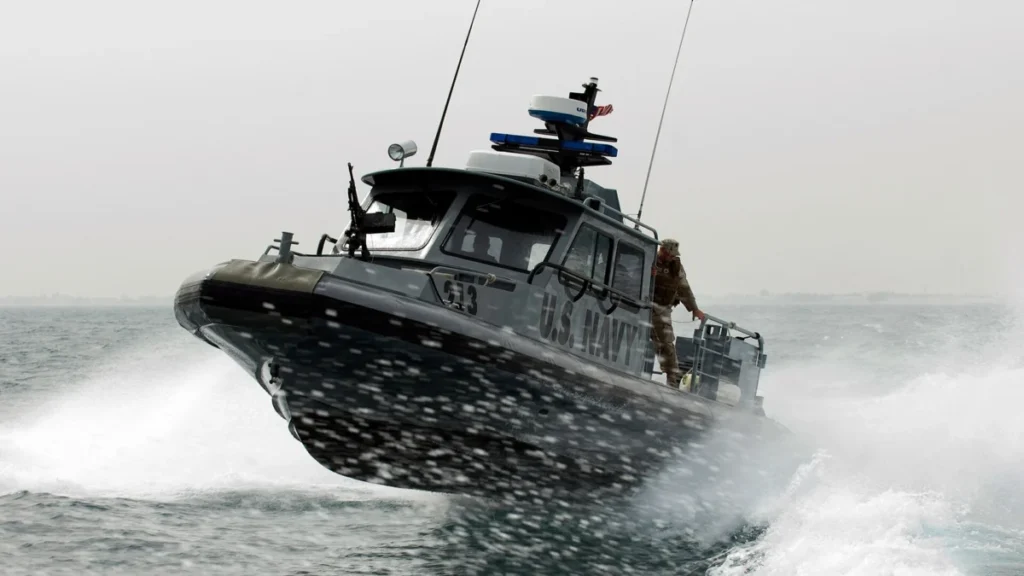
The United States Navy has taken a significant step towards solidifying its future warfighting capabilities with the establishment of a new Robotic and Autonomous Systems Warfighting Development Center (RASWDC). Launched on September 24, this pivotal center is designed to rapidly integrate robotic and autonomous systems (RAS) into naval operations, training protocols, and deployment strategies, aiming to maintain a decisive maritime advantage in an increasingly complex global security landscape. Headquartered at the Joint Expeditionary Base Little Creek-Fort Story in Virginia, RASWDC is poised to become the Navy’s dedicated operational integration point for these cutting-edge technologies across all maritime domains.
Rear Admiral Melvin Smith has been appointed as the inaugural commander of RASWDC, tasked with overseeing its phased implementation plan as it progresses towards full operational capability. The creation of RASWDC underscores the Navy’s strategic imperative to not only field unmanned systems but to master their operational employment, ensuring U.S. forces are equipped with the tactical edge required to dominate in high-end conflicts.
The Strategic Imperative: Maintaining Maritime Dominance
The establishment of RASWDC is a direct response to the evolving geopolitical environment and the accelerated pace of technological innovation. In an era marked by peer competition, particularly from nations like China and Russia that are investing heavily in advanced naval capabilities, maintaining a decisive maritime advantage is paramount for U.S. national security. Robotic and autonomous systems are increasingly viewed as force multipliers, capable of extending reach, enhancing persistence, reducing risk to human personnel, and providing new operational paradigms for naval warfare.
Chief of Naval Operations (CNO) Admiral Daryl Caudle articulated the urgency behind this initiative, stating, "To maintain our decisive maritime advantage, we must rapidly integrate robotic and autonomous systems into how we operate, train, and deploy." He emphasized that "The establishment of RASWDC will equip Sailors with the tactical edge, advanced training, and specialized doctrine required to win the high-end fight." This statement highlights a fundamental shift in naval strategy, moving beyond mere experimentation with autonomous platforms to their comprehensive integration as core components of the fleet.
For years, the U.S. Navy has been exploring the potential of these technologies across various warfare communities, commands, laboratories, and acquisition organizations. This extensive experimentation, as noted by CNO Caudle in an administrative note, "has produced important capability and invaluable experience." However, much of this progress has occurred independently within individual domains, leading to siloed development and integration efforts. The primary objective of RASWDC is to consolidate these disparate efforts, creating a unified framework for the operational integration of RAS across air, surface, and undersea platforms.
A History of Unmanned Systems in Naval Warfare
The journey toward integrating autonomous systems into naval operations is not a new one for the U.S. Navy. The concept of unmanned warfare has evolved significantly over the past few decades, driven by technological advancements and shifting strategic priorities. Early experimentation with remotely operated vehicles (ROVs) and drones laid the groundwork, primarily focusing on intelligence, surveillance, and reconnaissance (ISR) missions, as well as mine countermeasures.
Key milestones in this evolution include the development of the Navy’s Unmanned Campaign Plan, which outlined a vision for a hybrid fleet incorporating both manned and unmanned systems. Initiatives like Project Overmatch have sought to connect sensors, shooters, and decision-makers across the fleet, with autonomous systems playing a critical role in data collection, processing, and dissemination. Exercises such as the biannual International Maritime Exercise (IMX) and Digital Horizon have provided crucial real-world testing grounds for various unmanned aerial systems (UAS), uncrewed surface vessels (USVs), and unmanned underwater vehicles (UUVs), simulating their deployment in complex operational scenarios.
Despite these advancements, the challenge has always been the transition from successful prototypes and experimental deployments to widespread, integrated fleet operations. The RASWDC aims to bridge this gap, serving as the central hub for standardizing procedures, developing new tactics, and ensuring that these systems are not just technologically viable but operationally effective and resilient.
Core Missions of RASWDC: Concepts, Training, and Testing
RASWDC, an Echelon 3 warfighting development center operating under U.S. Fleet Forces Command, has been assigned three foundational missions designed to achieve its overarching goal of rapid and effective integration:
-
Developing Warfighting Concepts: This mission involves conceptualizing how robotic and autonomous systems will be employed in future conflicts. This includes exploring advanced concepts such as Distributed Maritime Operations (DMO), Mosaic Warfare, and manned-unmanned teaming (MUM-T). RASWDC will be responsible for defining the roles, capabilities, and limitations of various RAS platforms, developing innovative tactics, techniques, and procedures (TTPs) that leverage their unique attributes. This extends to understanding how autonomous systems can contribute to areas like anti-access/area denial (A2/AD) environments, logistics support, strike operations, and defensive measures. The center will work to integrate these systems seamlessly into the existing naval architecture, ensuring they enhance, rather than complicate, command and control.
-
Training Sailors for Autonomous Warfare: A critical aspect of integrating new technology is preparing the human element. RASWDC will develop and implement advanced tactical instruction frameworks for sailors who will operate, maintain, and deploy autonomous platforms. This goes beyond basic operational training; it encompasses specialized doctrine, advanced simulation environments, and practical exercises designed to foster proficiency in human-machine teaming. Sailors will be trained to understand the nuances of autonomous decision-making, manage multiple unmanned assets simultaneously, and operate these systems effectively in contested and degraded communication environments. The goal is to cultivate a new generation of warfighters who are not just competent users but innovative strategists in the realm of autonomous warfare.
-
Fielding and Testing New Technologies: RASWDC will serve as the Navy’s primary operational test bed for new robotic and autonomous systems. This involves rigorous evaluation of uncrewed platforms under realistic and challenging operational conditions, including environments with degraded or denied communications, electronic warfare (EW) threats, and cyber-attacks. The center will assess system performance, reliability, and resilience, providing crucial feedback to developers and acquisition programs. As CNO Caudle noted, "Systems that work will move forward." Conversely, systems that do not meet the rigorous operational standards will be improved, redirected, or discontinued, ensuring that only the most effective and survivable technologies make it to the Fleet. This mission is vital for ensuring that the Navy invests in capabilities that truly enhance warfighting effectiveness rather than becoming technological liabilities.
Connecting Development with the Fleet: The Acquisition-Operations Feedback Loop
A key innovation in the Navy’s approach to RAS integration is the close operational coupling between RASWDC and the recently announced Direct Reporting Portfolio Manager for Robotic and Autonomous Systems (DRPM RAS). While DRPM RAS provides overarching portfolio authority for RAS acquisition, requirements implementation, budgeting, and technical standards, RASWDC’s focus is squarely on employment. This division of labor, with a built-in feedback mechanism, is designed to overcome historical challenges in defense procurement, often referred to as the "valley of death" between technology development and operational deployment.
The Navy emphasizes that these two organizations will create a direct, iterative feedback loop between the acquisition enterprise and operational forces. Lessons learned and performance data gathered through RASWDC’s testing, experimentation, and training activities will be systematically returned to developers and program managers within DRPM RAS. This continuous flow of information will enable rapid iteration and improvement of future capabilities, ensuring that technological advancements are directly informed by operational realities and sailor feedback. CNO Caudle highlighted this synergy, stating, "RASWDC is the critical bridge between capability development and operational employment. By forging a direct feedback loop, we are accelerating the delivery of unmanned capabilities from the foundry directly to the Fleet, ensuring our forces are postured to meet any challenge."
This integrated approach aims to streamline the development cycle, reducing the time it takes for promising technologies to move from concept to widespread operational use. It also ensures that the Navy’s investments in RAS are aligned with its strategic warfighting requirements, preventing the development of systems that are technically capable but operationally irrelevant.
Preparing Sailors for "The Fight"
The ultimate goal of RASWDC is to prepare sailors for "The Fight" – the complex, high-stakes conflicts of the future. This preparation extends beyond technical proficiency to encompass a comprehensive understanding of how autonomous systems fundamentally alter the character of naval warfare. Rear Admiral Melvin Smith underscored this, stating, "Our purpose here is to consolidate the Navy’s autonomous efforts across air, surface, and undersea domains, and give them a single home here at Little Creek." He further elaborated that the center’s mandate includes "educating warfighters, equipping the Fleet with systems that can survive operational environments, and developing combined tactics for their use."
This holistic approach recognizes that the successful integration of RAS depends not just on the technology itself, but on the human capacity to wield it effectively. Sailors will need to adapt to new operational paradigms, where human-machine teaming becomes the norm, and distributed, autonomous operations require new forms of command, control, and communication. RASWDC will be instrumental in developing the institutional knowledge and human capital necessary to harness the full potential of these systems.
Importantly, RASWDC is designed to complement, rather than replace, existing Warfighting Development Centers, Type Commanders, Systems Commands, or operational commands. Instead, it will function as a dedicated integration point, coordinating closely with these organizations. Its role will be to incorporate emerging requirements, share lessons learned, and facilitate the smooth transition of robotic and autonomous systems into routine fleet operations. This collaborative model ensures that RAS integration is a fleet-wide endeavor, benefiting from the expertise and insights of various naval entities.
Broader Implications and Future Outlook
The establishment of RASWDC signals a profound commitment by the U.S. Navy to a future where robotic and autonomous systems are not merely adjuncts but integral components of its warfighting capabilities. The implications of this move are far-reaching:
- Enhanced Combat Effectiveness: RAS can perform dull, dirty, and dangerous missions, freeing up manned assets for higher-value tasks and reducing risk to human lives. They offer persistence, stealth, and reach that manned platforms often cannot match, contributing to a more distributed and resilient force posture.
- Cost-Effectiveness: While initial development costs can be high, autonomous systems, particularly smaller, attritable platforms, offer the potential for more cost-effective mass and capability compared to traditional manned platforms, which are increasingly expensive to procure and maintain.
- Technological Leadership: By consolidating and accelerating RAS integration, the U.S. Navy reinforces its position as a global leader in naval innovation, pushing the boundaries of artificial intelligence, machine learning, sensor technology, and human-machine interface development.
- Personnel Development: This initiative will necessitate new skill sets, training pathways, and potentially new ratings for sailors, shaping the future workforce of the Navy. It presents opportunities for personnel to engage with cutting-edge technology and contribute to strategic naval advancements.
- Deterrence: A highly capable and integrated autonomous fleet enhances the Navy’s deterrence posture, signaling to potential adversaries that the U.S. possesses superior and adaptable warfighting capabilities.
- Challenges Ahead: Despite the promise, significant challenges remain. These include ethical considerations surrounding autonomous decision-making in combat, cybersecurity vulnerabilities of networked systems, ensuring the reliability and resilience of platforms in highly contested environments, and navigating the complexities of integrating diverse systems into a cohesive architecture. Furthermore, sustained funding and public acceptance will be critical for the long-term success of this initiative.
Rear Admiral Smith’s declaration that "We are here to make sure our forces don’t just field unmanned systems, but dominate with them," encapsulates the ambitious vision for RASWDC. As the center moves through its phased implementation, its success will be measured by its ability to rapidly transform cutting-edge technology into undeniable operational advantage, ensuring the U.S. Navy remains the world’s preeminent maritime force. This strategic move is not just about adopting new tools; it’s about fundamentally reshaping the future of naval warfare.