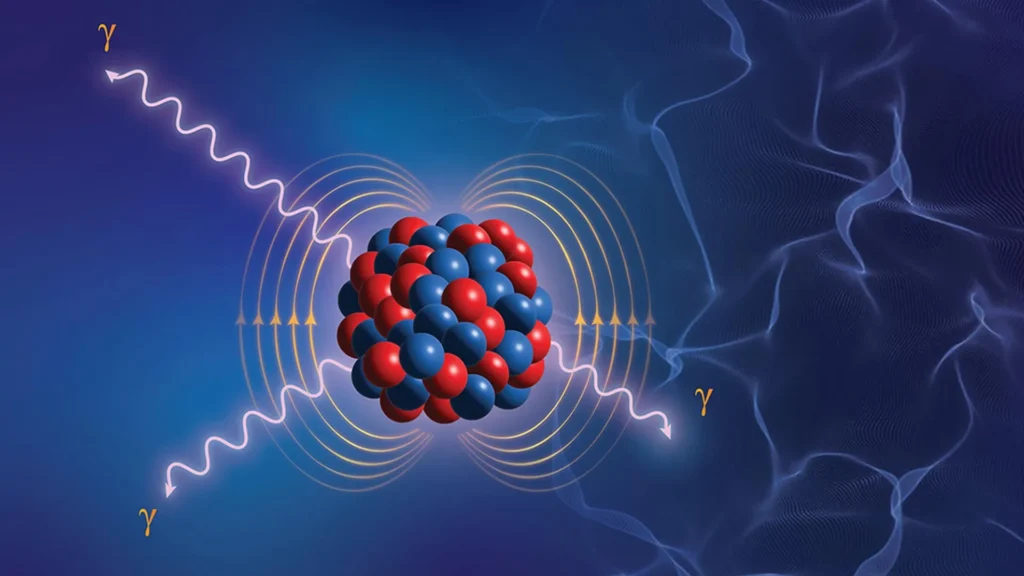
A decades-old puzzle in nuclear physics, concerning the anomalous release of low-energy gamma rays from certain atomic nuclei, may finally have found its resolution. A groundbreaking new study, spearheaded by researchers at the Facility for Rare Isotope Beams (FRIB) and involving key contributions from Lawrence Livermore National Laboratory (LLNL), has provided compelling evidence that magnetic transitions within the nucleus are the primary culprits behind this long-standing mystery. Published in the prestigious journal Nature, these findings promise to deepen our understanding of atomic nuclei and carry significant implications for fields ranging from astrophysics and nuclear energy to national security and nuclear forensics.
Gamma rays, a potent form of electromagnetic radiation akin to visible light and radio waves, are emitted when an atomic nucleus, in an excited state, sheds energy to achieve a more stable configuration, typically during radioactive decay. For many years, scientists observed that a subset of these nuclear decays resulted in an unusually high abundance of low-energy gamma rays – a phenomenon termed "low-energy enhancement." This effect proved stubbornly elusive, defying theoretical predictions and exhibiting an unpredictable presence across different atomic nuclei, leaving researchers without a reliable framework for its occurrence.
A Decades-Long Gamma Ray Conundrum
The observation of low-energy enhancement was not merely a minor discrepancy; it represented a significant theoretical challenge. "This low-energy enhancement wasn’t predicted by theory, so it was kind of a shock to the community when it was first observed," explained Eleanor Ronning, the lead author of the study and a former graduate student at FRIB. "It is difficult to predict where [low-energy enhancement] occurs – we don’t know which nuclei will exhibit it." This unpredictability hampered efforts to develop comprehensive nuclear models and understand fundamental nuclear processes. The lack of a theoretical basis meant that experimental observations were often treated as isolated curiosities rather than as windows into deeper nuclear physics.
The new research, however, offers a unified explanation, bridging the gap between experimental data and theoretical frameworks. "This is a key step forward," stated Andrea Richard, a co-lead of the study, who was a postdoctoral researcher at LLNL at the time of the research and is now an assistant professor at Ohio University. "We now have a consistent explanation that connects experimental observations with theory." This breakthrough marks a significant advancement in nuclear physics, offering a clear pathway for future investigations and refinements of existing nuclear models.
Disentangling Electric and Magnetic Nuclear Decay Pathways
To unravel this persistent mystery, the research team focused on a radioactive copper isotope undergoing decay into zinc. The advanced capabilities of FRIB, a national user facility funded by the U.S. Department of Energy’s Office of Science, proved instrumental. Its specialized instruments allowed the scientists to meticulously separate and individually analyze two distinct decay pathways.
These pathways represent different modes by which the nucleus can transition to a lower energy state. In one observed state, the decay process involved an "electric transition." During this transition, the fundamental particles within the nucleus, namely protons, reconfigured their positions, altering the nucleus’s charge distribution.
The second pathway, however, involved a "magnetic transition." This mode of decay is characterized by a reorientation of the intrinsic magnetic moments of the protons and neutrons within the nucleus – essentially, their internal compasses flipped. It was this magnetic transition that, crucially, was found to be the sole producer of the low-energy gamma ray enhancement. This definitive correlation firmly established the magnetic nature of the phenomenon.
The experimental design and execution were a testament to collaborative effort. Ronning and Richard jointly conceptualized the experiment. Richard’s contributions as a postdoctoral researcher at LLNL were substantial, and other scientists from LLNL provided crucial expertise, dedicating their efforts to continuously monitoring the experiment throughout its demanding, week-long, 24/7 operation. This sustained dedication was essential for capturing the precise data needed to isolate the subtle differences between the decay pathways.
Timeline of Discovery and Investigation
While the precise start date of the "decades-old puzzle" is difficult to pinpoint, the consistent observation of low-energy enhancement in gamma ray spectra from various nuclear reactions began to garner significant attention in the latter half of the 20th century. Early theoretical models, largely based on the shell model of the nucleus, struggled to account for the observed excess of low-energy photons.
By the early 2000s, experimental techniques had advanced to a point where more precise measurements of gamma ray emissions became feasible. Facilities capable of producing and studying rare isotopes, like those at FRIB and LLNL, became increasingly vital for these investigations. The decision to focus on the decay of a copper isotope into zinc was likely driven by a combination of factors: the availability of suitable radioactive beams, the well-understood decay properties of these specific elements, and the potential for these elements to exhibit the low-energy enhancement phenomenon.
The planning and execution of the experiment described in the Nature paper would have spanned several years, involving proposal writing, theoretical modeling to predict optimal experimental conditions, instrument calibration, beam time allocation at FRIB, and the meticulous data acquisition and analysis phases. The week-long, 24/7 run signifies a period of intense, continuous data collection, likely occurring in late 2022 or early 2023, given the publication date of the study. The subsequent months would have been dedicated to analyzing the vast amounts of data, comparing it with theoretical predictions, and preparing the manuscript for publication. The Nature publication in mid-2024 marks the culmination of this multi-year scientific endeavor.
Supporting Data and Nuclear Models
The specific copper isotope studied was likely $^60$Cu, which decays primarily to $^60$Ni. The energy levels of atomic nuclei are quantized, meaning they can only exist at specific, discrete energy states. When a nucleus decays, it transitions from a higher energy state to a lower one, emitting a photon (gamma ray) with an energy corresponding to the difference between these states. The "low-energy enhancement" refers to an overpopulation of gamma rays with energies below a certain threshold, which is not predicted by standard models that primarily consider electric dipole transitions.
Traditional nuclear physics models, such as the nuclear shell model, are highly successful at describing many nuclear properties. However, they often struggle to accurately predict the strength and prevalence of magnetic transitions, particularly those involving the collective magnetic moments of nucleons. The observed phenomenon suggests that magnetic dipole transitions ($M1$ transitions) play a more significant role in populating low-lying excited states than previously appreciated.
For instance, in a typical electric dipole ($E1$) transition, a proton might move from one orbital to another, changing the nucleus’s charge distribution. In a magnetic dipole ($M1$) transition, the spin and orbital angular momentum of nucleons align or reorient, creating a magnetic dipole moment that interacts with the electromagnetic field. The energy of the emitted gamma ray in an $M1$ transition is often lower than that of an $E1$ transition. The FRIB experiment likely involved measuring the intensity and energy distribution of gamma rays emitted following the decay. By employing techniques that distinguish between different multipolarities of radiation (like $E1$ vs. $M1$), the researchers were able to isolate the contribution of magnetic transitions to the observed low-energy enhancement.
Official Responses and Expert Commentary
The significance of these findings has been met with enthusiasm within the scientific community. Dr. Darren Bleuel, an author of the study and a scientist at LLNL, emphasized the practical applications of this fundamental discovery. "We can improve the knowledge of our stockpile performance and interpretation of past test program results using the improved theory based on these discoveries," he stated. This directly addresses the implications for national security, suggesting that a more accurate understanding of nuclear processes can enhance the reliability and interpretation of data related to nuclear weapons.
Furthermore, Bleuel highlighted the impact on nuclear forensics: "In addition, we can improve nuclear forensics – our ability to determine if a nuclear event has occurred and identify the most likely source." Nuclear forensics involves analyzing trace evidence from nuclear incidents to identify the origin and nature of the event. A refined understanding of nuclear decay signatures, particularly those involving the newly elucidated magnetic transitions, would provide more precise tools for this critical field.
The potential implications extend beyond terrestrial applications. The study’s findings could also significantly improve scientific models of astrophysical phenomena. "The findings could also help scientists better model nuclear reactions in stars, supernovae and neutron star mergers – including the reactions responsible for creating heavy elements – while improving understanding of processes relevant to nuclear energy," the article notes. The nucleosynthesis of heavy elements, such as gold and platinum, is believed to occur in extreme cosmic events like neutron star mergers. Understanding the precise nuclear reactions involved, including those influenced by magnetic transitions, is crucial for accurately modeling these processes and understanding our cosmic origins. Moreover, a deeper understanding of nuclear processes is fundamental to advancing nuclear energy technologies, potentially leading to more efficient and safer reactor designs.
Broader Impact and Future Directions
The implications of this research are multifaceted and far-reaching. By solving a long-standing enigma, the FRIB and LLNL collaboration has not only advanced fundamental nuclear physics but has also provided tools and insights that can be applied to a wide array of critical domains.
- Astrophysics: The creation of heavy elements in the universe is a complex process governed by nuclear reactions. The ability to more accurately model the role of magnetic transitions in these reactions will refine our understanding of stellar nucleosynthesis, supernovae, and the formation of neutron stars. This could lead to new insights into the abundance of elements observed in the cosmos and the evolution of stars.
- Nuclear Energy: While the study focused on radioactive decay, the fundamental understanding of nuclear interactions gained can inform the development of advanced nuclear reactors. More precise nuclear models can aid in predicting fuel behavior, optimizing energy extraction, and enhancing reactor safety.
- National Security: The direct application to stockpile stewardship, as mentioned by Dr. Bleuel, is significant. Improved theoretical models can enhance the ability to assess the performance and longevity of nuclear materials without the need for extensive testing. This is crucial for maintaining a safe, secure, and effective nuclear deterrent.
- Nuclear Forensics: The ability to identify the origin and nature of nuclear materials or events is paramount for non-proliferation efforts and counter-terrorism. The refined understanding of gamma ray signatures, particularly those previously unexplained, provides more discriminating analytical tools for forensic investigations. This could be vital in identifying illicit nuclear activities or in characterizing debris from potential nuclear incidents.
The study’s success in isolating the magnetic nature of the low-energy enhancement suggests that future research will likely focus on quantifying the contribution of these magnetic transitions across a broader range of isotopes and nuclear reactions. Further experimental work at FRIB and other facilities will aim to map out the prevalence of this phenomenon and refine the theoretical models that describe it. The insights gained are expected to fuel advancements in nuclear theory, experimental techniques, and computational modeling, solidifying this discovery as a pivotal moment in nuclear science.