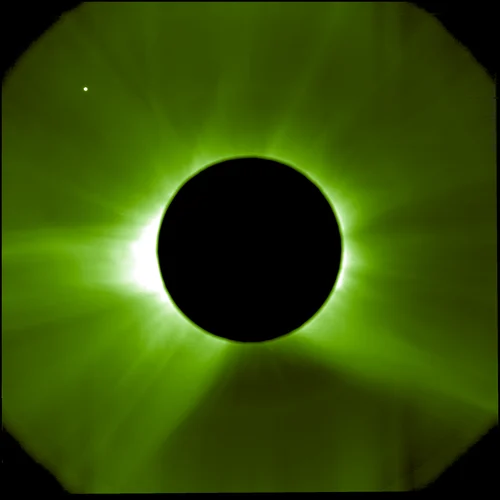
On August 12, 2026, a celestial spectacle of profound significance will unfold across parts of Europe: a total solar eclipse. For a fleeting period, the Moon will align perfectly with the Sun, casting a shadow that will plunge daylight into twilight and unveil the Sun’s ethereal outer atmosphere, the solar corona. This rare astronomical event, lasting at most a few minutes, offers a precious window for scientists to study the Sun’s enigmatic halo, a region teeming with activity that drives space weather and impacts our technologically dependent society.
The impending eclipse will traverse a path across Greenland, Iceland, Spain, and Portugal. During totality, which will last for just over two minutes in some locations, the blinding glare of the Sun will be suppressed, allowing the fainter, yet immensely powerful, solar corona to become visible to the naked eye. This faint glow, extending millions of kilometers into space, is the birthplace of phenomena such as the solar wind, a continuous stream of charged particles, and powerful coronal mass ejections (CMEs), which can have far-reaching consequences for Earth.
The Science Behind the Shadow: Understanding Space Weather
The solar corona is not merely a beautiful spectacle; it is the engine room of space weather. Here, the solar wind accelerates to speeds of hundreds of kilometers per second, streaming out into the solar system. It is also from this dynamic region that CMEs erupt, colossal expulsions of plasma and magnetic field from the Sun’s atmosphere. These energetic events can travel at incredible speeds and, when directed towards Earth, pose significant threats to our modern infrastructure.
The implications of unchecked space weather are substantial. Disruptions to satellite networks can cripple global communication and navigation systems. Power grids can experience surges and blackouts, leading to widespread economic losses. Even air travel and space exploration missions can be jeopardized by intense solar radiation and geomagnetic storms. Historically, understanding and predicting these events has been a formidable challenge, largely due to the difficulty in observing the corona.
Until recently, the only reliable way to study the full extent of the solar corona was during the brief, infrequent occurrences of total solar eclipses visible from Earth. These events are naturally rare, happening on average about once a year, and are only visible from specific locations on the planet. Their short duration, often just a few minutes, severely limits the scientific data that can be gathered.
Artificial Eclipses: A Technological Marvel
To overcome the limitations of natural eclipses, scientists have developed ingenious methods to create "artificial eclipses." These techniques involve a phenomenon known as solar occultation, where an object blocks the Sun’s disc from an observer’s perspective. While a natural eclipse uses the Moon, scientists employ instruments called coronagraphs. A coronagraph is essentially a telescope equipped with a precisely engineered disc that blocks the direct light of the Sun, allowing the fainter corona to be observed.
However, even traditional coronagraphs have limitations. They are typically adept at imaging the outer regions of the corona but struggle to capture the crucial area immediately surrounding the Sun’s surface, known as the inner corona. This region is vital for understanding the initiation of the solar wind and the early stages of CMEs.
To bridge this observational gap, the European Space Agency (ESA) has spearheaded innovative missions designed to create more comprehensive and prolonged observations of the corona. The mission that stands at the forefront of this endeavor is Proba-3 (Project for On-Board Autonomy).

Proba-3: The Dawn of On-Demand Eclipses
Proba-3 represents a paradigm shift in solar observation. Launched as a two-satellite formation, it operates autonomously as a single, sophisticated spacecraft. The mission’s ingenious design involves two spacecraft flying in precise formation, approximately 150 meters apart. One satellite, designated the "Occulter," is positioned to precisely block the Sun’s disc, effectively creating an artificial eclipse for the second satellite, the "Coronagraph."
The Coronagraph satellite is equipped with a state-of-the-art scientific instrument called ASPIICS (Advanced Space-borne Instrument for the Observation of Solar Corona). This instrument is designed to capture high-resolution images of the solar corona for extended periods, often for hours at a time, far exceeding the duration of natural eclipses.
Andrei Zhukov, the principal investigator for the ASPIICS instrument at the Royal Observatory of Belgium, highlights the mission’s success and its relevance to the upcoming natural eclipse. "This is the 62nd eclipse of Proba-3’s nominal operations—a part of the mission during which we acquire coronal images," Zhukov stated. He further elaborated on a recent artificial eclipse captured just two weeks prior to the August 12th event. "What makes this one unique is that it was taken about two weeks before the upcoming natural eclipse on 12 August. It takes the Sun two weeks to rotate halfway around its axis, so if we mirror the image horizontally, we get a prediction of what the corona will look like during the natural eclipse seen from Earth two days from now. The overall large-scale coronal structure usually doesn’t change much during that time." This capability allows scientists to anticipate and prepare for the phenomena they will observe during the natural event.
Solar Orbiter: A Unique Vantage Point
While Proba-3 excels at creating artificial eclipses, other ESA missions are also contributing significantly to our understanding of the Sun. The Solar Orbiter mission, a collaborative effort between ESA and NASA, is conducting a special observation campaign in the lead-up to the August 12th eclipse. This mission offers a unique perspective by orbiting the Sun on a different trajectory than most other solar observatories.
Solar Orbiter’s distinct orbit allows it to view the Sun from angles that are not accessible from Earth. This "side view" is invaluable for testing the accuracy of computer models that simulate the Sun’s magnetic environment. Total solar eclipses provide a crucial opportunity to validate these models by comparing real-world observations with theoretical predictions.
"A total solar eclipse lets us verify that our models are correct by comparing forecasts with actual observations," explains Jorge Amaya, ESA Space Weather Modelling Coordinator. "Most solar observations are made from near Earth, providing only a limited view of a vast three-dimensional system. Luckily, Solar Orbiter follows a different path around the Sun than other solar observatories. Today, the spacecraft is facing the side of the Sun that will soon roll into Earth’s view, giving observers on the ground the opportunity to decide which targets to focus on during the eclipse."
Mapping the Sun’s Magnetic Field
A key component of the Solar Orbiter’s contribution is its ability to provide detailed magnetic maps of the Sun’s surface, known as magnetograms. These are captured by the spacecraft’s Polarimetric and Helioseismic Imager (PHI) instrument. The data from PHI, combined with Solar Orbiter’s unique vantage point, provides modellers with a far more comprehensive understanding of the Sun’s magnetic field.
For instance, PHI has recently identified a newly emerging active region on the Sun. Such regions are often associated with increased solar activity, including flares and CMEs, and their presence is likely to influence the appearance and behavior of the corona during the August 12th eclipse. Spotting such features from a unique perspective is a testament to the power of multi-vantage point observations.

"The magnetic field lines that we see in simulations are like hairs in a fuzz ball," adds Amaya. "Observing the Sun from multiple viewpoints allows us to determine their orientation in three dimensions. That is the key to dramatically improving forecasts of how solar activity will affect our technology."
The data gathered by Solar Orbiter is also providing an early glimpse into what ESA’s future space weather forecasting mission, Vigil, will observe. Vigil, slated for launch in 2031, will be positioned in a halo orbit around the Sun-Earth L5 point, providing continuous, near real-time observations of the Sun’s side.
Miho Janvier, ESA project scientist for both Proba-3 and Solar Orbiter, emphasizes the synergistic value of these missions. "With Proba-3 and Solar Orbiter, we have an unprecedented view of our star," she states. "Both missions are contributing to our understanding of the Sun, from its surface to its extended atmosphere. The upcoming total solar eclipse offers a chance to see how this knowledge comes together, comparing observations with modelling."
Predictive Modeling and Virtual Totality
The scientific community is leveraging these advanced observations to refine predictive models. Companies like Predictive Science Inc. are collaborating with the Solar Orbiter team, utilizing their unique data to generate highly accurate predictions of the Sun’s corona during the August 12th eclipse. These predictions are publicly available, offering a "virtual totality" experience for those unable to witness the event firsthand.
Furthermore, KU Leuven is actively supporting ESA’s Space Weather Office with its own eclipse predictions. These efforts collectively aim to enhance our understanding and forecasting capabilities for solar activity.
Witnessing the Event: Livestream and Safety
For those unable to experience the total solar eclipse in person, ESA will be broadcasting a live stream on August 12th, from 19:30 to 20:45 CEST. This broadcast will provide viewers worldwide with a spectacular view of the celestial event.
Crucially, ESA also reiterates the importance of safe solar observation. Looking directly at the Sun without proper protection, even during a partial eclipse, can cause irreversible eye damage. Standard sunglasses are entirely inadequate for this purpose. Certified eclipse glasses that meet international safety standards are essential for observing the partial phases of the eclipse. It is only during the brief period of totality, when the Moon completely obscures the Sun, that it is safe to briefly look without protection. As soon as the Sun begins to reappear, eclipse glasses must be worn again.
The total solar eclipse of August 12, 2026, represents more than just a breathtaking astronomical phenomenon. It is a pivotal moment for scientific research, offering a unique opportunity to deepen our understanding of the Sun, its influence on our solar system, and the critical phenomena of space weather that directly impact our daily lives. Through the combined efforts of groundbreaking missions like Proba-3 and Solar Orbiter, and the dedication of scientists worldwide, this rare event promises to yield invaluable insights into the heart of our star.