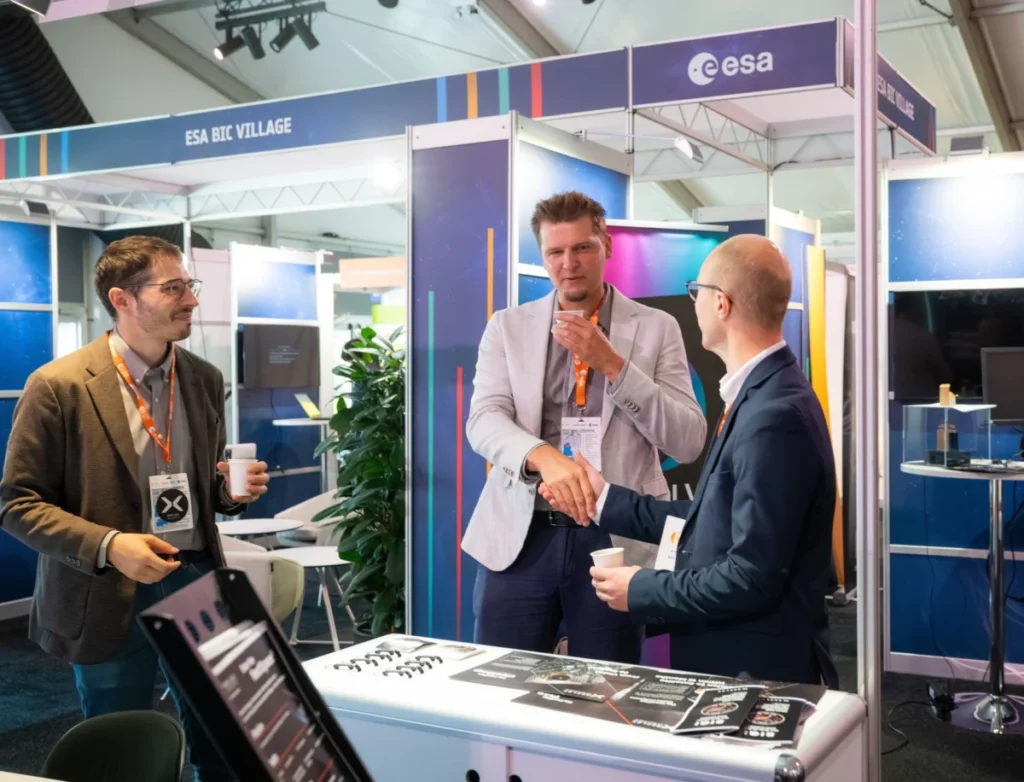
The European Space Agency (ESA) is gearing up to host its biennial Industry Space Days (ISD) event, scheduled for September 16-17, 2026, at ESA-ESTEC in Noordwijk, the Netherlands. This pivotal gathering will bring together Europe’s vibrant space sector, fostering collaboration, innovation, and the exploration of new commercial opportunities. A significant focus of this year’s event will be the "ESA BIC Village," a dedicated exhibition area highlighting the groundbreaking work of 32 startups incubated within ESA’s extensive network of Business Incubation Centres (BICs).
The Industry Space Days have become a cornerstone event for the European space community, serving as a critical platform for dialogue and business development. For over two decades, ISD has facilitated invaluable exchanges between established industry players, burgeoning startups, and ESA itself. The event’s primary objective is to bridge the gap between technological innovation and market application, driving forward the commercialization of space and exploring novel uses of space technology for terrestrial benefit. In 2026, the emphasis on startups within the ESA BIC Village underscores ESA’s commitment to nurturing a dynamic and competitive European space economy.
ESA’s Business Incubation Centres (BICs) play a crucial role in this ecosystem. With 40 centers strategically located across 23 European Participating States, these BICs provide comprehensive business support to over 250 new space-based start-up companies annually. This support extends beyond technical assistance, encompassing mentorship, access to funding, and crucial networking opportunities. The ISD event provides a magnified stage for these incubated companies, allowing them to showcase their unique offerings to a global audience of potential customers, investors, and strategic partners.
Jens Kauffmann, Head of ESA’s SME Section, which orchestrates the ISD event, elaborated on the significance of the gathering. "At Industry Space Days, there will be thousands of pre-planned business meetings, presentations from ESA directors and industry leaders, and forums to share ideas and collaborate on new commercial uses of space," Kauffmann stated. "This is an opportunity for startups to introduce themselves to other industry players of all sizes for potential collaboration. The ESA BIC Village, in particular, is designed to give these innovative companies maximum visibility and facilitate critical connections."

The ESA BIC Village will feature 32 selected startups, each sharing a booth with another company for one day of the two-day event. This collaborative setup aims to maximize exposure and encourage cross-pollination of ideas. These startups represent a diverse range of cutting-edge technologies and services spanning both upstream (space segment) and downstream (ground segment) markets, as well as technology transfer initiatives.
Showcasing Diverse Innovations at the ESA BIC Village
The startups exhibiting at ISD 2026 represent a broad spectrum of innovation, addressing critical needs and opening new frontiers in space and beyond. Their offerings demonstrate the pervasive impact of space technology across various sectors.
Alloy Additive: Revolutionizing Metal Component Manufacturing
Germany-based Alloy Additive is set to impress attendees with its rapid, on-demand manufacturing of custom titanium, nickel, and stainless-steel parts. Leveraging advanced TIG-Wire Arc Additive Manufacturing (WAAM), the company drastically reduces lead times from months to mere days. Their capabilities are particularly relevant for the space industry, enabling the production of high-performance launcher subcomponents, large-scale structural metal parts, and lightweight, optimized pressure vessels for space missions.

Mehmet Çetinkaya, CEO and Founder of Alloy Additive, highlighted the strategic importance of ISD. "Joining an event like this brings us directly to the centre of the European space business ecosystem," he said. "At the ISD, we hope to connect with prime integrators looking to drastically reduce lead times for large-scale metal components, while demonstrating how our 3D-printing technology makes space hardware manufacturing faster, cleaner, and more cost-effective." Alloy Additive is actively seeking partnerships with launch vehicle manufacturers, satellite and spacecraft manufacturers, space-system integrators, propulsion companies, and Tier-1 aerospace suppliers who require agile and efficient solutions for complex metal components. The ability to produce large, intricate metal parts with significantly reduced lead times could be a game-changer for space mission timelines and cost-effectiveness.
CompPair Technologies: Pioneering Self-Repairing Composite Materials
Switzerland’s CompPair Technologies will present its innovative composite materials engineered for ultra-fast self-repair using its proprietary HealTech™ technology. These advanced materials have the potential to revolutionize spacecraft structural integrity, extending component lifetimes and significantly improving mission reliability. The HealTech™ technology enables the repair of matrix microcracks through a simple thermal activation process, offering a sustainable and robust solution for the demanding conditions of space.
Amaël Cohades, CEO of CompPair Technologies, emphasized the event’s significance. "Industry Space Days is a key event for connecting with the European space community and strengthening collaborations across the sector," Cohades stated. "We are developing advanced healable composite technologies that will soon make repairable spacecraft structures possible, improving reliability, durability, and sustainability for future space missions. Our projects with ESA, Genesis and First!, are helping to enable a more sustainable and competitive space transportation ecosystem that supports Europe’s vision of reusable, low-impact space infrastructure." The development of self-healing materials aligns with the growing trend towards more sustainable and long-lasting space assets, reducing the need for costly replacements and minimizing space debris.
Marine Weather Intelligence: Enhancing Maritime Safety with AI

France-based Marine Weather Intelligence (MWI) is a deeptech startup utilizing artificial intelligence to optimize maritime operations. Their solutions focus on enhancing weather forecasting, improving route planning, and bolstering safety at sea. MWI’s technology serves a broad range of maritime professionals, enabling smarter, safer navigation while also contributing to the reduction of the carbon footprint associated with maritime activities. A key highlight at ISD will be their "proximity alert system," designed to anticipate hazardous weather phenomena, a critical capability in an era of increasingly unpredictable climate patterns.
Basile Rochut, CTO and Co-founder at Marine Weather Intelligence, expressed his expectations for the event. "At ISD we hope to explore data partnerships with ESA and connect with potential clients and fellow ESA BIC startups, as well as investors interested in space, deeptech, artificial intelligence and maritime topics," Rochut said. The integration of AI and space-derived data for enhanced maritime safety and efficiency represents a significant downstream application of space technology, with direct implications for global trade and environmental protection.
Nautilus: Enabling Autonomous Satellite Operations
Italy’s Nautilus is at the forefront of developing autonomous navigation and guidance technology for satellites. Their innovative solutions extend to mission design and flight dynamics services for both Earth-orbiting and deep-space missions. A core offering is EON, an onboard autonomous navigation and collision avoidance flight unit, which seamlessly interfaces with NEMO, their highly automated, ground-based flight dynamics software. This integrated system is designed to manage satellite fleets efficiently and autonomously.
Mattia Pugliatti, Head of On-Board Systems at Nautilus, shared his insights based on previous participation. "Nautilus attended ISD 2024. That first experience helped us understand the event’s format and connect with key players in the European space ecosystem. This year we’re returning with a more targeted plan for partnerships and visibility," Pugliatti noted. "We would like to meet mainly satellite integrators and potential customers interested in the technologies behind EON and NEMO. We would also be interested in getting in touch with possible early adopters who would be interested in using EON in their daily operations." The development of autonomous capabilities for satellites is crucial for the future of space exploration and operations, enabling more complex missions, reducing operational costs, and enhancing safety in an increasingly crowded orbital environment.

ARKai: Leveraging Space for Critical Infrastructure Safety
Latvia-based ARKai is employing satellite technology to enhance the safety of critical infrastructure, specifically focusing on dams. Their platform integrates satellite-derived ground deformation data (InSAR) with existing in-situ sensors and operational records to provide dam and hydropower operators with early risk identification. ARKai is developing a comprehensive dam-monitoring platform that consolidates multiple data sources, enabling operators to detect subtle movements, differentiate between normal seasonal behavior and hazardous changes, and generate compliance-ready risk intelligence.
Alberto Manuel García Navarro, CTO and co-founder of ARKai, sees broad applicability for their technology. "Dam owners and operators have expressed significant interest in our technology which is transferable to railways, mining and other critical infrastructure," Navarro stated. "At ISD, we hope to meet ESA technology and research partners, especially dam operators interested in pilot projects in Europe and Asia." ARKai’s application of Earth observation data for terrestrial risk management exemplifies the significant downstream benefits of space technology, contributing to public safety and infrastructure resilience.
The Broader Landscape of ESA’s Industry Space Days
The Industry Space Days event is more than just an exhibition; it is a strategic initiative by ESA to foster a self-sustaining and competitive European space industry. The agency recognizes that innovation often originates from agile and forward-thinking startups, and by providing them with a platform and support network, ESA aims to accelerate their growth and integrate their technologies into the wider space ecosystem.

The choice of ESTEC in Noordwijk, the Netherlands, as the venue is significant. ESTEC serves as ESA’s largest technical center, housing a vast array of expertise and facilities crucial for space mission development and research. This proximity allows for direct engagement between startups and ESA’s technical specialists, further enhancing the value of the event.
Looking back, previous Industry Space Days have been instrumental in launching and scaling numerous space businesses. The event has consistently facilitated high-value business-to-business meetings, often resulting in tangible collaborations and investment opportunities. The structured format, including pre-planned meetings and dedicated networking sessions, ensures that participants can maximize their time and achieve their objectives.
The implications of the innovations showcased at ISD 2026 are far-reaching. From enabling faster and more cost-effective space hardware production with Alloy Additive, to enhancing the longevity and reliability of spacecraft with CompPair Technologies, and improving the safety and efficiency of both space and terrestrial operations with Nautilus, MWI, and ARKai, these startups are pushing the boundaries of what is possible. Their work not only contributes to the advancement of space exploration and utilization but also addresses pressing global challenges, from climate change to infrastructure security.
The continued investment in and support for these startups by ESA through its BIC program and events like Industry Space Days signals a clear commitment to Europe’s leadership in the global space sector. As the space economy continues to expand, driven by both governmental and commercial endeavors, the role of innovative SMEs and startups will only become more critical. ISD 2026 promises to be a crucial inflection point, showcasing the next wave of European space innovation and setting the stage for future collaborations and market successes.
For those interested in attending or learning more about the event, further information and registration details can be found on the official Industry Space Days website. The success of this event is intrinsically linked to the future growth and dynamism of the European space industry.