Astronomers have long been captivated by Betelgeuse, a colossal red supergiant star that graces the night sky with its distinctive ruddy hue. Visible to the naked eye in the constellation Orion, this stellar titan has been a subject of intense scientific scrutiny for centuries. Now, a groundbreaking discovery by a team of international astronomers, led by French astronomer Miguel Montargès, has provided the most compelling evidence to date that Betelgeuse is not a solitary star but rather part of a binary system, accompanied by a faint stellar companion. This revelation marks the culmination of a quest that has spanned approximately a century, potentially reshaping our understanding of this iconic star and its eventual fate.
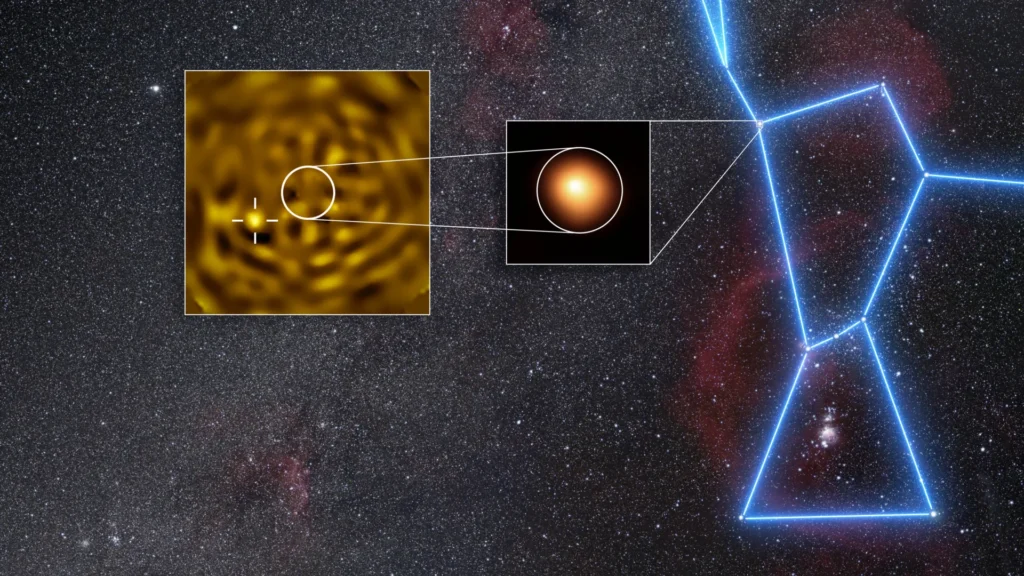
The team utilized the formidable capabilities of the European Southern Observatory’s Very Large Telescope (ESO’s VLT) to capture an unprecedentedly clear image of what is believed to be Betelgeuse B, a star orbiting the famous red supergiant. "This is the conclusion of a century-long quest," stated Montargès, an astronomer at the Observatoire de Paris — PSL, France, and the lead author of the study published in the prestigious journal Astronomy & Astrophysics. "We have shown that Betelgeuse is not single, it is accompanied by a faint stellar companion."
Betelgeuse, known for its variable brightness, has puzzled and intrigued observers for millennia. Even with the advent of advanced astronomical tools, the star continues to unveil new mysteries, underscoring the dynamic and complex nature of stellar evolution.
A Century-Long Pursuit: Unraveling Betelgeuse’s Companionship
The notion that Betelgeuse might harbor a stellar companion first emerged around the turn of the 20th century. Astronomers posited that the enigmatic fluctuations in Betelgeuse’s brightness could potentially be explained by the gravitational influence of an unseen orbiting star. For decades, however, despite numerous observational campaigns, this elusive companion remained just beyond reach, a persistent phantom in the celestial tapestry.
"I jumped from my chair when I saw the processed images," Montargès recounted, describing the moment of discovery. This emotional reaction underscores the profound significance of finally obtaining tangible proof for a theory that had long been hypothesized.
The path to this discovery was paved by two pivotal studies published in 2024. These research efforts, employing sophisticated modeling and theoretical predictions, pinpointed the precise location where Betelgeuse B was expected to be found. Crucially, they indicated that December 2024 would present an optimal window for observation, with the companion star reaching its greatest apparent separation from Betelgeuse. This predicted alignment provided the necessary impetus for Montargès and his team to direct the VLT towards the stellar giant.
The VLT’s Triumph: Capturing the Elusive Companion
In December 2024, Montargès and his colleagues seized the opportunity, conducting observations of Betelgeuse using the VLT. The subsequent months were dedicated to meticulous image processing and rigorous analysis of the collected data. "Honestly, I thought we did not have the sensitivity to detect Betelgeuse B as it was predicted," Montargès admitted. "Because it is more massive than predicted, we see it!"
This unexpected finding regarding the companion’s mass is a significant development. Initial estimations had suggested that Betelgeuse B would possess a mass comparable to our Sun. However, the new observations indicate that Betelgeuse B is considerably more substantial, with an estimated mass of two to three times that of the Sun.
"The fact that we can still discover a nearby companion, more massive and brighter than the Sun, around such a well-studied star is remarkable," Montargès emphasized. "These are among the best moments in science: seeing something new, unexpected." This sentiment highlights the inherent thrill of astronomical exploration – the continuous unveiling of the cosmos’s hidden wonders.
Unveiling Betelgeuse B: The Clearest Image Yet
The researchers employed direct imaging techniques, a method that involves detecting the light emitted by the companion star itself. This feat was achieved using the SPHERE (Spectro-Polarimetric High-contrast Exoplanet REsearch) instrument on ESO’s VLT, situated in the arid expanse of Chile’s Atacama Desert. SPHERE is renowned for its advanced capabilities in blocking the glare of bright stars, a crucial feature for detecting faint objects in their vicinity, akin to its primary use in exoplanet hunting.
While previous observations had offered tantalizing hints of Betelgeuse’s companion, including a potential direct detection by the Gemini North Telescope in Hawai’i, the latest VLT observations represent the most definitive evidence to date. They not only confirm the companion’s existence but also provide the clearest image of Betelgeuse B ever obtained.
"It is remarkable to see how SPHERE and advanced post-processing techniques, originally developed to find exoplanets, also excel at detecting a companion around a massive, evolved star like Betelgeuse," commented co-author Anthony Boccaletti, also an astronomer at the Observatoire de Paris. This demonstrates the versatility of cutting-edge astronomical instrumentation and analytical methods, extending their utility beyond their initial design parameters.
The Road to Certainty: Awaiting Further Confirmation
Despite the overwhelming evidence, the scientific community maintains a cautious approach. For complete confirmation, astronomers require another observation that captures the candidate companion when its orbital path predicts it to be in a different position relative to Betelgeuse. "To be certain that the companion is really there, we still need to observe it in one year on the other side of the star, but there is very little space left for doubt," Montargès added. This adherence to rigorous scientific verification is a cornerstone of astronomical research.
Betelgeuse’s Famous Dimming Event: A Dust Cloud, Not Imminent Doom
Betelgeuse gained significant public attention several years ago due to a dramatic and noticeable dimming of its brightness. As an evolved supergiant star, Betelgeuse is destined to end its life in a spectacular supernova explosion. This sudden decrease in luminosity fueled widespread speculation that the star might be on the verge of collapse.
However, subsequent investigations, also led by Montargès and his team using the VLT, revealed that the dimming was caused by a vast cloud of dust that temporarily obscured a portion of Betelgeuse’s light. This dust cloud was ejected from the star itself, a common phenomenon for red supergiants, and is a testament to the star’s ongoing, albeit less dramatic, evolutionary processes.
The discovery of Betelgeuse B adds another layer of complexity to the star’s already intricate behavior. This newly identified companion must now be factored into all future studies of Betelgeuse’s evolution and its eventual demise.
Implications for a Supernova: Could the Companion Play a Role?
The presence of a substantial stellar companion raises intriguing questions about its potential influence on Betelgeuse’s future. Scientists are now keen to investigate whether Betelgeuse B could impact the evolutionary trajectory of the red supergiant, including the characteristics and timing of its eventual supernova explosion.
"The question is truly opened whether this companion is going to have an impact on the evolution of the red supergiant," Montargès concluded. The gravitational interactions between two massive stars in close proximity can lead to complex dynamics, potentially affecting mass transfer, orbital evolution, and even the very nature of the supernova event.
The research, titled "VLT/SPHERE images the candidate companion of Betelgeuse," is set to be formally published in Astronomy & Astrophysics. The collaborative effort involved a distinguished international team of researchers from institutions including the Observatoire de Paris, the University of Amsterdam, the National Optical Astronomy Observatory, and the Center for Astrophysics-Harvard & Smithsonian, among others. This discovery underscores the power of global scientific collaboration and the continuous advancement of astronomical observation and analysis.
Background: Betelgeuse – A Star of Magnitude
Betelgeuse (Alpha Orionis) is a red supergiant star located in the constellation Orion. It is one of the largest and most luminous stars known, with an estimated diameter of around 800 to 1,000 times that of our Sun. If placed at the center of our solar system, its surface would extend beyond the orbit of Jupiter. Its immense size and advanced stage of stellar evolution make it a prime candidate for a supernova explosion in the relatively near astronomical future, though "near" in cosmic terms can still mean hundreds of thousands or even millions of years.
The star’s distance from Earth is estimated to be between 500 and 650 light-years. Its variability in brightness has been noted for centuries, with its dimming and brightening cycles contributing to its mystique. The most recent significant dimming event, which occurred between 2019 and 2020, was particularly pronounced, causing widespread public interest and scientific investigation.
Chronology of Discovery: Key Milestones
- Circa 1920s: The possibility of a stellar companion to Betelgeuse is first proposed as an explanation for its variable brightness.
- Early 21st Century: Decades of observations fail to definitively detect a companion, though indirect evidence continues to emerge.
- 2024: Two significant studies are published, providing theoretical predictions and pinpointing the optimal observation window for detecting Betelgeuse B.
- December 2024: Astronomers led by Miguel Montargès use ESO’s VLT to observe Betelgeuse, targeting the predicted location of its companion.
- Post-Observation Period (Late 2024 – Early 2025): Extensive image processing and data analysis are conducted by Montargès’s team.
- Early 2025: The team announces the strongest evidence yet for Betelgeuse B, including the clearest image of the companion star.
- Mid-2025: The findings are published in Astronomy & Astrophysics.
- Late 2025 – 2026: Further observations are planned to confirm the companion’s existence and orbital path.
Supporting Data and Technological Advancements
The detection of Betelgeuse B was made possible by the sophisticated instrumentation and advanced observational techniques employed by the ESO’s VLT. The SPHERE instrument, in particular, is designed to achieve extremely high contrast ratios, enabling the detection of faint objects close to bright stars. Its adaptive optics system corrects for atmospheric distortions, delivering sharper images than ground-based telescopes could achieve without it.
The success of this observation also highlights the power of modern data processing techniques. Algorithms originally developed for the challenging task of exoplanet detection were repurposed and refined to tease out the faint signal of Betelgeuse B from the overwhelming glare of its primary star. The ability to achieve such precise measurements around a star as luminous and evolved as Betelgeuse is a testament to the rapid progress in astronomical technology.
Broader Impact and Future Research
The confirmation of Betelgeuse B as a binary system has profound implications for stellar evolution research. It introduces a new dynamic to the study of Betelgeuse, a star already at the forefront of understanding the end stages of massive stars.
Future research will undoubtedly focus on:
- Precise Orbital Determination: Accurately mapping the orbit of Betelgeuse B will provide crucial data on the masses and interactions of the binary system.
- Companion Star Properties: Detailed analysis of Betelgeuse B’s light will reveal its spectral type, temperature, and luminosity, offering insights into its own evolutionary history.
- Supernova Influence: Investigating the gravitational and radiative influence of Betelgeuse B on Betelgeuse’s evolution, particularly concerning its impending supernova, is a key area of interest. Could the companion’s presence alter the timing, mechanism, or even the observable characteristics of the supernova?
- Binary Star Evolution Models: This discovery will serve as a critical test case for existing models of binary star evolution, potentially leading to refinements and new theoretical frameworks.
The discovery of Betelgeuse B represents a significant leap forward in our understanding of one of the night sky’s most prominent celestial bodies. It reminds us that even the most familiar astronomical objects can hold surprising secrets, and that the universe continues to offer new frontiers for exploration and discovery. The quest to fully comprehend Betelgeuse and its newly revealed companion promises to be a captivating chapter in the ongoing story of astronomical exploration.