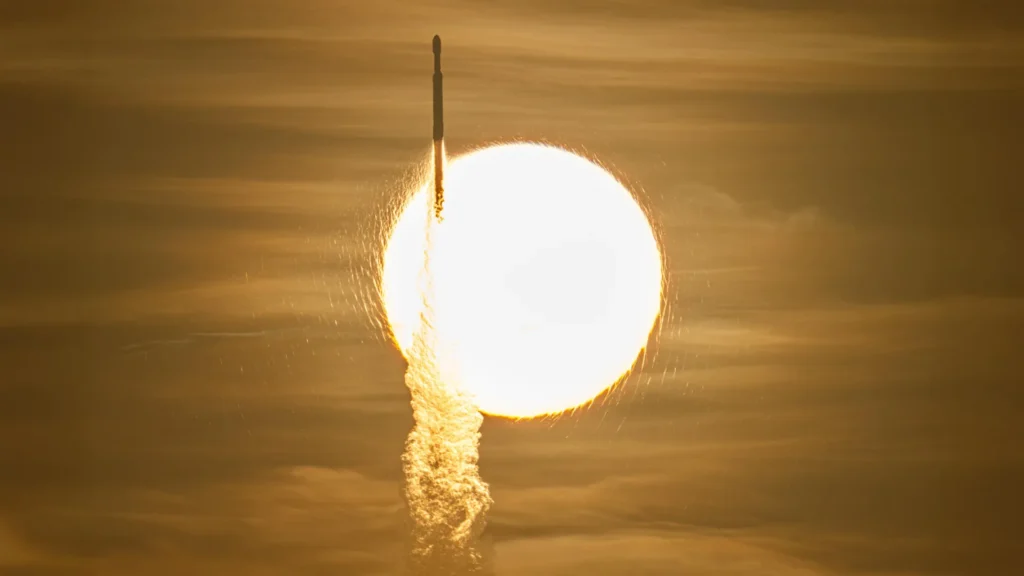
The Nancy Grace Roman Space Telescope, NASA’s ambitious new observatory, has commenced a pivotal three-month voyage spanning approximately one million miles, charting a course towards its operational orbit. The highly anticipated observatory was successfully launched at 7:26 a.m. EDT on Sunday, carried aloft by a powerful SpaceX Falcon Heavy rocket from Launch Complex 39A at NASA’s Kennedy Space Center in Florida. This launch marks the beginning of an era where Roman is poised to revolutionize our understanding of the universe, from the enigmatic nature of dark matter and dark energy to the burgeoning field of exoplanet discovery.
A New Era of Astronomical Observation Dawns
Upon achieving operational status, the Roman Space Telescope will distinguish itself through a groundbreaking combination of exceptionally sharp infrared vision and an unprecedentedly wide field of view. This dual capability will empower astronomers to survey vast swathes of the cosmos, delving into the deepest reaches of cosmic history with remarkable clarity. Its primary scientific objectives are monumental: to illuminate the nature of dark matter and dark energy, the invisible forces that shape the universe, and to expand our catalog of exoplanets, worlds beyond our solar system that may harbor the potential for life. Beyond these core missions, Roman’s sweeping observational capacity is expected to catalyze a cascade of serendipitous discoveries, pushing the boundaries of astronomical knowledge in unforeseen directions.
NASA Administrator Jared Isaacman hailed the launch as a testament to the agency’s commitment to excellence and innovation. "Roman is exactly the kind of success story we want to see across NASA," Isaacman stated, emphasizing the mission’s timely delivery and adherence to budget. "Delivered ahead of schedule and on budget, this mission reflects more than a decade of dedication from the NASA workforce and our industry partners. Now, Roman will give us a new atlas of the universe, push the boundaries of discovery, and demonstrate what is possible when America’s space program pairs bold ambition with disciplined execution." This sentiment underscores the meticulous planning and collaborative spirit that characterized Roman’s development.
From Liftoff to Deep Space: A Journey Begins
The journey commenced with precision. Controllers at NASA’s Goddard Space Flight Center in Greenbelt, Maryland, began receiving critical telemetry data from Roman a mere seven minutes after its ascent. The SpaceX Falcon Heavy rocket performed flawlessly, executing its planned separation from the observatory 31 minutes post-liftoff. Following its crucial role, the Falcon Heavy’s two boosters executed a successful return to the launch site, a testament to SpaceX’s reusable rocket technology, where they can be refurbished for future missions. This successful launch sequence is a critical first step in a long and complex mission.
Nicky Fox, associate administrator for the Science Mission Directorate at NASA Headquarters in Washington, articulated the profound scientific potential of the Roman mission. "Roman will be a discovery machine that will bring us closer than ever before to answering humanity’s most profound questions about our cosmic history," Fox remarked. "With its large field of view and fast survey speeds, Roman will usher us into a new era of discovery and make the invisible visible, setting the foundation for humanity’s search for life beyond our solar system." Her words highlight the telescope’s transformative power in addressing fundamental questions about our place in the universe.
The initial phase of Roman’s transit is facilitated by NASA’s Near Space Network, a sophisticated infrastructure comprising ground stations and relay satellites vital for tracking, telemetry, and command operations. Approximately 70 minutes after launch, communication channels shifted to NASA’s Deep Space Network (DSN). This network, with its global reach, will guide the observatory towards its ultimate destination: the second Sun-Earth Lagrange point, or L2. Located about one million miles from Earth, L2 offers a gravitationally stable environment ideal for long-duration space missions.
Navigating the Cosmos: The Role of the Deep Space Network
The L2 point is a region of space where the gravitational forces of the Sun and Earth are in equilibrium, allowing spacecraft to maintain a relatively stable position with minimal fuel expenditure. This strategic location minimizes the need for constant course corrections, thereby conserving precious propellant for scientific operations. During its transit to L2, Roman’s communication will be managed by a synchronized network of DSN complexes. The initial contact will be established with the Canberra Deep Space Communication Complex in Australia. Roughly six hours later, communication will transition to the Madrid Deep Space Communication Complex in Spain, followed by the Goldstone Deep Space Communication Complex in California. This interconnected system ensures continuous and reliable contact with the spacecraft throughout its arduous journey, a critical factor for mission success.
The establishment of robust communication links is paramount. The DSN has been a cornerstone of NASA’s deep space exploration for decades, enabling missions from the Mariner probes of the 1960s to the Mars rovers of today. Its advanced capabilities, including large radio antennas and sophisticated signal processing, are essential for transmitting commands and receiving vast quantities of data from missions operating far beyond Earth’s orbit.
Key Systems Deployed: Unfolding the Observatory
In the hours following its launch, Roman began the intricate process of unfolding its sophisticated instrumentation. One hour and 23 minutes after liftoff, the Roman mission team confirmed the successful deployment of the observatory’s crucial solar panels, the power source for its extensive operations, and its lower instrument sunshade. This shade is vital for protecting sensitive infrared instruments from stray sunlight and thermal interference, ensuring the integrity of scientific data.
Over the ensuing days, further critical deployments were scheduled. The observatory’s high-gain antenna, essential for high-bandwidth data transmission back to Earth, and its visor-like deployable aperture cover, designed to shield sensitive optics during transit, were slated for activation. Concurrently, mission controllers were to execute the first of two planned course corrections, fine-tuning Roman’s trajectory towards L2. A significant milestone was also the planned activation of Roman’s Coronagraph Instrument.
The Coronagraph Instrument represents a leap forward in exoplanet detection technology. It is designed to demonstrate a capability that could be instrumental for future missions, such as NASA’s Habitable Worlds Observatory concept, in directly imaging Earth-like planets. Directly photographing such worlds is an exceptionally challenging endeavor, primarily because the light from a host star can be billions of times brighter than the faint light reflected by its orbiting planet. A coronagraph effectively acts as a sophisticated shield, blocking the overwhelming glare of the star, thereby making nearby planets more readily detectable. Roman’s coronagraph will pave the way for this technology by capturing images of planets similar in size to Jupiter, providing invaluable data on their atmospheres and composition.
A 300-Megapixel Window to the Universe
A few weeks into its journey, Roman’s primary scientific workhorse, the Wide Field Instrument (WFI), was set to be activated. This instrument is a marvel of modern engineering, featuring a colossal 300-megapixel infrared camera. It is equipped with 18 advanced 4K detectors, each roughly the size of a saltine cracker. These highly sensitive detectors will work in concert to capture photons emitted by distant astronomical objects, transforming them into breathtakingly detailed panoramas of the cosmos.
The WFI’s design is optimized for efficiency and speed. Roman was engineered to maintain exceptional optical stability while executing rapid slews between different observational targets. This capability means the telescope can cover vast expanses of the sky without lengthy pauses, a stark contrast to the observational constraints of many previous instruments. NASA estimates that Roman will be capable of surveying the universe approximately 1,000 times faster than the iconic Hubble Space Telescope.
This unparalleled speed is one of Roman’s defining advantages. While Hubble excels at capturing incredibly detailed images of relatively small celestial regions, Roman is designed to achieve similarly sharp views but across a vastly larger field of view. This allows astronomers to study enormous populations of galaxies, stars, and planets in a fraction of the time that was previously required, accelerating the pace of discovery. For instance, mapping large-scale structures like the cosmic web or cataloging millions of galaxies for cosmological studies will become vastly more efficient.
The Road to First Light: Calibration and Commissioning
The remaining months of Roman’s three-month commissioning period will be dedicated to rigorous testing and meticulous calibration of its sophisticated instruments. This comprehensive process is essential to ensure that the observatory is functioning with optimal precision and accuracy before its full science program commences. Scientists and engineers will meticulously analyze performance metrics, fine-tune instrument settings, and validate data pipelines.
NASA anticipates the release of Roman’s inaugural images in early 2027. These first glimpses of the universe, captured with Roman’s unique capabilities, are expected to be spectacular and scientifically significant, offering a preview of the transformative discoveries to come.
Once science operations are in full swing, Roman is projected to transmit an astounding 1.4 terabytes of data to Earth every single day. This represents the highest daily data rate ever achieved by a NASA astrophysics mission, underscoring the sheer volume of information the telescope will gather. Managing and analyzing such an immense dataset will necessitate innovative approaches. Traditional analytical methods alone will be insufficient.
To effectively sift through the torrent of data, Roman’s operations will heavily rely on advanced computational techniques. Machine learning algorithms, artificial intelligence, and the invaluable contributions of citizen scientists will be employed to help researchers identify potentially significant discoveries within the vast observational archives. This collaborative approach will empower astronomers to focus their expertise on investigating the most promising findings in greater detail, maximizing the scientific return of the mission.
Julie McEnery, Roman’s senior project scientist at NASA Goddard, expressed profound excitement about the mission’s potential. "We’ve never been able to view the universe with eyes like Roman’s before," McEnery stated. "There’s no telling what more we’ll know and have seen by this time next year." Her words capture the palpable anticipation within the scientific community for the groundbreaking insights Roman is poised to deliver.
A Landmark Mission in NASA’s Astrophysics Portfolio
The launch of the Nancy Grace Roman Space Telescope marks a significant milestone in NASA’s ongoing exploration of the cosmos. It is the fourth primary NASA mission to be launched aboard a SpaceX Falcon Heavy rocket, a testament to the evolving landscape of space launch capabilities and the agency’s strategic partnerships. Earlier this year, NASA’s Launch Services Program worked diligently with SpaceX to accelerate the launch date, a move made possible by the early completion of the telescope itself, reflecting exceptional project management and execution.
The Roman mission is managed by NASA Goddard, with crucial contributions from the Jet Propulsion Laboratory in Southern California, Caltech/IPAC in Pasadena, California, and the Space Telescope Science Institute in Baltimore. A diverse array of research institutions and scientists from across the globe are also integral to the mission’s success, contributing their expertise to various scientific working groups and data analysis efforts.
The mission’s primary industrial partners, including BAE Systems Inc., L3Harris Technologies, and Teledyne Scientific & Imaging, have played pivotal roles in the development and construction of the telescope’s complex systems. Furthermore, international collaboration is a cornerstone of Roman’s global reach, with significant contributions from the European Space Agency (ESA), the Japan Aerospace Exploration Agency (JAXA), the French space agency CNES, and the Max Planck Institute for Astronomy in Germany. This international cooperation not only broadens the scientific talent pool but also fosters shared knowledge and technological advancements in space exploration.
The implications of the Roman Space Telescope are far-reaching. By providing an unprecedentedly wide and deep view of the universe, it will enable breakthroughs in fundamental physics, cosmology, and the search for life beyond Earth. The data it collects will fuel scientific research for decades to come, inspiring new generations of scientists and shaping our understanding of the cosmos for the foreseeable future. Roman is not just a telescope; it is a new set of eyes for humanity, poised to reveal the universe in ways we have only dreamed of.