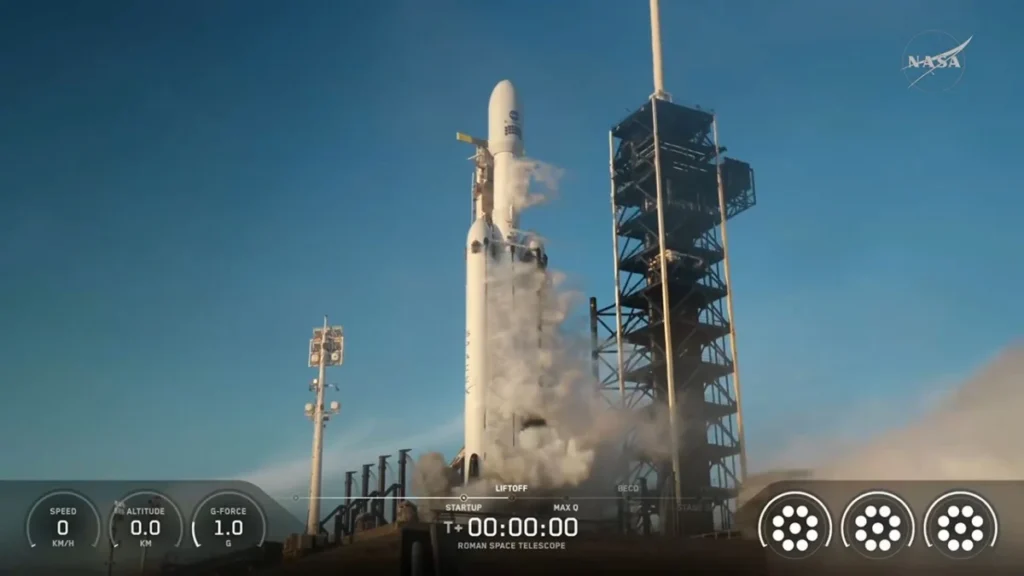
The Nancy Grace Roman Space Telescope (RST) has been successfully launched into space, heralding a significant advancement in humanity’s quest to understand the universe. This groundbreaking observatory, designed to explore the cosmos with unprecedented scope and sensitivity, began its journey from Kennedy Space Center, Florida, aboard a SpaceX Falcon Heavy rocket. The launch, which occurred yesterday, marks the culmination of years of planning, development, and international collaboration, promising to revolutionize our understanding of dark energy, exoplanets, and a myriad of other astronomical phenomena.
A Leap Forward in Observational Power
The Roman Space Telescope boasts a primary mirror of identical size to the venerable Hubble Space Telescope, a testament to the enduring legacy of that iconic observatory. However, the RST’s optical design and instrumentation are engineered to achieve a far more expansive view of the universe. It possesses the capability to capture images of the sky that are 100 times larger than Hubble’s in a single observation. This remarkable increase in field of view is attributed to several key design features: a more highly curved primary mirror, a closer secondary mirror, and a significantly larger main camera, known as the Wide Field Instrument.
This enhanced observational capacity will enable scientists to survey vast swathes of the sky with remarkable speed and efficiency. The primary mission objectives of the RST include a deep dive into the nature of dark energy, a mysterious force believed to be responsible for the accelerating expansion of the universe. By detecting and studying a multitude of Type Ia supernovae, which serve as "standard candles" for measuring cosmic distances, the RST will provide crucial data to refine our understanding of dark energy’s behavior and its implications for the universe’s ultimate fate.
Beyond its cosmological ambitions, the Roman Space Telescope is poised to make significant contributions to the field of exoplanet research. Its sensitive instruments will be capable of discovering thousands of new planets orbiting stars beyond our solar system. A key technique it will employ is microlensing, a method particularly adept at finding planets that are farther from their host stars and potentially reside in regions where life might be more plausible. This will dramatically expand our catalog of exoplanets, offering invaluable insights into the diversity of planetary systems and the conditions that might support life elsewhere in the galaxy.
Chronology of a Cosmic Endeavor
The concept for a large, wide-field space telescope capable of addressing key questions in cosmology and exoplanet science began to take shape in the early 2000s. NASA’s decadal survey in astronomy and astrophysics, a comprehensive report outlining scientific priorities for the coming decade, consistently highlighted the need for such an instrument.
- Early 2000s: Initial studies and concept development for a wide-field infrared survey telescope begin.
- 2006: The U.S. National Academy of Sciences’ Astronomy and Astrophysics Decadal Survey identifies a "Beyond Einstein" program, including a wide-field infrared survey telescope, as a top priority.
- 2010: The project is formally named the Wide-Field Infrared Survey Telescope (WFIRST).
- 2016: NASA announces that the telescope will be named the Nancy Grace Roman Space Telescope in honor of Dr. Nancy Grace Roman, a pioneering astrophysicist who played a crucial role in NASA’s development of the Hubble Space Telescope.
- 2017-2020s: Design, development, and construction phases, involving extensive collaboration between NASA, the European Space Agency (ESA), and various scientific institutions. This period included the selection and development of key scientific instruments, rigorous testing, and assembly.
- August 2024 (Yesterday): Successful launch from Kennedy Space Center, Florida, aboard a SpaceX Falcon Heavy rocket.
The journey from concept to launch has been a complex undertaking, requiring sustained funding, technological innovation, and the coordination of a global scientific community. The successful liftoff of the RST marks a critical milestone, transitioning the mission from its terrestrial development phase to its operational phase in orbit.
Technical Specifications and Scientific Capabilities
The Nancy Grace Roman Space Telescope is designed for optimal performance in the infrared spectrum, allowing it to peer through cosmic dust and observe the faint light from distant objects. Its primary mirror, measuring 2.4 meters in diameter, will feed light to its advanced instruments.
- Wide Field Instrument (WFI): This is the RST’s primary camera, boasting an exceptionally large field of view. It is equipped with multiple detectors, enabling it to capture vast areas of the sky simultaneously. The WFI will be crucial for both deep cosmological surveys and wide-field exoplanet searches.
- Coronagraph Instrument (CGI): While the WFI focuses on broad surveys, the CGI is designed for high-contrast imaging of exoplanets. It will utilize advanced coronagraphy techniques to block out the overwhelming glare of host stars, allowing for the direct observation of planets in their vicinity. This instrument is particularly important for studying the atmospheres of exoplanets and searching for biosignatures.
- Orbit: Unlike Hubble, which orbits Earth, the Roman Space Telescope will operate from the second Sun-Earth Lagrange point (L2). This gravitationally stable location, approximately 1.5 million kilometers from Earth, offers a clear, unobstructed view of the cosmos and a stable thermal environment crucial for infrared observations. The James Webb Space Telescope also operates from L2.
The choice of L2 is strategic. It minimizes interference from Earth’s heat and light, which can be problematic for sensitive infrared instruments. This location also simplifies communication with ground control, as the spacecraft will remain in a relatively fixed position relative to the Earth and Sun.
Broader Impact and Implications
The launch of the Nancy Grace Roman Space Telescope is more than just the deployment of a new scientific instrument; it represents a significant investment in our collective understanding of the universe and our place within it. The data it will gather is expected to fuel scientific discovery for decades to come, influencing fields from fundamental physics to astrobiology.
The quest to understand dark energy, for example, is one of the most pressing challenges in modern cosmology. The RST’s ability to map the distribution of galaxies and the evolution of the universe over cosmic time will provide unprecedented constraints on dark energy models, potentially revealing whether its properties change over time or if our current understanding needs a radical revision. This could have profound implications for our theories of gravity and the fundamental laws governing the universe.
In the realm of exoplanets, the RST’s discoveries will not only expand the known planetary census but also provide crucial data for understanding planet formation and evolution. By studying a diverse range of planetary systems, scientists can begin to discern common patterns and unique anomalies, helping to answer questions about how frequently Earth-like planets form and what conditions are necessary for habitability. The potential discovery of biosignatures in exoplanet atmospheres, while challenging, would be one of the most significant scientific findings in human history, offering tangible evidence of life beyond Earth.
The legacy of Dr. Nancy Grace Roman, after whom the telescope is named, is deeply intertwined with this mission. Her foundational work in establishing NASA’s astronomy programs and her instrumental role in the Hubble Space Telescope’s conception and development paved the way for future generations of space observatories. The RST stands as a direct continuation of that pioneering spirit, carrying forward the mission of exploring the unknown and inspiring future scientists and engineers.
Official Responses and Scientific Community Reactions
While specific direct quotes from officials or scientists regarding yesterday’s launch were not immediately available in the provided content, the successful deployment of such a high-profile mission is invariably met with widespread enthusiasm and anticipation within the scientific community and from NASA leadership.
Inferred Reactions:
- NASA Leadership: Statements would likely emphasize the successful execution of a complex launch operation, acknowledging the hard work of the numerous teams involved, and expressing profound optimism about the scientific return of the mission. They would highlight the RST’s role in addressing key scientific questions and its contribution to NASA’s broader exploration goals.
- Principal Investigators and Science Teams: Researchers directly involved in the RST’s scientific programs would express immense excitement about the imminent commencement of observations. They would be eager to begin analyzing the first data streams, validating instrument performance, and initiating the groundbreaking scientific investigations for which the telescope was designed.
- Broader Astronomical Community: Astronomers worldwide would view the launch as a momentous occasion, signaling a new era of discovery. The RST’s capabilities will undoubtedly stimulate new research proposals, collaborations, and theoretical investigations across a wide spectrum of astrophysical disciplines. The availability of its data will be a boon to researchers globally.
The successful launch of the Nancy Grace Roman Space Telescope is a testament to human ingenuity and our enduring curiosity about the cosmos. As it embarks on its journey through space, it carries the hopes and dreams of scientists and the public alike, promising to unlock new secrets of the universe and redefine our understanding of the cosmos. The coming years are poised to be a golden age of astronomical discovery, fueled by the extraordinary vision of this new, powerful observatory. The transition from apod.nasa.gov to science.nasa.gov/apod for the Astronomy Picture of the Day also signifies a broader shift in how NASA is organizing and presenting its scientific content, aiming to consolidate its vast resources under more focused domains. This move further underscores the ongoing evolution of NASA’s digital presence and its commitment to making scientific discoveries accessible to the public.