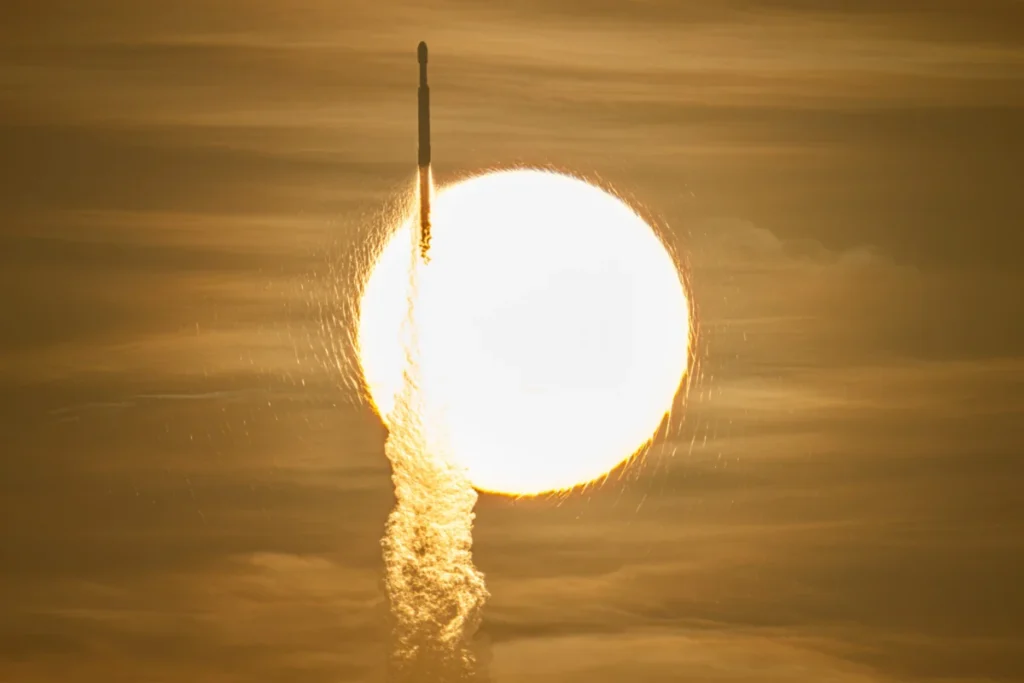
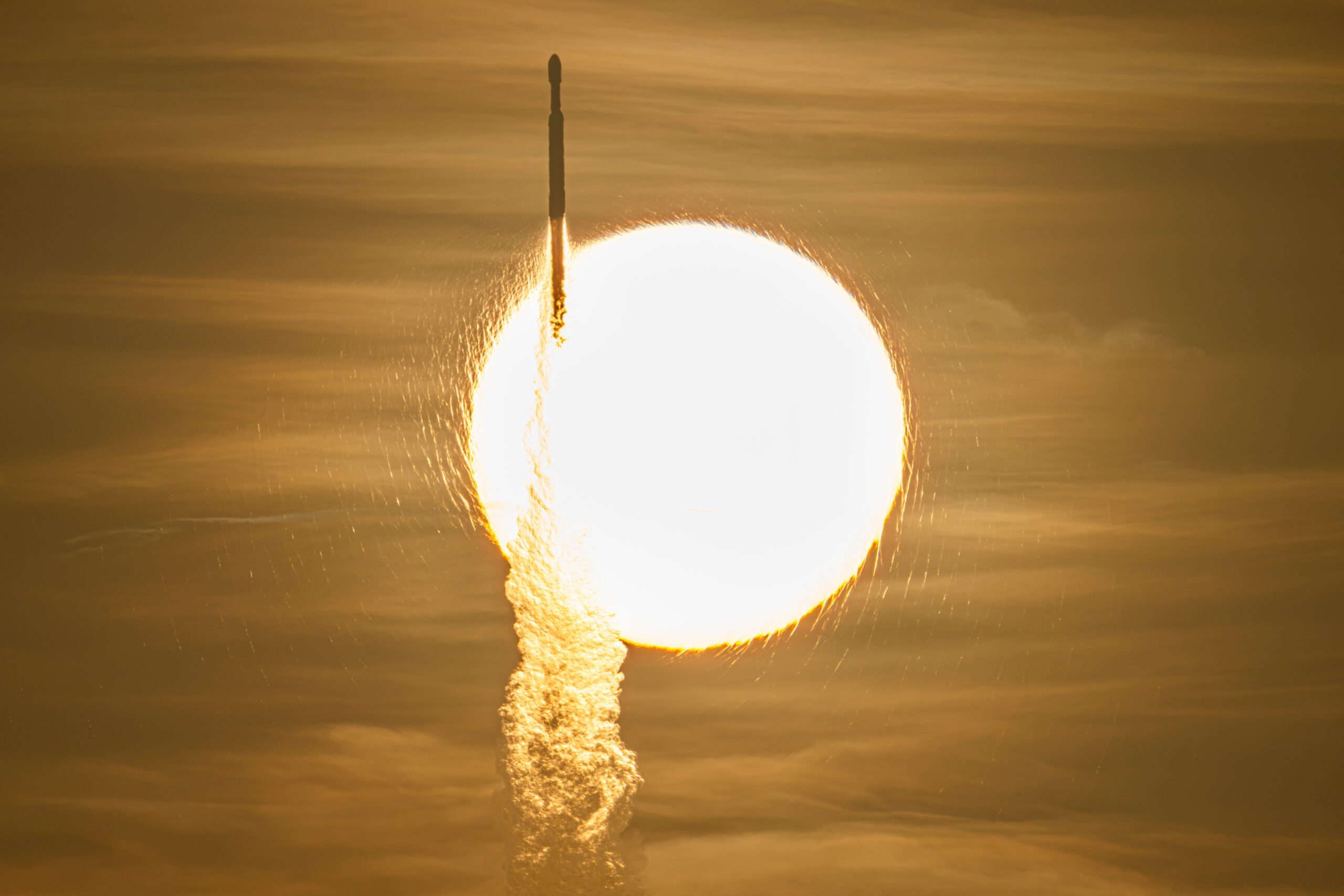
The Nancy Grace Roman Space Telescope, a monumental endeavor by NASA, has embarked on its crucial three-month voyage to deep space, marking a pivotal advancement in humanity’s quest to image countless exoplanets and delve into the profound enigmas of dark energy and dark matter. The launch, a spectacle of engineering prowess, occurred at precisely 7:26 a.m. Eastern time from Kennedy Space Center, Florida, as a SpaceX Falcon Heavy rocket ascended into the pre-dawn sky, its fiery ascent silhouetted against the rising sun over the Atlantic Ocean. Approximately thirty minutes post-liftoff, Roman gracefully separated from the rocket’s upper stage, commencing its journey towards its designated orbit around the Sun-Earth Lagrange Point 2 (L2), a gravitationally stable location situated 1.5 million kilometers (approximately 932,000 miles) from Earth.
During this extensive transit to L2, NASA mission controllers will meticulously guide the telescope through its commissioning phase. This critical period will involve the startup and precise calibration of Roman’s sophisticated onboard instruments, ensuring they are primed to deliver groundbreaking scientific data. During NASA’s live broadcast of the launch, a commentator aptly declared that Roman is "poised to revolutionize our understanding of the universe," a sentiment that encapsulates the immense expectations surrounding this ambitious observatory.
A New Era of Astronomical Observation
Roman is architected to work in concert with its esteemed predecessors, NASA’s Hubble Space Telescope and the James Webb Space Telescope. While Hubble and Webb are renowned for their capacity to capture highly detailed, in-depth images of specific celestial targets, Roman’s unique strength lies in its extraordinary wide field of view. This powerful capability will enable the telescope to rapidly survey vast expanses of the sky, capturing images that are approximately 100 times more expansive than Hubble’s and 50 times greater than Webb’s. This unprecedented survey capacity is key to Roman’s primary scientific objectives.
The total mission cost for the Nancy Grace Roman Space Telescope is estimated at $4.3 billion. NASA plans for Roman to operate for a minimum of one decade, with its operational lifespan ultimately dependent on the consumption rate of its onboard propellant.
Engineering Marvel: Design and Instrumentation
At first glance, the Roman Space Telescope, roughly the size of a semi-trailer, bears a visual resemblance to the iconic Hubble Space Telescope. It features a cylindrical trunk housing the intricate mirror systems designed to collect and focus photons from distant stars and galaxies. Its primary instrument is the Wide Field Instrument (WFI), a highly advanced infrared camera. Roman’s primary mirror boasts a diameter of 2.4 meters, identical to Hubble’s. However, the distance between Roman’s primary and secondary mirrors is significantly shorter, a design choice crucial for achieving its exceptionally wide field of view.
Photons entering the telescope will traverse a path reflecting off these mirrors before being directed to the Focal Plane System. This sophisticated system comprises multiple sensors and 18 high-resolution detectors meticulously arranged on a mosaic plate. This plate possesses the remarkable ability to be repositioned during operations, allowing for precise adjustments as needed for optimal data acquisition.
For the rigors of launch, including the intense vibrations of the Falcon Heavy rocket, the focal plane plate and its controlling motors were locked into a fixed, stable position. Jeff Kruk, Roman’s deputy senior project scientist at NASA’s Goddard Space Flight Center, explained in an email response that "After launch the mechanisms are moved to their nominal in-focus position and then adjusted later as-needed" during the calibration and aiming processes.
Precision Engineering by Industry Partners
The development of the WFI’s focal plane assembly and calibration system was undertaken by NASA’s Goddard Space Flight Center. The remainder of the instrument, including the critical "element wheel," was constructed by BAE Systems at their facilities in Colorado. This element wheel is capable of precisely articulating eight optical filters, as well as a prism and a grism—a component that combines a prism with a grating to diffract light. BAE Systems also engineered the mechanical, structural, electrical, and thermal systems essential for maintaining the WFI’s exceptional stability and keeping its large detector array at a consistently low temperature.
BAE highlighted the extraordinary precision required for the focal plane’s stability: "The focal plane needs to stay stable to within two microns. This is about the size of a bacteria and a one-third of the size of a red blood cell. Hubble’s focus can change by more than 25 microns over an orbit, making Roman at least 10 times more stable, in this one respect."
To prevent thermal interference from compromising scientific observations, BAE designed the WFI’s thermal management system to maintain the hardware surrounding the focal plane below -143 degrees Celsius (-225 degrees Fahrenheit). For comparative context, the instruments on the James Webb Space Telescope operate at even colder temperatures, as low as -266 degrees Celsius (-447 degrees Fahrenheit).
Calibration and Commissioning: Ensuring Scientific Readiness
A paramount priority during the commissioning phase will be the meticulous calibration of the WFI. NASA plans to achieve this by directing Roman to observe known star fields. The images captured by Roman will then be cross-referenced and compared with historical data obtained by Hubble and other telescopes. Key celestial targets for this calibration include the Large Magellanic Cloud dwarf galaxy, selected for its high density of stars within an optimal brightness range, and the star cluster NGC 6811 in the constellation Cygnus. These calibration strategies are detailed in a 2025 paper authored by Roman researchers.
Unprecedented Data Throughput
Once fully operational, Roman is projected to transmit an astonishing volume of scientific data back to Earth: approximately 1.4 terabytes of compressed data daily. This surpasses the daily data volume of Hubble, which is around 3 gigabytes, and significantly exceeds that of Webb, which transmits between 50 and 60 gigabytes per day.
"Roman’s total downlinked data volume is unprecedented for a space-based astrophysics mission," stated Jeff Kruk. He elaborated on the technical challenges: "This necessitated new developments in detector readout electronics and data storage as well as in the radio-frequency system for actually transmitting the data from a million miles away."
Pioneering Exoplanet Discovery Through Microlensing
A central scientific objective for the Roman Space Telescope is to conduct a comprehensive survey of exoplanets within the Milky Way galaxy. A key technique employed for this endeavor will be gravitational microlensing. This method leverages the principle that the gravity of an object, such as a star, planet, or black hole, can bend the light of more distant stars or galaxies. By observing these subtle distortions in light as an object passes in front of a background celestial body, astronomers can detect and characterize exoplanets, even those that are small or distant.
Scott Gaudi, a professor of astronomy at Ohio State University and a principal investigator for the Roman Galactic Exoplanet Survey Project Infrastructure Team, emphasized the significance of Roman’s capabilities for this survey. "It’s not necessarily the wide field of view that is valuable to that particular survey, but rather Roman’s ability to quickly scan vast areas at a high resolution," Gaudi explained in an interview.
He further elaborated on the transformative impact of Roman’s speed: "We can look at 100 million stars every 12 minutes, so that means what was previously considered rare phenomena become common, and that is the true power of Roman for the exoplanet survey."
Gaudi’s personal fascination lies with the microlensing events themselves: "I’m most interested in the microlensing events, because they do not repeat. They happen once and if you miss it, it’s gone. And so you have to characterize it when you’re seeing it. In other words, you have to get it right the first time." This underscores the critical importance of Roman’s precision and rapid observation capabilities.
Broader Scientific Implications and Future Prospects
The data generated by the Nancy Grace Roman Space Telescope will not only advance our understanding of exoplanets but also provide crucial insights into the nature of dark energy and dark matter, two of the most enigmatic components of the universe. Roman’s wide-field surveys will enable astronomers to map the distribution of galaxies over vast cosmic distances, offering new perspectives on the accelerating expansion of the universe, a phenomenon attributed to dark energy. Furthermore, its ability to detect subtle gravitational effects will contribute to refining models of dark matter, the invisible substance that is thought to comprise a significant portion of the universe’s mass.
The synergy between Roman, Hubble, and Webb promises a new golden age of astronomical discovery. While Hubble and Webb delve into the fine details of the cosmos, Roman will provide the broad, comprehensive overview, enabling scientists to identify promising targets for deeper investigation by the other observatories and to place these detailed findings within a grander cosmic context. The sheer volume of data Roman will produce also presents opportunities for advancements in data science, artificial intelligence, and the development of new analytical tools, further pushing the boundaries of scientific exploration. The successful launch of the Nancy Grace Roman Space Telescope represents a significant leap forward, promising to reshape our understanding of the universe and our place within it.