Scientific advancements rarely emerge in a sudden flash of inspiration; they are typically the culmination of years, even decades, of meticulous research and incremental progress. What was once considered groundbreaking eventually becomes a foundational element, paving the way for new frontiers. Researchers at the University of Michigan and the Air Force Research Laboratory (AFRL) may be on the cusp of such a paradigm shift, having successfully 3D printed intricate tubular structures with a unique internal geometry that can suppress vibrations with unparalleled efficacy, surpassing the capabilities of naturally occurring materials. These innovative creations belong to the burgeoning field of mechanical metamaterials, a class of engineered substances whose extraordinary properties are derived not from their chemical composition, but from their meticulously designed structure.
This breakthrough in vibration isolation has profound implications across a multitude of industries, from the aerospace and automotive sectors where minimizing resonant frequencies is critical for performance and longevity, to civil engineering and seismic protection, where dampening structural vibrations can enhance safety and resilience. The findings, published in the prestigious journal Physical Review Applied, represent a significant leap from theoretical models and computer simulations to tangible, real-world applications that can passively disrupt the propagation of vibrations.
"The true innovation lies in the realization that we can now fabricate these sophisticated structures," stated James McInerney, a research associate at AFRL, who was a postdoctoral fellow at the University of Michigan working under Professor Xiaoming Mao of the Physics department, a co-author of the study. "We are optimistic that these advancements can be harnessed for beneficial purposes, with vibration isolation being a primary application."
This pioneering project received crucial support from government agencies, including partial funding from the Defense Advanced Research Projects Agency (DARPA) and the Office of Naval Research. Additional support was provided through the U.S. National Research Council Research Associateship Program, administered by the esteemed National Academies of Sciences, Engineering, and Medicine, underscoring the strategic importance and collaborative nature of this research.
A New Paradigm: Geometry Over Chemistry
Professor Xiaoming Mao emphasized the fundamental shift in material science that metamaterials represent. "For centuries, humanity has improved materials by altering their chemical makeup. Our work builds upon the field of metamaterials, where it is the geometry – rather than the chemistry – that bestows unusual and highly useful properties," Mao explained. "These geometric principles are scalable, applicable from the nanoscale to the macroscale, thereby conferring extraordinary robustness to engineered structures."
This approach signifies a departure from traditional material science, which has historically focused on manipulating atomic and molecular structures. Instead, the research team is exploring how precise control over shape and structural arrangement at fine scales can unlock novel and advantageous mechanical characteristics.
Structural Foundations: The Art and Science of Engineering
McInerney elaborated on the interdisciplinary nature of the study, which harmoniously integrates classical structural engineering principles with modern physics and advanced manufacturing techniques such as 3D printing. "There is a significant probability that we will soon be able to manufacture materials from the ground up with remarkable precision," he remarked. "The overarching vision is to create materials with highly specific architectures, prompting the question: ‘What novel functionalities can we achieve with these custom-designed materials?’"
The researchers are not aiming to replace existing materials like steel and plastics, but rather to enhance their performance and application through intelligent design. "The goal is not to replace steel and plastics, but to utilize them more effectively," McInerney clarified.
This innovative approach draws inspiration from nature, where intricate geometries are employed to achieve remarkable strength and resilience. For instance, the internal structure of human bones and the shells of plankton, despite being composed of relatively simple materials, exhibit exceptional durability due to their optimized designs. By leveraging advanced 3D printing capabilities, scientists can now replicate and even augment these natural design principles in a wide array of materials, including metals and polymers, to achieve effects previously unattainable.
New-School Meets Old-School: Echoes of Maxwell and Topology
While the current research harnesses cutting-edge technologies, its conceptual underpinnings trace back to significant historical scientific contributions. A notable influence is the work of 19th-century physicist James Clerk Maxwell. While renowned for his pioneering contributions to electromagnetism and thermodynamics, Maxwell also made significant advancements in mechanics, developing crucial design considerations for stable structures known as Maxwell lattices, characterized by their repeating subunits.
Another foundational concept emerged in the latter half of the 20th century with the study of emergent behaviors at the edges and boundaries of materials. This area of research, known as topology, has been instrumental in explaining these phenomena and has opened avenues for their practical application.
"Approximately a decade ago, a seminal publication demonstrated that Maxwell lattices can exhibit a topological phase," McInerney explained. This discovery provided a theoretical framework that McInerney and his colleagues have been exploring over the past several years, specifically in the context of vibration isolation. The team has developed a comprehensive model that explains this topological behavior and outlines how to design real-world objects that exhibit it. Their recent achievement – the successful fabrication of such objects using 3D-printed nylon – represents the most advanced stage of this theoretical model’s realization.
Kagome Tubes: A Glimpse into the Future of Vibration Control
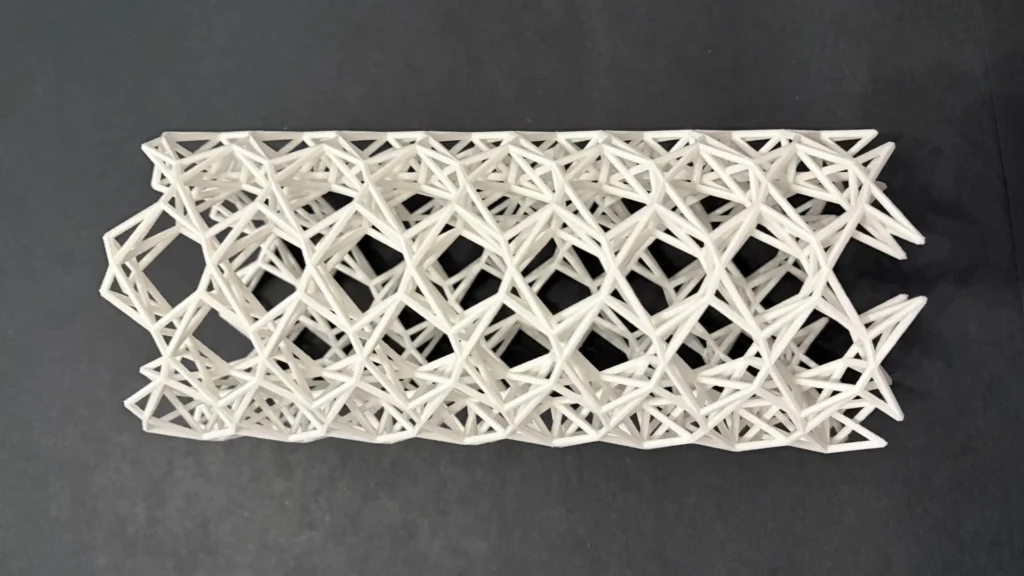
A visual inspection of the fabricated structures reveals the complexity that previously posed manufacturing challenges. They resemble a chain-link fence that has been intricately folded and rolled into a tube, featuring interconnected inner and outer layers. Physicists refer to these structures as "kagome tubes," a nomenclature inspired by the traditional Japanese basket-weaving patterns that exhibit similar geometric arrangements.
McInerney cautioned that this successful fabrication is merely the initial step in unlocking the full potential of these novel structures. A significant challenge identified during the research is the inherent trade-off between vibration suppression capabilities and load-bearing capacity. The structures that excel at dampening vibrations tend to have a reduced ability to support weight, a compromise that could be a limiting factor in certain applications. However, this trade-off also presents exciting opportunities for further fundamental research and innovation.
As these novel structures transition from laboratory curiosities to potential industrial applications, there will be a critical need to develop new standards, testing methodologies, and characterization techniques. McInerney views this as a stimulating challenge for the scientific community. "Because we are dealing with such unprecedented behaviors, we are still uncovering not only the underlying models but also the most effective ways to test them, the conclusions we can draw from these tests, and how to integrate these findings into the design process," he stated. "These are fundamental questions that need to be thoroughly addressed before we can fully explore specific applications."
Broader Impact and Future Directions
The implications of this research extend far beyond mere vibration dampening. The ability to precisely engineer materials at a structural level opens up a vast landscape of possibilities for creating materials with tailored properties for a wide range of applications.
- Aerospace: Lighter, more robust aircraft components that can withstand extreme vibrations from engines and atmospheric conditions, leading to improved fuel efficiency and passenger comfort.
- Automotive: Quieter and smoother vehicle operation through the reduction of engine and road noise, enhancing the driving experience and potentially reducing driver fatigue.
- Civil Engineering: The development of seismic-resistant structures and bridges that can absorb and dissipate earthquake energy, saving lives and minimizing property damage.
- Medical Devices: The creation of highly sensitive instruments that require minimal interference from external vibrations, improving diagnostic accuracy and surgical precision.
- Consumer Electronics: The design of more durable and reliable electronic devices, from smartphones to complex computing systems, that are less susceptible to damage from shock and vibration.
The foundational work laid by McInerney, Mao, and their colleagues at the University of Michigan and AFRL represents a significant step forward in the field of mechanical metamaterials. By demonstrating the practical fabrication of these complex structures, they have moved the concept from theoretical possibility to tangible reality. The ongoing research into the trade-offs and the development of new testing and design methodologies will be crucial in translating this scientific breakthrough into widespread technological adoption. This interdisciplinary endeavor, bridging physics, engineering, and advanced manufacturing, promises to redefine the capabilities of engineered materials and usher in an era of unprecedented structural performance. The journey from abstract theory to concrete application, exemplified by these vibration-suppressing kagome tubes, underscores the power of persistent scientific inquiry and collaborative innovation.