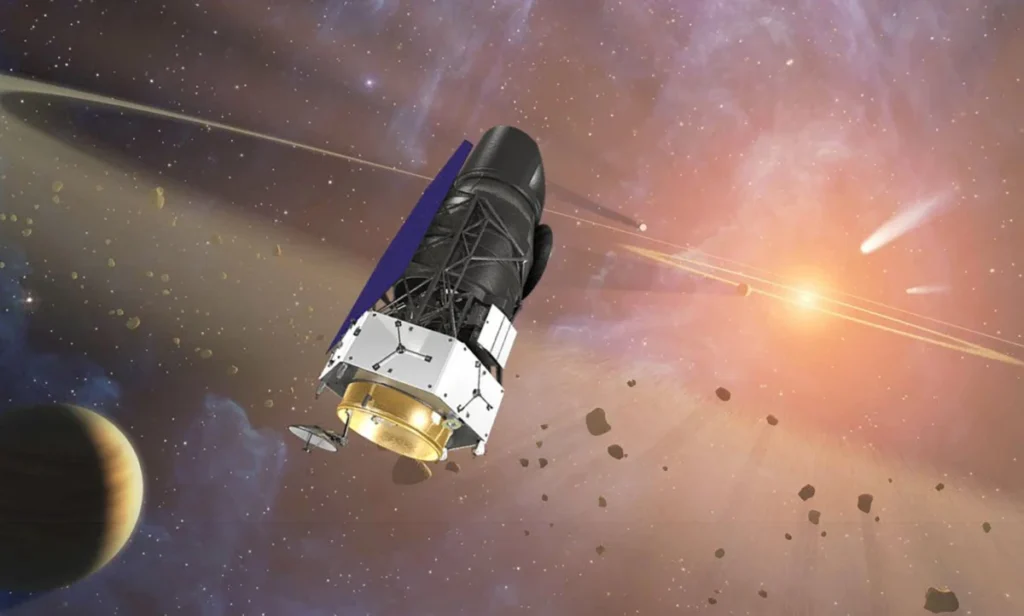
Now that the Nancy Grace Roman Space Telescope is on its way to its intended orbit in deep space, NASA scientists are looking to early 2027 when the first science imagery is expected. And they’re anticipating more than just fresh views of the cosmos. With its wide field of view, Roman is designed to survey expanses of the sky many times more vast than any previous space telescope, revealing new information about dark matter and dark energy, among other phenomena. The telescope also carries an experimental coronagraph, whose observations will help shape the design and operations of the one slated to be aboard NASA’s next flagship telescope: the Habitable Worlds Observatory (HWO), planned for launch in the mid-2040s. This advanced coronagraph technology represents a critical step forward in humanity’s quest to find and characterize potentially habitable exoplanets.
A New Era of Cosmic Observation
The Nancy Grace Roman Space Telescope, named after the pioneering astrophysicist who laid the groundwork for understanding dark energy, is a testament to NASA’s continued commitment to pushing the boundaries of astronomical observation. Launched on August 30th, 2023, from Cape Canaveral Space Force Station in Florida aboard an Atlas V rocket, Roman is poised to revolutionize our understanding of the universe. Its primary mission objectives include mapping the distribution of dark matter through gravitational lensing, studying the nature of dark energy by observing distant supernovae, and surveying hundreds of thousands of exoplanets. However, a particularly exciting and forward-looking aspect of the Roman mission is its integrated coronagraph instrument.
The Coronagraph: Unveiling Hidden Worlds
At its most basic level, a coronagraph is a sophisticated masking device designed to partially block the blinding glare of a host star. This stellar obstruction allows a telescope to detect the fainter light emitted by planets orbiting that star, which would otherwise be completely overwhelmed. While coronagraphs have been employed on previous space telescopes, none have possessed the advanced capabilities of Roman’s instrument. This cutting-edge technology was specifically engineered to achieve a significant milestone: the direct imaging of Jupiter-sized exoplanets. This capability serves as a crucial stepping stone, a vital testing ground, for the coronagraph that will be central to the Habitable Worlds Observatory (HWO). The HWO’s coronagraph aims for an even more ambitious goal: the direct imaging of Earth-sized planets, which scientists consider the most promising candidates for harboring life beyond our solar system.
Adaptive Optics: The Key to Precision
To achieve its groundbreaking observational goals, Roman’s coronagraph will employ a novel star-dimming technique known as "adaptive optics." This technology utilizes deformable mirrors, a key component developed at NASA’s Jet Propulsion Laboratory (JPL) in California, to correct for imperfections and interference that can plague astronomical observations. These imperfections can arise from various sources, including the telescope’s own internal vibrations, minute thermal fluctuations, or even the subtle warping of optical surfaces over time. Adaptive optics systems work by actively adjusting the shape of these mirrors in real-time, effectively "undoing" these distortions and sharpening the resulting image.
Nicola "Nicky" Fox, associate administrator for NASA’s Science Mission Directorate, emphasized the lineage of innovation in this endeavor. In an interview prior to Roman’s launch, Fox stated, "Every mission that we fly sort of stands on the shoulders of the mission that came before it. Habitable Worlds will have a coronagraph based on the one that is flying on Roman. We now have this unbelievable deformable mirror technology, and Roman is a demonstration of that technique." This statement highlights the incremental yet significant progress in space-based astronomy, where each new mission builds upon the successes and lessons learned from its predecessors.
The Mechanics of Adaptive Optics
The specific deformable mirrors designed for Roman’s coronagraph are approximately 5 centimeters in diameter. Each mirror is equipped with an array of over 2,000 tiny pistons, also known as piezoelectric actuators. These actuators, controlled with remarkable precision, can subtly mold and shape the mirror’s surface. This dynamic adjustment allows the system to compensate for optical aberrations caused by the telescope’s lenses or by vibrations generated by Roman’s internal mechanisms, such as its motors and reaction wheels, as the spacecraft repositions itself to observe different celestial targets.
The computational demands of operating such a sophisticated adaptive optics system are substantial. Roman, like many space-based observatories, does not possess the onboard processing power to perform the complex calculations required for real-time mirror adjustments for every image captured. Instead, the intricate calculations are managed by a dedicated team of operators on Earth.
The process begins with Roman capturing an image of a reference star located in close proximity to the intended exoplanet target. This reference image is then transmitted back to Earth, where it is fed into specialized software. This software analyzes the distortions present in the reference image and computes the precise adjustments needed for the deformable mirrors. Once these instructions are formulated, they are sent back to the Roman telescope, enabling it to capture a significantly sharper and clearer image of the target exoplanet.
Vanessa Bailey, the JPL Roman coronagraph scientist, drew an analogy to everyday vision correction to explain the process: "Just as eyeglasses can be shaped to correct for vision problems, the coronagraph’s mirrors can be adjusted to make an image sharper." She further elaborated that the mirrors might be shaped into forms resembling a "Pringles chip or parabola" to counteract specific optical issues. This analogy effectively conveys the dynamic and corrective nature of the adaptive optics system.
Refining Technology for Future Missions
The data gathered from Roman’s coronagraph observations will be instrumental in refining the adaptive optics technology for the Habitable Worlds Observatory. While the specific mirrors for HWO may not be identical to those on Roman, Bailey noted that "the big picture concept has a lot of similarities." This suggests a continuity in design philosophy and a focus on iterative improvement.
Bailey anticipates that the HWO’s coronagraph will necessitate advancements beyond Roman’s capabilities. "Almost certainly, Habitable Worlds will need more actuators than we have. They’ll need finer control than we have," she stated. This indicates a need for increased resolution and sensitivity in the future instrument, driven by the more challenging target of Earth-sized planets.
The Challenge of Direct Imaging
NASA has often used an analogy to illustrate the immense difficulty of directly imaging exoplanets. The task of Roman’s coronagraph in imaging Jupiter-sized exoplanets is akin to trying to spot a firefly next to a floodlight from across the entire United States. This stark comparison underscores the technological hurdles involved in overcoming the overwhelming brightness of stars.
For the Habitable Worlds Observatory, the challenge will be even greater. Joshua Schlieder, a research astrophysicist in the Exoplanets and Stellar Astrophysics Laboratory at NASA’s Goddard Space Flight Center, explained the increased complexity: "What we learn in the process will be critical for a next-generation coronagraph instrument that’s designed to be even more sensitive and more precise, which is where we have to go for this ultimate goal of directly imaging a small planet like the Earth around a nearby star." Schlieder concluded, "The Roman coronagraph will be a huge leap in that direction."
The development and deployment of the Roman coronagraph are not merely about capturing unprecedented images; they represent a crucial phase in a long-term strategic plan to identify and characterize potentially habitable worlds. The lessons learned from Roman’s observations of Jupiter-sized exoplanets will directly inform the design and engineering of the HWO’s coronagraph, enabling it to tackle the even more formidable task of imaging Earth-sized planets. This iterative process of technological development and scientific exploration is fundamental to NASA’s ambitious goals in exoplanetary science.
Broader Implications and the Search for Life
The success of Roman’s coronagraph will have profound implications for the search for extraterrestrial life. By enabling the direct imaging of exoplanets, scientists can move beyond indirect detection methods and begin to study the atmospheres of these distant worlds. Analyzing the composition of an exoplanet’s atmosphere for biosignatures – gases like oxygen, methane, or water vapor in specific combinations – could provide compelling evidence for the presence of life.
The Habitable Worlds Observatory, equipped with the advanced coronagraph technology refined by Roman, aims to be the premier instrument for this type of investigation. Its ability to directly image Earth-sized planets around nearby stars will offer unprecedented opportunities to search for signs of life and to understand the diversity of planetary systems in our galaxy.
A Timeline of Innovation
- Early 2027: First science imagery from the Nancy Grace Roman Space Telescope is expected, including initial observations from its coronagraph.
- Mid-2040s: The Habitable Worlds Observatory (HWO) is planned for launch, carrying an advanced coronagraph that builds upon the technology demonstrated by Roman.
- Ongoing: Data from Roman’s coronagraph observations will be continuously analyzed to refine adaptive optics techniques and inform HWO’s design.
The journey of the Nancy Grace Roman Space Telescope from conception to its current operational phase is a testament to decades of scientific ingenuity and international collaboration. Its coronagraph, a marvel of engineering, stands as a critical bridge between current observational capabilities and the ultimate goal of discovering life beyond Earth. As Roman begins its mission, the scientific community eagerly awaits the first glimpses of cosmic wonders, knowing that each image holds the potential to not only expand our understanding of the universe but also to bring us one step closer to answering humanity’s most profound question: Are we alone? The advanced adaptive optics system aboard Roman is not just about seeing farther; it’s about seeing clearer, with the ultimate aim of revealing the faint signatures of other living worlds.