A groundbreaking innovation from researchers at MIT and Sumitomo Heavy Industries is poised to fundamentally transform how heavy machinery, specifically excavators, are operated and how their operators are trained. This new control system, dubbed the "World-Space Interface" (WSI), promises a significantly more intuitive and efficient interaction with complex equipment, potentially addressing critical challenges faced by the global construction and industrial sectors.
"This is a more intuitive way to command the machine," states Hermano Krebs, principal research scientist in MIT’s Department of Mechanical Engineering and a leading figure in the project. "With this new interface, we can eliminate a lot of the mental maps that an operator would need to build in order to operate an excavator." This core principle of intuitive control forms the bedrock of the WSI, moving away from abstract joystick movements to a more direct, mimetic interaction that mirrors human arm movements.
A Paradigm Shift in Control: Eliminating Mental Maps
The traditional method of operating heavy machinery, particularly excavators, relies heavily on complex joystick controls. Operators must develop intricate mental maps to translate joystick manipulations into the corresponding movements of the excavator’s arm, bucket, and cab. This cognitive load is substantial, leading to prolonged training periods and a steep learning curve, even for experienced individuals transitioning to new models or tasks. The WSI aims to bypass this mental translation entirely, offering a direct, physically resonant control scheme.
Krebs envisions the interface as a dual-purpose tool: not only a faster method for training new excavator operators but also a novel way to physically operate the machines, both on-site and remotely. This dual functionality addresses key industry demands for efficiency and safety. The research team’s open-access results, detailing the development and efficacy of the WSI, were recently published in the Journal of Computing and Civil Engineering. MIT co-authors include Moises Alencastre-Miranda, Joao Buzzatto, and Eran Beeri Bamani, working alongside collaborators from Sumitomo Heavy Industries, a prominent industrial machinery manufacturer based in Japan.
Addressing Industry Challenges: The Aging Workforce and Training Gap
The impetus for this innovation stems from pressing demographic and operational challenges within the heavy machinery sector. Across the globe, but particularly pronounced in countries like Japan, the workforce of skilled heavy machinery operators is aging rapidly. This demographic shift creates a significant gap in experienced personnel, making the efficient training of replacements an urgent priority. Traditional training methods, which involve extensive hands-on experience with actual excavators on controlled courses, are time-consuming, costly, and inherently carry safety risks for novices.
Industry statistics underscore this issue. According to various reports from construction industry associations, the average age of a heavy equipment operator in many developed nations is often in the mid-40s to early 50s, with a substantial percentage nearing retirement. For instance, in Japan, where the collaboration with Sumitomo originated, the demographic crisis is particularly acute, with a shrinking pool of younger workers entering these physically demanding professions. The need for accelerated and safer training solutions is not merely an efficiency goal but a critical factor in maintaining national infrastructure development and industrial productivity.
The Genesis of Innovation: MIT’s Expertise Meets Industry Need
The journey to the World-Space Interface began with MIT’s Hermano Krebs’s group, renowned for its work on human-robot interactions. Their long-standing focus on physical rehabilitation has endowed them with profound insights into how humans control their limbs and the most intuitive ways to interact with machines. This deep understanding of biomechanics and human motor control proved invaluable in developing an interface that feels natural and responsive.
In 2018, Krebs initiated a collaboration with researchers at Sumitomo Heavy Industries. Sumitomo was actively seeking solutions to expedite the training of excavator operators, recognizing the demographic pressures and the inherent inefficiencies of existing methods. The Japanese firm’s operational expertise in heavy machinery, combined with MIT’s pioneering research in human-robotics, created a fertile ground for innovation.
Traditional operator training involves learning to coordinate multiple joysticks to control the complex movements of an excavator’s arm, bucket, and cab. Mastering these actions to perform specific tasks—like scooping, digging, or grading—can take months to years. The joint team theorized that by eliminating the necessity for this "mental map," they could drastically reduce the training period. They sought a control mechanism that was more aligned with human intuition than abstract joystick commands. This quest led them to the mechanical arm design, reasoning that its physical resemblance to the excavator’s own arm and bucket would allow operators to directly mimic and control the machine’s movements without requiring significant cognitive translation.
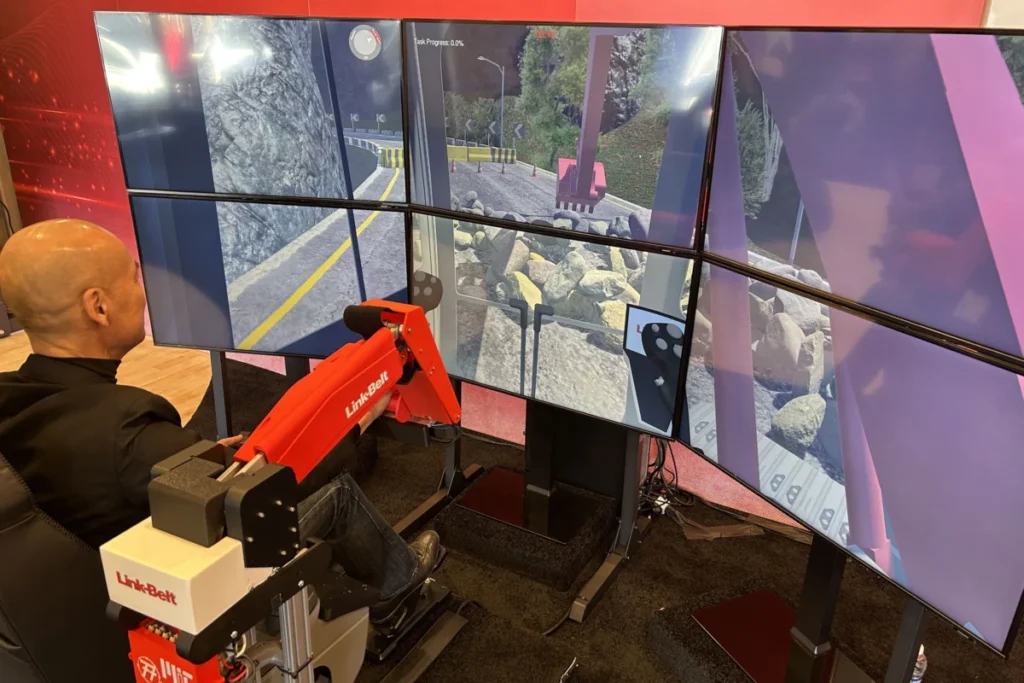
Over several years, the researchers meticulously engineered the mechanical arm, developing sophisticated software to synchronize its movements with a virtual simulation of an excavator. This synergistic combination of the physical arm and the virtual simulator forms the core of the new training and control platform, the World-Space Interface.
Deconstructing the World-Space Interface: Mimicry over Manuals
The "World-Space Interface" derives its name from its fundamental operational principle. "‘World-space’ refers to everything in the world that is outside of yourself, or in this case, outside of the excavator’s cab," Krebs clarifies. "Normally, operators have to build a mental map of how to manipulate things in the world-space. But now, we can just mime picking up rocks or dirt, and the computer will do that translation to the world-space for us." This ability to directly "mime" actions represents a profound departure from traditional control paradigms.
The Miniature Arm: A Natural Extension
The physical manifestation of the WSI involves a miniature arm, which an operator can manipulate with their own arm, akin to wearing an exoskeleton. This miniature arm is precisely designed to mimic the kinematic chain of an excavator’s boom, stick, and bucket. As the operator moves their arm, the WSI translates these natural human gestures into corresponding movements of the virtual (and eventually, physical) excavator. This direct mapping eliminates the abstract cognitive leap required by joysticks, where a push forward on one stick might control boom extension, while a twist on another controls bucket curl. Instead, if an operator wants to scoop, they perform a scooping motion with their arm. If they want to lift, they lift their arm.
"Instead of having joysticks, you might have this miniature arm on the side, where the operator would place their own arm, kind of like an exoskeleton, which would allow them to operate the excavator in the cab," Krebs explains. This integrated design means that even on-site, within the physical cab of an excavator, operators could potentially use the WSI as an intuitive alternative to existing controls, enhancing precision and reducing fatigue over long shifts.
Beyond the Cab: The Promise of Remote Tele-operation
Beyond its immediate application for in-cab operation and training, one of the most significant implications of the WSI is its potential for remote tele-operation. This capability opens doors to unprecedented safety and efficiency in hazardous environments. "If work has to be done in a difficult or unsafe environment, you could have an operator sitting off-site in a trailer and using this arm to remotely tele-operate the excavator," Krebs elaborates.
Imagine scenarios in disaster relief zones, nuclear decommissioning sites, deep-sea exploration, or even lunar construction, where direct human presence is too dangerous or impossible. The WSI could allow skilled operators to control heavy machinery from a safe distance, maintaining high levels of precision and responsiveness that are difficult to achieve with conventional remote-control systems. This tele-operation capability could revolutionize dangerous industries, reducing human exposure to risks while ensuring critical tasks are performed effectively.
The Evolution of Control: From Joysticks to Intuition
The development of heavy machinery has seen continuous evolution, from purely mechanical levers to hydraulic systems, and more recently, advanced electronic controls integrated with joysticks. While joysticks offered a significant improvement over earlier mechanical systems, they still require a learned skill set and cognitive effort to master. The WSI represents the next logical step in this evolution, prioritizing human intuition and natural movement patterns over abstract mechanical inputs. It leverages the inherent capabilities of the human body, turning operator intention directly into machine action.
Rigorous Testing Yields Breakthrough Results
To validate the efficacy of the World-Space Interface, the MIT team conducted a series of rigorous training experiments. These studies involved volunteers, including both expert excavator operators and complete novices, who used the WSI alongside a more traditional joystick-based excavator simulator.
Experimental Design: Simulating Real-World Scenarios
The researchers developed an impressive array of 15 virtual excavation environments, meticulously designed to mimic realistic construction scenarios. These included diverse settings such as urban construction sites, highways, forest roads, riverbanks, mining areas, and rural landscapes. Each virtual environment presented a variety of excavation tasks, from routine scooping and dumping of materials like sand or gravel to more complex operations such as digging and grading trenches, clearing debris from roads, removing tree branches from water edges, and breaking up rocks. This comprehensive set of tasks ensured that the training simulations were representative of real-world challenges faced by operators.
The experiment was structured to mirror a typical week-long excavator driving course. For one hour each day over seven consecutive days, volunteers engaged with both the WSI and the joystick simulator, progressively tackling tasks of increasing difficulty. This controlled and extended training period allowed the researchers to observe learning curves and performance improvements over time for both control interfaces.
Performance Metrics: Novices Match Experts Instantly
The results of the study were striking and unequivocally demonstrated the superiority of the WSI in terms of learnability and initial performance. When operating the joystick simulator, novices consistently performed worse than experienced operators at the outset, although their performance did improve over the seven-day training period, as expected. This confirmed the traditional understanding that joysticks require significant practice to master.
In stark contrast, the team found that with the new World-Space Interface, novices performed just as well as experts from the very first day of training. This immediate parity between novice and expert performance represents a monumental breakthrough. It signifies that the WSI effectively eliminates the steep learning curve associated with conventional controls, allowing individuals with no prior experience to achieve a high level of proficiency almost instantaneously.
"In this case, joysticks are a non-intuitive way to control and coordinate the machine," emphasizes study co-author and MIT postdoc Joao Buzzatto. "This is the first interface that does not require me to command the excavator with joysticks." This statement highlights the fundamental shift in control philosophy that the WSI embodies.
The Future is Tactile: Integrating Haptics for Enhanced Immersion
The research team is not resting on its laurels. The next phase of development involves integrating haptics, or the sense of touch, into the WSI’s physical arm. This enhancement aims to provide tactile feedback to the operator, further enriching the intuitive experience. The concept is that when an operator uses the arm to mime an action, such as picking up a pile of rocks, the arm will generate a corresponding force. This force feedback would simulate the heaviness of the rocks, providing a tangible confirmation that the excavator is indeed engaging with the material.
"Haptics would make this an even more intuitive system," states co-author and visiting engineer Solmon Jeong. This haptic feedback would not only enhance the realism of the simulation but also provide critical sensory information, allowing operators to "feel" the machine’s interaction with its environment, potentially improving precision and preventing errors. It would bridge the gap between virtual control and the physical realities of excavation, further reducing the cognitive load and enhancing operational awareness.
Broader Implications for the Construction and Robotics Industries
The World-Space Interface holds transformative potential for a wide array of industries beyond just construction. Its implications span workforce development, safety protocols, operational efficiency, and the competitive landscape of industrial robotics.
Transforming Operator Training and Workforce Development
The ability to train operators in days rather than months or years would be a game-changer for the construction industry. It could significantly reduce the costs associated with training, accelerate the onboarding of new personnel, and help address the severe shortage of skilled operators. Companies could quickly scale up their workforce in response to project demands, making the industry more agile and responsive. Furthermore, by making operator roles more accessible and less intimidating to learn, the WSI could attract a more diverse pool of candidates, including younger generations and individuals who might have been deterred by the complexity of traditional controls. This could lead to a more robust and sustainable workforce for heavy machinery operation globally.
Elevating Safety in Hazardous Environments
The remote tele-operation capability of the WSI is perhaps its most impactful contribution to safety. Operating excavators in environments compromised by natural disasters (earthquakes, floods, landslides), chemical spills, active war zones, or extreme weather conditions poses immense risks to human life. By enabling operators to control these machines from a safe, distant location, the WSI can protect lives while allowing critical work to proceed. This also extends to routine but dangerous tasks like demolition of unstable structures or handling hazardous waste, where removing the operator from the immediate vicinity drastically reduces risk.
Enhancing Operational Efficiency and Productivity
Beyond training and safety, the intuitive nature of the WSI could lead to significant improvements in day-to-day operational efficiency. By eliminating the mental translation required by joysticks, operators, even experienced ones, could potentially perform tasks with greater speed, precision, and reduced cognitive fatigue. This translates to higher productivity, fewer errors, and more efficient project completion. For large-scale construction projects, mining operations, or infrastructure development, even marginal gains in efficiency can result in substantial cost savings and accelerated timelines.
A Competitive Edge in the Evolving Simulator Market
The construction industry is already actively exploring and adopting virtual simulators for operator training and remote control. Major players like Caterpillar, Hyundai, and Komatsu are investing heavily in these technologies. However, many of these existing simulators are still built around traditional joystick controllers, meaning they inherit the same learning curve challenges. The WSI offers a distinct competitive advantage by providing a fundamentally more intuitive interface. If incorporated into next-generation simulators or even directly into excavator cabs, the WSI could differentiate products and become a benchmark for user-friendly heavy machinery control. This could compel other manufacturers to innovate their control schemes to remain competitive.
The Road Ahead: Expanding Applications and Further Research
While the immediate focus is on excavators, the underlying principles of the World-Space Interface are highly transferable. The concept of mimicking machine movements with natural human gestures could be applied to a wide range of heavy machinery, including cranes, bulldozers, loaders, and agricultural equipment. This could standardize control paradigms across different types of complex machines, making cross-training easier and accelerating automation efforts. Further research will likely explore these expanded applications, as well as delve deeper into the neurocognitive benefits of intuitive control. The integration of advanced AI and machine learning could further enhance the WSI, potentially allowing the system to learn and adapt to individual operator styles.
Collaborative Innovation Driving Progress
This pioneering research is a testament to the power of interdisciplinary collaboration between academia and industry. The expertise of MIT’s human-robot interaction specialists, combined with Sumitomo Heavy Industries’ deep knowledge of industrial machinery and real-world operational needs, created a synergistic environment for innovation. The financial support from Sumitomo Heavy Industries underscores the strategic importance of this research for the future of the industry.
In conclusion, the World-Space Interface developed by MIT and Sumitomo Heavy Industries is not merely an incremental improvement; it represents a fundamental rethinking of how humans interact with complex machinery. By leveraging natural human intuition and eliminating cognitive barriers, it promises to revolutionize operator training, dramatically enhance safety in hazardous environments, and significantly boost operational efficiency across the heavy machinery sector. The vision of first-time operators getting to work on day one, seamlessly controlling powerful excavators, is now closer to reality than ever before.