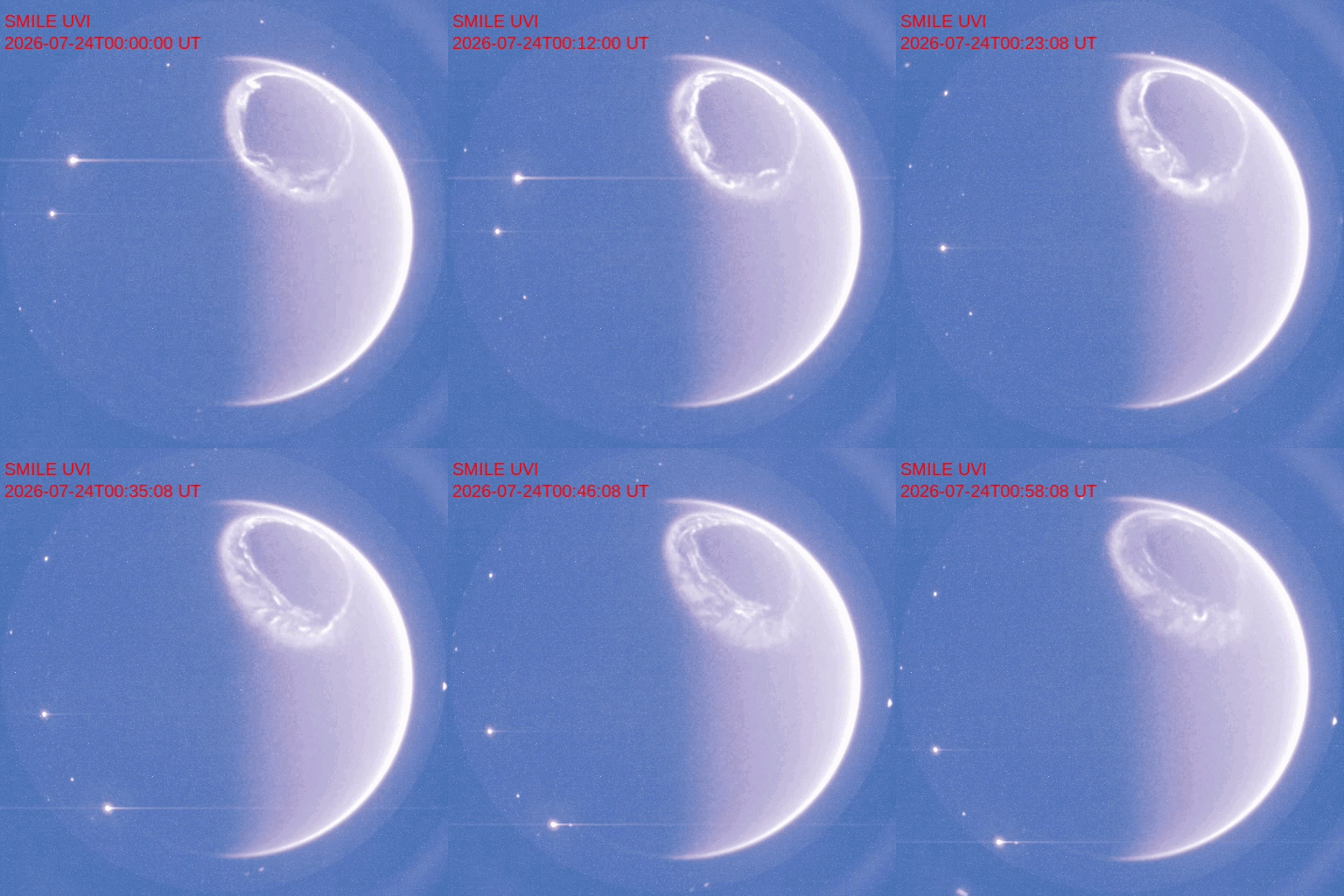
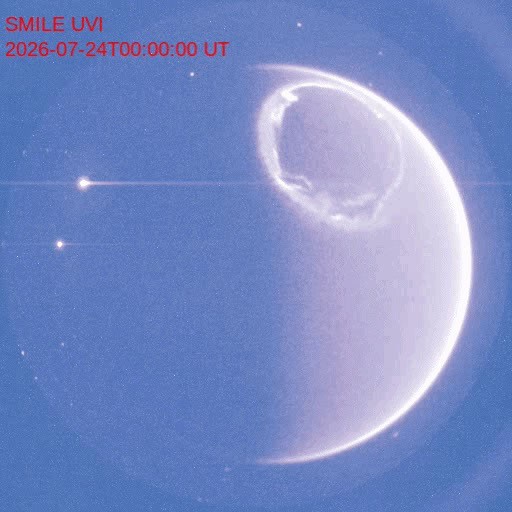
The European Space Agency (ESA) and the Chinese Academy of Sciences (CAS) have released groundbreaking ultraviolet footage captured by their joint SMILE (Solar wind Magnetosphere Ionosphere Link Explorer) spacecraft, showcasing a complete auroral oval surrounding Earth’s North Pole. This first-of-its-kind visualization, obtained using ultraviolet light, provides an unparalleled perspective on the dynamic and often turbulent nature of Earth’s auroras, even during daylight hours. The time-lapse video, spanning approximately one hour in late July, offers a vivid demonstration of the variability and intensity of these celestial displays.
Unveiling the Full Auroral Oval
For ground-based observers, a complete auroral oval is an elusive spectacle. Its immense circumference, encircling one of Earth’s magnetic poles, renders it too vast to be seen in its entirety from the planet’s surface. However, from the vantage point of space, SMILE’s sophisticated instruments have successfully captured this phenomenon. The footage reveals a swirling, luminous band of light concentrated around the Arctic, a testament to the complex interactions between the solar wind and Earth’s magnetosphere.
The video also highlights distant stars, which appear to shift due to the constant repositioning of SMILE’s camera as the spacecraft orbits the Earth. This subtle movement underscores the dynamic environment in which SMILE operates and the precision required for its scientific observations.
The Science Behind the Spectacle: Understanding Solar Wind-Magnetosphere Interactions
The primary objective of the SMILE mission is to deepen our understanding of how the solar wind, a continuous stream of charged particles emanating from the Sun, interacts with Earth’s magnetosphere. This protective magnetic shield envelops our planet, deflecting most of the harmful radiation and particles from space. However, the interaction is not always a perfect defense.
During periods of heightened solar activity, such as solar flares or coronal mass ejections (CMEs), the solar wind can become significantly more intense and energetic. These events can compress and distort the magnetosphere, injecting charged particles that trigger more powerful and widespread auroral displays. Understanding these interactions is crucial for predicting and mitigating the effects of space weather.
Implications for Space Weather and Terrestrial Infrastructure
The data gathered by SMILE has profound implications for space weather forecasting and the protection of critical infrastructure on Earth. Space weather events, driven by the Sun’s activity, can have far-reaching consequences, including:
- Disruption of Satellite Operations: Intense geomagnetic storms can interfere with satellite communication, navigation systems (like GPS), and even damage sensitive electronic components.
- Threats to Astronauts: Increased radiation levels during solar storms pose a significant risk to astronauts in orbit, particularly those on the International Space Station or during future deep-space missions.
- Impact on Power Grids: Geomagnetically induced currents (GICs) can flow through long conductors, such as power transmission lines, potentially causing widespread blackouts. This was famously demonstrated during the 1989 Quebec blackout.
- Radio Communication Blackouts: Ionospheric disturbances caused by solar events can disrupt high-frequency radio communications, affecting aviation, maritime, and military operations.
By providing a more comprehensive view of the magnetosphere’s response to solar wind variations, SMILE aims to improve the accuracy of space weather models. This enhanced understanding will enable space agencies and infrastructure operators to better prepare for and respond to potentially disruptive solar events, safeguarding both our technological assets and human endeavors in space.
SMILE Mission: A Collaborative Endeavor
SMILE is a pioneering mission, representing the first joint space science undertaking between ESA and the CAS. Launched on December 13, 2023, the spacecraft is designed to observe the magnetosphere from a unique perspective, complementing ground-based observations and data from other spacecraft. Its key instruments include:
- Wide-Angle Imager (WAI): This instrument is designed to observe the magnetospheric light emissions in ultraviolet and visible light, providing a broad overview of the magnetosphere’s dynamics.
- X-ray Spectrometer (XLS): The XLS is capable of detecting X-rays emitted by oxygen ions in the magnetosheath, a region of space between the bow shock and the magnetopause, offering insights into the composition and energy of incoming solar wind particles.
- Magnetometer (MAG): This instrument measures the strength and direction of the magnetic field around SMILE, crucial for understanding the magnetic environment and its interactions.
- Langmuir Probe (LP): The LP measures the plasma density and temperature in the spacecraft’s vicinity, providing direct measurements of the space environment.
The mission’s orbit is designed to provide extended observation periods of the magnetosphere, allowing for the study of its behavior over various timescales. The successful capture of this auroral oval footage is a significant milestone, validating the capabilities of SMILE’s instruments and its innovative approach to magnetospheric research.
Historical Context of Auroral Observation
The study of auroras dates back centuries, with early observations often attributed to mythological interpretations. Scientific investigations began to gain momentum in the 17th century with figures like Galileo Galilei, who first used the term "aurora borealis." However, it wasn’t until the 20th century, with the advent of rocketry and space exploration, that a true understanding of the underlying physics began to emerge.
Key milestones in auroral research include:
- Early 20th Century: Kristian Birkeland’s experiments with a terrella (a small, magnetized sphere) in a vacuum chamber led to his theory that auroras were caused by charged particles from the Sun interacting with Earth’s magnetic field.
- Mid-20th Century: The launch of the first sounding rockets and satellites provided direct measurements of the magnetosphere and the charged particles within it, confirming Birkeland’s theories.
- Late 20th and Early 21st Century: A series of missions, including NASA’s IMAGE (Imager for Magnetopause-to-Aurora Global Exploration) and ESA’s Cluster mission, provided increasingly sophisticated global and three-dimensional views of the magnetosphere and its dynamics.
SMILE builds upon this legacy, offering a new perspective with its focus on ultraviolet imaging and its unique orbital path. The ability to observe auroras during the day in ultraviolet light is particularly important because much of the energy transfer from the solar wind to the magnetosphere occurs continuously, not just during nighttime displays.
Future Prospects and Scientific Returns
The release of SMILE’s first ultraviolet footage marks the beginning of a new era in magnetospheric research. Scientists anticipate that the mission will yield a wealth of data, leading to:
- Improved Models of Magnetospheric Dynamics: The comprehensive data on auroral oval behavior, coupled with in-situ measurements of the solar wind and magnetic field, will allow for the refinement of existing magnetospheric models and the development of new ones.
- Enhanced Understanding of Solar Wind-Magnetosphere Coupling: SMILE’s ability to observe the magnetosphere from a unique vantage point will shed light on the complex processes by which energy and particles are transferred from the solar wind into Earth’s magnetic environment.
- Better Predictions of Space Weather Events: By understanding the fundamental mechanisms driving auroral displays and magnetospheric disturbances, scientists can improve the accuracy and lead time of space weather forecasts.
- New Insights into Planetary Magnetospheres: The knowledge gained from studying Earth’s magnetosphere can be applied to understand the magnetic environments of other planets, both within our solar system and beyond.
The SMILE mission is a testament to the power of international collaboration in advancing scientific understanding. As SMILE continues its observations, the scientific community eagerly awaits further revelations about the intricate dance between the Sun and our planet, and the ever-present, awe-inspiring spectacle of the aurora. The mission’s data is expected to contribute significantly to our ability to protect astronauts, satellites, and critical terrestrial infrastructure from the potentially hazardous effects of space weather for decades to come. The recorded time-lapse, offering a full hour of dynamic auroral activity, is a compelling visual narrative of the forces that shape our space environment.