Researchers at Osaka Metropolitan University have achieved a significant breakthrough in the field of artificial photosynthesis, unveiling a novel system capable of generating solar fuel with unprecedented consistency. This advance eliminates the need for conventional battery-based control equipment by integrating a self-regulating chemical component directly into the electrolyzer, thereby substantially reducing both system complexity and overall cost. This innovation represents a crucial step forward in the quest for sustainable energy solutions, addressing a long-standing challenge in harnessing intermittent solar power for continuous fuel production.
The Promise of Artificial Photosynthesis: Mimicking Nature’s Efficiency
At its core, artificial photosynthesis seeks to replicate and enhance the natural process by which plants convert sunlight, water, and carbon dioxide into energy-rich compounds. This biomimetic approach holds immense potential for creating a closed-loop energy economy, where solar energy can be captured and stored in chemical bonds, much like fossil fuels, but without the associated environmental burden. One particularly promising product of artificial photosynthesis is formic acid (HCOOH), a chemical that can serve as a versatile fuel source and an efficient medium for energy storage. Its properties, including being a liquid at room temperature, non-toxic, and relatively easy to handle, make it an attractive candidate for various applications, from powering fuel cells to serving as a hydrogen carrier.
The global imperative to transition away from fossil fuels and mitigate climate change has accelerated research into renewable energy technologies. Solar energy, in particular, offers an abundant and clean power source. However, its inherent intermittency—fluctuating with day-night cycles, weather conditions, and seasonal changes—presents a significant challenge for grid stability and continuous energy supply. This is where energy storage solutions become critical, and solar fuels produced via artificial photosynthesis offer a compelling pathway to store solar energy chemically, overcoming the limitations of electrical battery storage for certain applications.
The Technical Hurdle: Managing Solar Variability and the MPPT Challenge
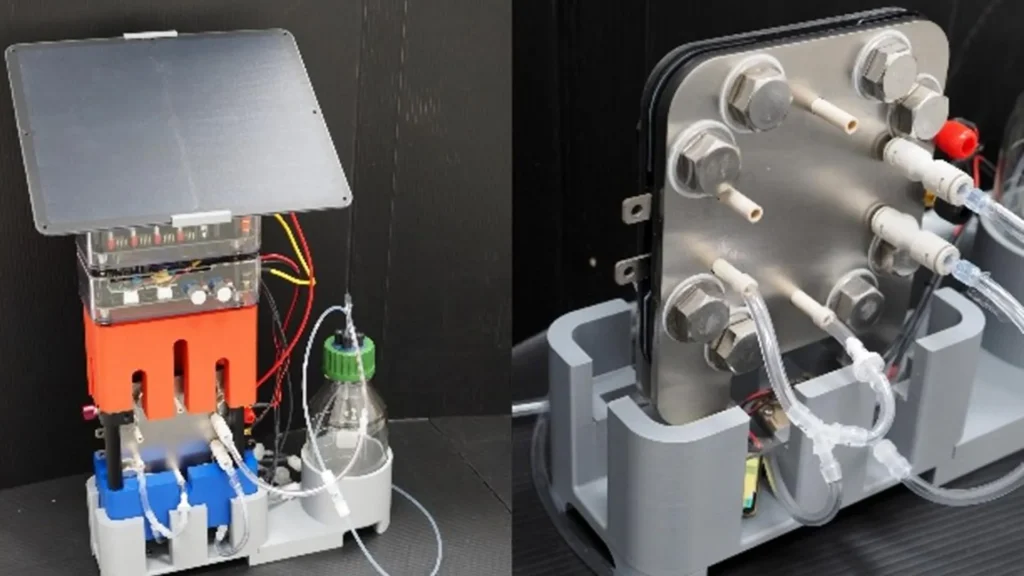
Central to most artificial photosynthesis systems is an electrolyzer, a device that uses electricity, typically supplied by solar cells, to drive chemical reactions that convert water and carbon dioxide into chemical energy stored in fuels like formic acid. A major technical hurdle in ensuring the efficient and continuous operation of these systems lies in managing the variability of sunlight throughout the day. Solar cells perform optimally at a specific operating point, known as the Maximum Power Point (MPP), where they deliver the highest possible power output. As sunlight intensity and temperature change, this MPP shifts.
To address this, many conventional artificial photosynthesis systems employ Maximum Power Point Tracking (MPPT) technology. MPPT is an algorithmic control method designed to continuously adjust the voltage and current drawn from solar cells, ensuring they operate at their MPP and thus deliver the maximum available power. While highly effective in maximizing solar energy capture, traditional MPPT setups typically rely on a suite of external electronic components, including DC-DC converters, microcontrollers, and, crucially, batteries. These batteries serve to smooth out energy flow, buffer against rapid fluctuations, and provide stable power to the electrolyzer even when solar input is inconsistent.
However, this conventional approach comes with notable drawbacks. The reliance on batteries and additional electronic control circuitry significantly increases the overall system complexity. More components mean more points of failure, higher maintenance requirements, and a larger physical footprint. Furthermore, the cost associated with these components, particularly high-capacity batteries, can be substantial, often representing a significant portion of the total system expenditure. Environmentally, the production and disposal of batteries also carry their own footprint, offsetting some of the clean energy benefits. These factors have historically hindered the widespread adoption and economic viability of artificial photosynthesis systems, especially for decentralized or smaller-scale applications.
Osaka Metropolitan University’s Game-Changing Innovation: The Self-Regulating Electrolyzer
To overcome these long-standing limitations, a dedicated team led by Associate Professor Yasuo Matsubara and Professor Yutaka Amao at the Research Center for Artificial Photosynthesis at Osaka Metropolitan University embarked on a mission to fundamentally redesign the electrolyzer itself. Their collaborative effort with Iida Group Holdings Co., Ltd. has culminated in a groundbreaking approach that integrates the MPPT function directly into the device’s intrinsic properties.
The core of their innovation lies in the development of a specially designed solid electrolyte built directly into the electrolyzer. This unique material possesses inherent thermal and impedance properties that enable the electrolyzer to automatically adjust its electrical characteristics in response to changing environmental conditions, effectively performing the MPPT function without any external electronic intervention or battery buffering.
Professor Amao elaborated on the ingenious mechanism: "As sunlight increases, the electrolyzer naturally heats up due to increased electrical current flow and internal resistance. The system is meticulously designed so that this warming causes the electrical resistance of the solid electrolyte to drop proportionally. This reduction in resistance, in turn, allows electricity to flow more freely and efficiently, matching the optimal power output of the solar cells. This makes the system automatically adjust its electrical behavior, intrinsically tracking the Maximum Power Point."
This elegant solution eliminates the need for external electronics, converters, or, critically, batteries. The electrolyzer essentially becomes its own smart controller, dynamically adapting to the fluctuating solar input. "This self-regulating behavior helps keep fuel production more stable throughout the day and automates the system, while drastically reducing dependence on batteries and costly external components," Professor Amao added, highlighting the dual benefits of enhanced stability and significant cost reduction.
A Collaborative Journey and Real-World Validation
The development of this innovative technology was not an overnight success but the result of sustained research and strategic partnerships. The collaboration with Iida Group Holdings Co., Ltd. underscores the university’s commitment to translating fundamental research into practical, market-ready solutions. Iida Group Holdings, a major player in the Japanese housing industry, brings valuable expertise in scale-up, application, and potential integration into residential or commercial energy systems.
The researchers rigorously tested their novel system under actual outdoor conditions, exposing it to the natural variability of sunlight. The results were highly encouraging: the system consistently produced formic acid from water and CO2, maintaining stable output even as sunlight levels fluctuated significantly throughout the day. This real-world validation is crucial, demonstrating the robustness and practical applicability of the technology beyond controlled laboratory environments.
The confidence in their innovation was evident even before the formal publication of their findings. Professor Matsubara noted, "We were confident that it would be successful, as we previously showcased this research at the ‘Joint Pavilion Iida Group × Osaka Metropolitan University’ exhibition as part of the Osaka Kansai Expo 2025." This pre-publication public demonstration served as a powerful testament to the system’s capabilities, where it successfully generated enough formic acid to power a miniature diorama within the pavilion. "This demonstration showed its potential as an efficient artificial photosynthesis system that could potentially be used to charge applications in our homes," Professor Matsubara concluded, emphasizing the near-term practical implications.
The comprehensive findings detailing the design, mechanism, and performance of this self-regulating artificial photosynthesis system were published in the prestigious scientific journal EES Solar, a testament to the significance and novelty of the research within the energy science community.
Formic Acid: A Promising Solar Fuel and Energy Carrier
Formic acid (HCOOH), the primary product of this system, holds considerable promise as a solar fuel. It is the simplest carboxylic acid, naturally found in insect venom and some plants. As a fuel, it can be directly used in direct formic acid fuel cells (DFAFCs) to generate electricity, with water and carbon dioxide as the only byproducts, completing a carbon-neutral cycle if the CO2 feedstock is sourced sustainably. Furthermore, formic acid serves as an excellent hydrogen storage material, with a high gravimetric and volumetric hydrogen density. Hydrogen can be safely and efficiently extracted from formic acid through catalytic decomposition at relatively low temperatures, offering a safer and more convenient alternative to storing gaseous hydrogen.
The global market for formic acid is projected to grow, driven by its diverse applications in agriculture (feed additive, preservative), leather tanning, textiles, and chemical synthesis. Its emergence as a viable solar fuel could open up entirely new market segments and significantly boost demand, aligning with global decarbonization efforts.
Broader Implications and the Future of Renewable Energy Storage
This breakthrough from Osaka Metropolitan University carries profound implications for the future of renewable energy and the global energy transition:
1. Cost Reduction and Accessibility: By eliminating the need for expensive batteries and complex control electronics, the new system drastically reduces the capital expenditure associated with artificial photosynthesis. This cost reduction is critical for making solar fuel production more economically viable and accessible, particularly for smaller-scale, decentralized energy applications in remote areas or for individual households.
2. Enhanced System Reliability and Simplicity: Fewer components translate to greater reliability and simpler maintenance. The self-regulating nature of the electrolyzer means fewer points of failure and a more robust system overall, which is vital for long-term operational stability.
3. Accelerated Adoption of Solar Fuels: The improved consistency and efficiency of solar fuel production, coupled with reduced costs, can accelerate the adoption of formic acid and other solar fuels. This could lead to a paradigm shift in how solar energy is stored and utilized, moving beyond direct electricity consumption or conventional battery storage towards chemical energy storage.
4. Decentralized Energy Production and Energy Security: Imagine homes or communities generating their own clean fuel from sunlight and water. This technology brings closer the vision of decentralized energy production, enhancing energy independence and security, especially in regions with abundant solar resources but limited grid infrastructure.
5. Environmental Benefits and Carbon Capture: If the CO2 feedstock for formic acid production is sourced from industrial emissions or direct air capture technologies, this system could contribute to carbon utilization and the circular economy, effectively turning a greenhouse gas into a valuable resource. The reduced reliance on battery manufacturing, with its associated material extraction and disposal challenges, also offers additional environmental advantages.
6. Paving the Way for Other Solar Fuels: The fundamental principle of a self-regulating electrolyzer could potentially be adapted to produce other solar fuels, such as methanol or hydrogen, further broadening the scope of artificial photosynthesis applications.
7. Economic Growth and Industrial Innovation: The commercialization of such systems would spur economic growth, creating new jobs in research, manufacturing, installation, and maintenance. It could also position Japan, and specifically Osaka Metropolitan University and Iida Group Holdings, at the forefront of the global solar fuel technology market.
The global renewable energy storage market is projected to grow exponentially in the coming decade, with various technologies vying for dominance. While electrochemical batteries remain crucial for grid-scale electricity storage, solar fuels offer distinct advantages for long-duration, high-density energy storage and transport. The International Energy Agency (IEA) consistently highlights the critical role of energy storage and flexible energy systems in achieving net-zero emissions targets. Innovations like Osaka Metropolitan University’s self-regulating system directly address these needs, offering a pathway to make solar energy a more reliable and versatile component of the future energy mix.
This groundbreaking research not only pushes the boundaries of scientific understanding but also provides a tangible, practical solution to some of the most pressing challenges in sustainable energy. As the world strives for a decarbonized future, the ability to consistently and cost-effectively convert sunlight into clean, storable fuel represents a monumental leap forward, bringing humanity closer to a truly sustainable energy paradigm. The work of Professors Matsubara and Amao, in collaboration with Iida Group Holdings, stands as a testament to the power of innovation in tackling global challenges and shaping a brighter, cleaner future.