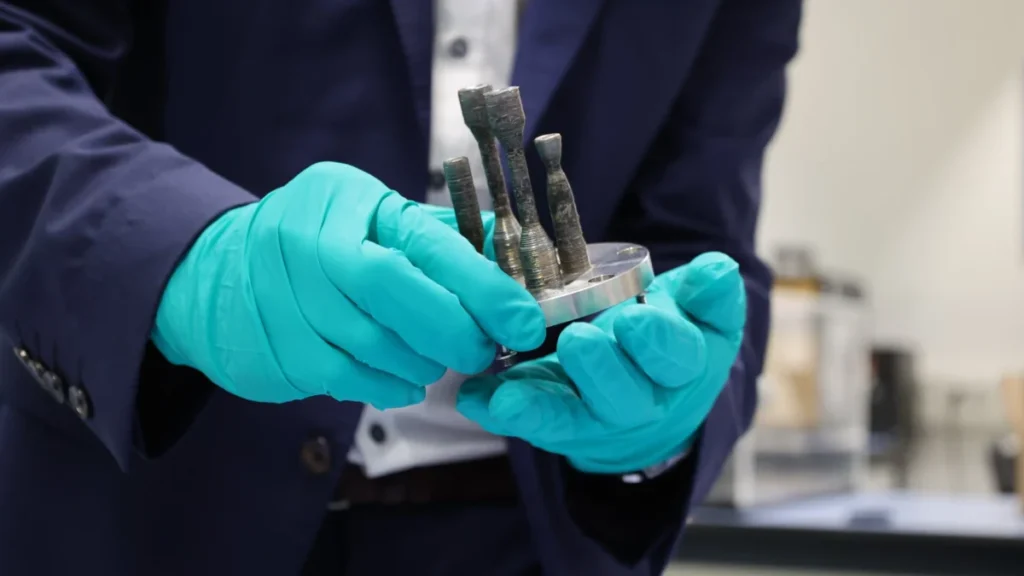
The fifth metal sample 3D-printed aboard the International Space Station (ISS) has successfully returned to Earth, marking a significant milestone in the advancement of in-space manufacturing. This particular sample, produced by the European Space Agency’s (ESA) Metal 3D Printer within the station’s Columbus module, holds particular importance as it contains the first thrusters ever fabricated in the microgravity environment of space. The sample was retrieved in July by ESA astronaut Sophie Adenot, bringing a tangible piece of orbital innovation back to terrestrial laboratories for rigorous analysis.
This achievement comes just months after the ESA Metal 3D Printer was launched to the ISS in January 2024. Its maiden voyage into orbit saw it produce its very first complete sample, which was subsequently identified as the initial metal component ever created beyond Earth’s atmosphere. Following its successful production, ESA’s material scientists at ESTEC, the agency’s technical hub located in the Netherlands, meticulously examined and tested this groundbreaking part. Their primary objective was to thoroughly investigate the effects of microgravity on the additive manufacturing process.
The insights gleaned from these initial investigations were instrumental in refining the printing procedure. These enhancements were directly applied to the creation of the two larger components that form the core of the fifth sample. These two smaller parts, designed by the German Aerospace Center (DLR), are specifically engineered as miniature thrusters, essential components for satellite propulsion systems.
Advanced Testing for In-Orbit Propulsion Components
Florian Merz, a research associate and test engineer at DLR, elaborated on the critical next steps for these space-manufactured thrusters. "We have designed two versions of the thruster," Merz explained. "One manufactured as closely as possible to the desired shape, and one with thicker walls that allow for post-processing to refine the thruster’s inner diameter." This dual approach aims to explore both the direct print capabilities and the potential for refinement of printed parts in space.
The rigorous testing phase will be conducted at DLR’s vacuum test bench facility in Lampoldshausen, Germany. "At our vacuum test bench in Lampoldshausen, Germany, we will assess the functionality and performance of the thrusters in hot-fire tests under representative operating conditions, demonstrating that space-manufactured components can achieve the precision required for propulsion and withstand relevant temperatures and pressures," Merz stated. This detailed evaluation is designed to confirm that components fabricated in space can meet the demanding performance and durability standards required for critical propulsion systems. The tests will simulate the harsh environmental conditions experienced by satellites in orbit, including vacuum, extreme temperatures, and operational pressures.
Sonja Steinbach, DLR’s project manager, underscored the comparative analysis that will be central to understanding the impact of microgravity. "By comparing the space-manufactured thrusters with equivalent components produced on Earth, we can investigate how microgravity influences the manufacturing process and how these effects translate into the performance of the finished components," Steinbach commented. "The results will help us further optimise metal 3D printing for future in-space manufacturing." This comparative methodology is crucial for isolating the effects of the space environment and for developing predictive models for in-orbit production.
The ability to produce and test propulsion components in space opens up new avenues for spacecraft design and maintenance. Instead of relying solely on components manufactured and launched from Earth, future missions could potentially fabricate replacement parts or even entirely new thruster systems while in orbit, significantly reducing launch mass and costs, and enhancing mission flexibility.
A Chronology of In-Orbit Metal 3D Printing
The development and successful return of this fifth metal sample represent the culmination of a strategic initiative by ESA and its partners to establish and validate metal additive manufacturing capabilities beyond Earth. The timeline of this project highlights a rapid progression from conceptualization to operational deployment and material return:
- January 2024: ESA launches its Metal 3D Printer to the ISS. This marked the beginning of a new era in on-orbit manufacturing capabilities. The printer itself is a sophisticated piece of technology, designed to withstand the rigors of spaceflight and operate reliably in microgravity. Its development involved extensive terrestrial testing to ensure robustness and precision.
- Early 2024 (following launch): The printer successfully produces its very first complete metal sample. This initial print was a foundational achievement, demonstrating the fundamental capability of the system to create a metal object in space. The material used for this first sample was likely a standard aerospace alloy, chosen for its well-understood properties.
- Subsequent Months (Spring/Summer 2024): ESA’s material scientists at ESTEC begin their in-depth examination of this first sample. This involved detailed microscopy, mechanical testing, and metallurgical analysis to understand how the microgravity environment affected the solidification, grain structure, and overall properties of the printed metal.
- Mid-2024: Based on the findings from the initial sample, the printing procedure is refined. This iterative process of testing and refinement is critical for optimizing the technology. The data gathered is invaluable for improving print parameters, such as laser power, scan speed, and powder distribution, to achieve better results in microgravity.
- During the same period (Spring/Summer 2024): DLR designs the two thruster components for the fifth sample. This design phase incorporates the learnings from the initial print, ensuring that the thruster geometry is suitable for microgravity printing and subsequent testing. The choice of specific alloys for the thrusters would have been driven by performance requirements, such as thermal resistance and propellant compatibility.
- July 2024: ESA astronaut Sophie Adenot retrieves the fifth metal sample, which includes the first space-manufactured thrusters, from the ISS. The act of retrieving samples from orbit is itself a complex logistical operation, requiring careful planning and execution by the astronaut crew.
- Post-Return (Late 2024/Early 2025): The retrieved sample, including the thrusters, arrives on Earth. This is the stage where the detailed functional and performance testing, as described by DLR, will commence.
This structured approach, involving rapid prototyping, in-orbit testing, and terrestrial validation, is a testament to the collaborative efforts between ESA and DLR in pushing the boundaries of space manufacturing. The successful return of these components is not merely an end point but a crucial step in validating the entire process for future applications.
Supporting Data and Technological Advancements
The ESA Metal 3D Printer is a sophisticated piece of equipment designed to operate within the controlled environment of the ISS. While specific technical specifications regarding the printer’s resolution, build volume, and material feedstock are proprietary, its successful operation in microgravity speaks volumes about its engineering. The printer likely utilizes a powder bed fusion (PBF) technology, such as Selective Laser Melting (SLM) or Electron Beam Melting (EBM), which are common in advanced metal 3D printing. These processes involve using a laser or electron beam to selectively melt and fuse fine metal powder particles layer by layer, building up a three-dimensional object.
The choice of metal alloys for space applications is critical. For thrusters, materials that can withstand high temperatures, corrosive propellants, and significant mechanical stress are paramount. Common materials for such applications include high-strength stainless steels, nickel-based superalloys (like Inconel), or titanium alloys. The performance of these alloys can be subtly altered by the microgravity environment during the solidification process, potentially leading to different microstructures and mechanical properties compared to their terrestrial counterparts.
The data gathered from the examination of the first metal part printed in space, and subsequently from the thruster samples, will contribute to a growing body of knowledge on space-based additive manufacturing. This knowledge is vital for developing predictive models that can accurately forecast the properties of 3D-printed parts in orbit without the need for extensive physical testing of every new design. Such models could significantly accelerate the design and deployment of in-space manufactured components.
Official Responses and Project Significance
Rob Postema, ESA’s technical officer for the project, conveyed the sustained excitement surrounding these endeavors. "Even though we have already received four samples from the ISS at ESTEC, the thrill of opening these very special packages remains the same," he commented. This sentiment highlights the pioneering nature of the work and the ongoing sense of discovery associated with bringing these unique artifacts back to Earth.
The significance of this project extends beyond the immediate scientific and engineering achievements. It represents a crucial step towards enabling a more sustainable and self-sufficient presence in space. The ability to manufacture tools, spare parts, and even complex components like thrusters in orbit can drastically reduce the reliance on Earth-based supply chains, which are both costly and time-consuming. This capability is particularly important for long-duration missions, such as those to the Moon or Mars, where resupply missions are infrequent and logistics are a major challenge.
Furthermore, the development of in-space manufacturing technologies is a key enabler for the burgeoning space economy. It opens up possibilities for servicing satellites, constructing space infrastructure, and even supporting commercial activities in orbit. The collaboration between ESA and DLR in this domain exemplifies a trend towards international cooperation in addressing complex space exploration and utilization challenges.
Broader Impact and Future Implications
The successful 3D printing of thrusters in space and their subsequent return for testing has profound implications for the future of space exploration and utilization.
Enhanced Mission Autonomy and Flexibility: The ability to produce critical components like thrusters on demand in space significantly enhances mission autonomy. Astronauts or robotic systems could repair or replace damaged parts, or even adapt a spacecraft’s capabilities by manufacturing new components, without waiting for lengthy resupply missions. This is particularly crucial for deep-space missions where communication delays and transit times make real-time intervention impossible.
Reduced Launch Costs and Mass: Traditional space missions are constrained by the mass and volume of payloads that can be launched. By enabling in-orbit manufacturing, the need to launch vast quantities of spare parts and tools can be significantly reduced. This can lead to substantial savings in launch costs and allow for larger, more capable scientific payloads or habitats to be sent into orbit.
Foundation for Lunar and Martian Habitats: The technologies being developed and tested on the ISS are directly applicable to future lunar and Martian bases. The ability to 3D print tools, construction elements, and repair parts using local resources (in-situ resource utilization) will be essential for establishing sustainable human settlements on other celestial bodies.
Advancements in Materials Science and Engineering: The ongoing research into how microgravity affects material properties during additive manufacturing will yield invaluable insights. This knowledge can inform the design of new materials specifically tailored for space applications and lead to a deeper understanding of fundamental material science principles.
Catalyst for the Space Economy: The successful demonstration of robust in-space manufacturing capabilities will likely spur further private sector investment in the space industry. Companies could develop specialized 3D printing services for orbital use, or focus on creating novel space-based manufacturing solutions, fostering a more dynamic and innovative space ecosystem.
The return of this fifth metal sample, carrying the first-ever space-printed thrusters, is more than just a scientific curiosity. It represents a tangible leap forward in humanity’s capacity to build, maintain, and expand its presence in space, paving the way for more ambitious and sustainable endeavors in the cosmos. The rigorous testing that will now ensue will be critical in validating these capabilities and charting the course for future in-orbit manufacturing operations.