By Larry Bell and Rushabh Mehta, University of Houston’s Sasakawa International Center for Space Architecture
NASA’s ambitious trajectory from brief lunar excursions to establishing enduring human presences on the Moon and eventually Mars has fundamentally reshaped the relationship between orbital and surface operations. The critical challenge has shifted from simply achieving a lunar landing to architecting an interconnected system capable of supporting long-term human occupancy, first on the Moon and then on the Red Planet. While the now-canceled Gateway program served as an important conceptual stepping stone, the overarching architectural imperative must extend far beyond any single station or vehicle. A truly effective system demands that orbital staging, surface infrastructure, transportation, habitats, power generation, communication networks, mobility systems, and human operations be envisioned and developed as components of a progressively expanding and integrated ecosystem.
Architecture, at its core, is the deliberate organization of a complex environment to serve human needs and objectives, while rigorously accounting for inherent constraints. In the realm of space exploration, these constraints are formidable and multifaceted, encompassing the intricate laws of orbital mechanics, the limitations of mass and energy, the pervasive threat of radiation, extreme thermal variations, the complexities of life support, the physical boundaries imposed by launch envelopes, the demands of propulsion systems, the challenges of alien terrain, the integration of robotics, the realities of economic feasibility, and the critical factor of human performance and psychology. Addressing these interconnected challenges requires a paradigm shift in how we conceptualize and build for the cosmos.
To illustrate a more integrated approach, the Sasakawa International Center for Space Architecture (SICSA) at the University of Houston proposes a common framework guided by six strategic imperatives. This framework emphasizes the critical importance of defining and understanding interfaces between different system elements before committing to specific technologies, thereby fostering a more adaptable and robust architectural design.
Strategic Imperative 1: Differentiate Crew and Cargo Priorities
A fundamental distinction must be made between the requirements for transporting human crews and the logistics of moving cargo. Crew transportation systems are inherently driven by the paramount needs for safety, reliability, redundancy, the ability to abort missions in emergencies, and the provision of a habitable environment. Conversely, cargo transportation prioritizes efficiency in terms of mass and volume, flexibility in packaging, and ultimately, the delivered cost of goods. Attempting to treat these as a single, undifferentiated problem inevitably leads to compromises that can negatively impact both crew safety and cargo efficiency.
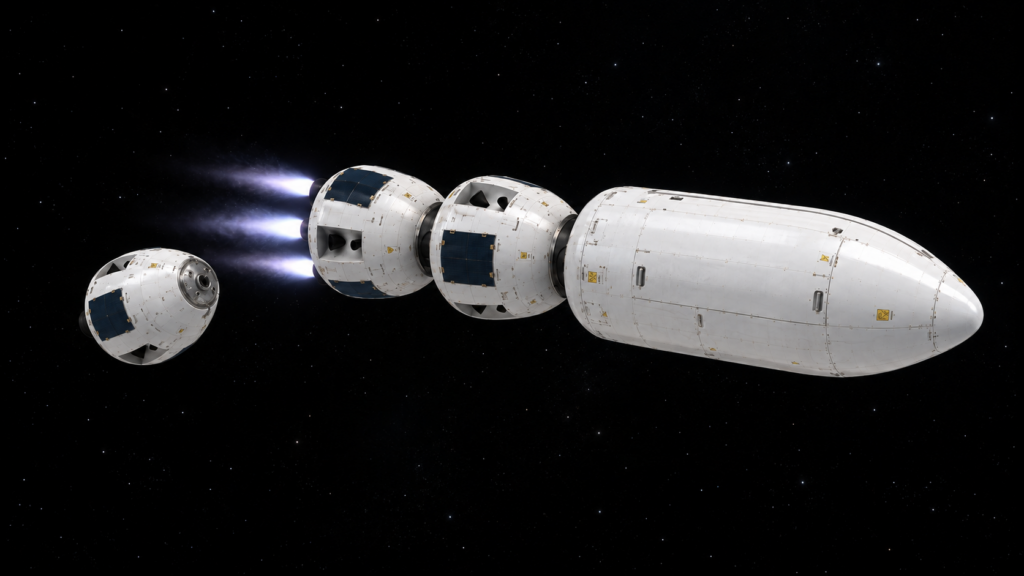
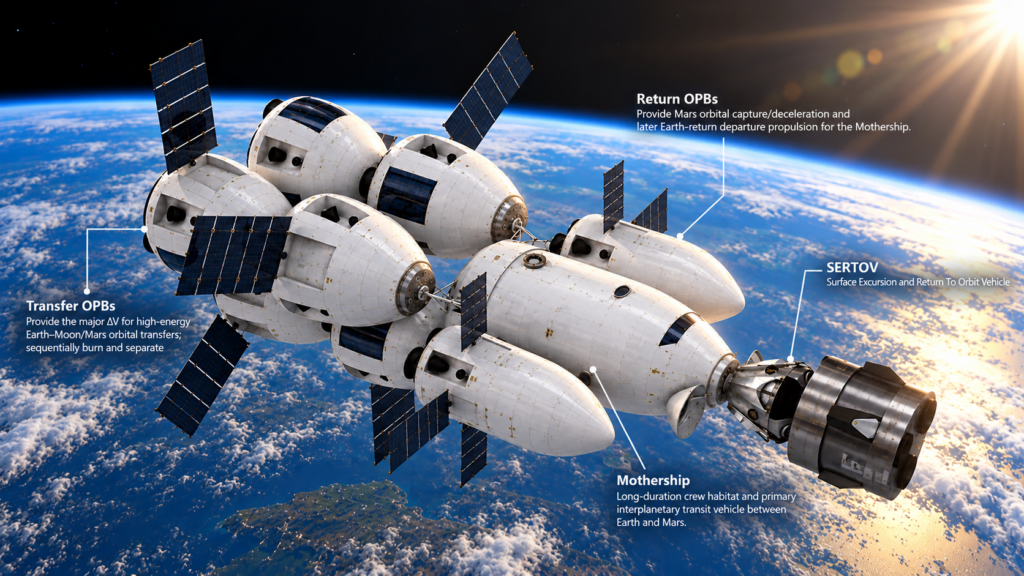
To address this, SICSA has conceptualized an Orbital Propulsion Booster (OPB) system. This innovative approach involves mechanically attaching modular propulsion units to specialized cargo carriers or to a dedicated Mars crew transport vessel, envisioned as a "Mothership." The strategic advantage of this concept lies in leveraging powerful launch systems to efficiently place large masses into orbit. Subsequently, downstream vehicles, optimized for their specific missions, can then utilize these orbital propulsion units for their journeys. This separation of functions allows for greater efficiency and tailored design for each segment of the mission architecture. For instance, the initial launch could deliver a large propulsion module to orbit, which then could be coupled with a cargo payload for transit to the Moon, or later detached and reconfigured to assist a crewed Mars transit vehicle. This modularity and task-specific optimization are key to managing the immense logistical challenges of deep space exploration.
Strategic Imperative 2: Decouple Orbital Vehicles from Surface Habitats
A common pitfall in space architecture is the default assumption that an orbital vehicle, optimized for long-duration transit in microgravity, will also serve as an effective surface habitat. The realities of lunar and Martian environments necessitate distinct design considerations. Weightlessness and partial gravity impose vastly different requirements. On planetary surfaces, fluids behave differently, floors become critical functional elements, vehicles must contend with terrain interactions, and habitats must be engineered to withstand the harsh conditions of dust, extreme thermal cycling, and radiation. An orbital vehicle designed for the zero-gravity transit phase, while perhaps highly advanced, is unlikely to be equally suitable for the demanding conditions of surface operations.
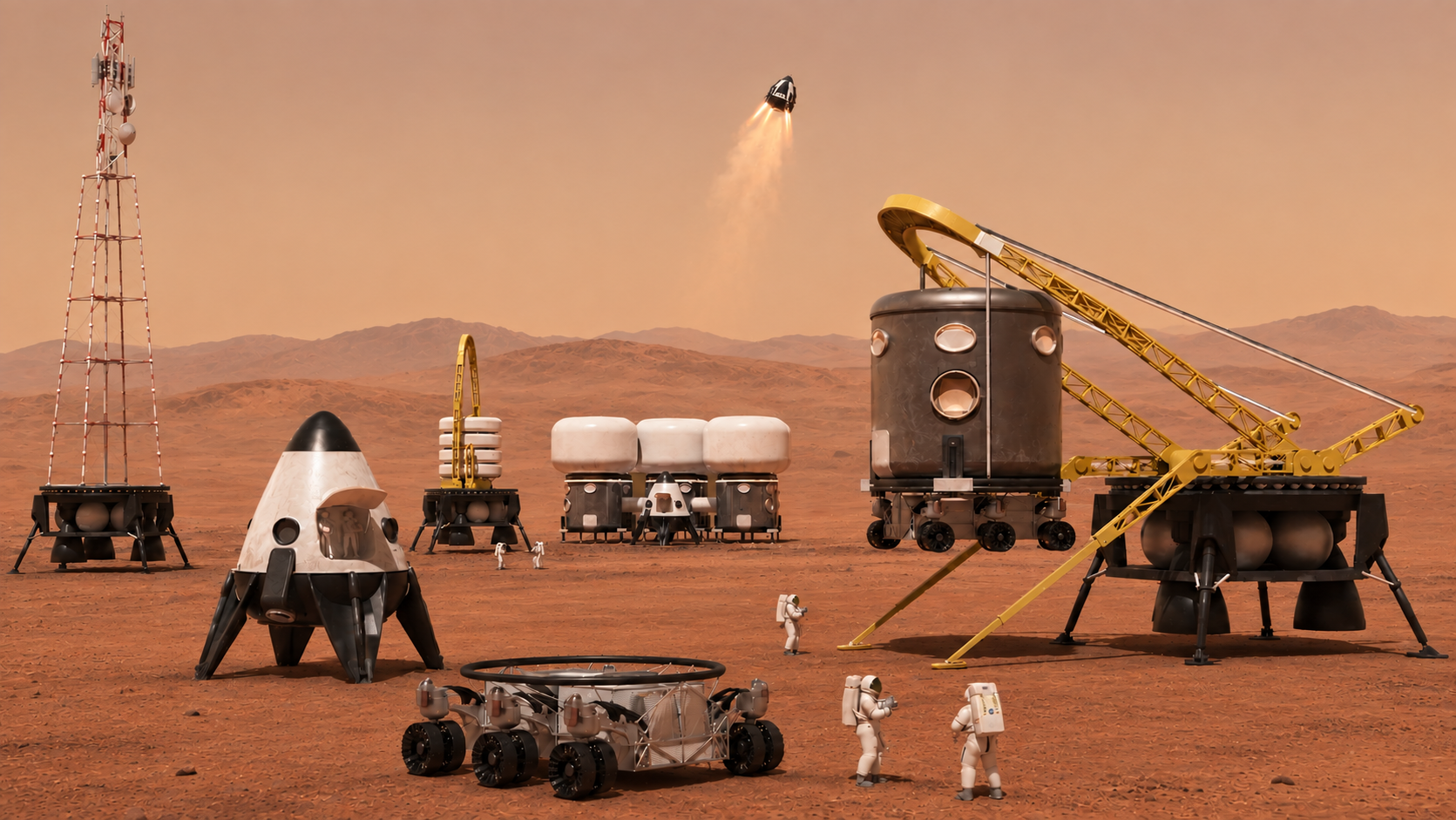
SICSA’s Mars Mothership concept exemplifies this principle of specialization. Under this proposal, the primary long-duration crew environment would remain in orbit aboard the Mothership. For descent to the Martian surface and subsequent ascent back to orbit, smaller, dedicated Surface Excursion and Return-to-Orbit Vehicles would be employed. This approach prioritizes specialization, with each vehicle optimized for its specific role, while ensuring interoperability between these specialized elements. The alternative – attempting to design a single vehicle to perform all functions – would likely result in a suboptimal compromise across all mission phases. This principle of modular, task-specific vehicles, designed for interoperability, is crucial for building flexible and resilient extraterrestrial infrastructure.
Strategic Imperative 3: Establish "Lights-On" Capability Before Crew Arrival
The true utility of any surface settlement or outpost is realized only when its delivered components coalesce into a functioning, operational system. Therefore, a critical imperative is to ensure that essential systems such as power generation, communications infrastructure, mobility capabilities, habitat functions, and logistical support are deployed, positioned, interconnected, and thoroughly tested before human crews become dependent on them. This "lights-on" capability is paramount for mission success and crew safety.
This is particularly crucial for missions to Mars, given the significant travel times involved and the limited launch windows that dictate meticulous planning. The inability to improvise or easily resupply after arrival makes any pre-arrival system readiness absolutely vital. SICSA’s studies consistently envision precursor cargo missions autonomously establishing a fully functional "lights-on" condition prior to the initial crewed landing. This involves deploying and activating power sources, establishing communication links, preparing basic habitat modules, and ensuring mobility assets are ready for immediate use upon the crew’s arrival. This proactive approach mitigates risks and allows the crew to focus on their primary scientific and exploration objectives from the outset.
Strategic Imperative 4: Integrate Landing and Surface Deployment into the Architecture
The act of landing on a celestial body should not be viewed merely as the conclusion of a transportation phase. Instead, it must be considered an integral part of the overall surface architecture. In airless environments like the Moon, the high-velocity ejecta from rocket plumes during landing can pose a significant threat to previously deployed assets, potentially causing damage or contamination. As a settlement grows and expands, the strategic placement of landing zones, the designation of protected areas, the planning of terrain traversability, the establishment of mobility routes, and the selection of infrastructure locations must all be holistically planned in conjunction with each other.
The lunar south pole, a region of intense scientific interest due to its potential for water ice and its challenging terrain, exemplifies the importance of this integrated approach. NASA’s identification of this region’s extreme environmental conditions and complex topography underscores the need for meticulous planning. A landing site is not simply a point of arrival; it is the foundation for a future settlement node, and its design must reflect this long-term perspective. This requires sophisticated simulations and planning tools that can accurately model plume effects, terrain interactions, and the sequential deployment of infrastructure to ensure a safe and efficient build-up of surface capabilities.
Strategic Imperative 5: Design the Surface as an Expandable Network
A forward-thinking space architecture should be designed to accommodate growth and the introduction of new capabilities without requiring a complete redesign of the existing infrastructure. This is best achieved through the implementation of modular systems for power, communications, habitats, cargo elements, and mobility. Such modularity allows for incremental expansion and adaptation of the architecture as mission objectives evolve and new technologies become available.
SICSA’s conceptual work on habitat design explores hybrid modules that combine robust, hard-shell utility cores with flexible, deployable living and working volumes. These can be augmented by specialized modules dedicated to specific functions, such as fabrication, biological research, advanced healthcare, food production, maintenance, and comprehensive logistics management. The overarching architectural objective is not for each individual module to be a self-sufficient entity, but rather for these modules to seamlessly integrate and function as essential components of a larger, cohesive system. This scalable and adaptable approach ensures that a settlement can evolve organically, efficiently utilizing resources and adapting to unforeseen challenges and opportunities.
Strategic Imperative 6: Leverage the Moon as a Stepping Stone to Mars
NASA’s "Moon to Mars" architecture explicitly links the concept of sustained lunar development with the ambitious goal of establishing human presence on Mars and preparing for increasingly complex and lengthy missions to the Red Planet. This strategic linkage elevates the significance of lunar infrastructure; its value extends far beyond lunar exploration if its interfaces and operational concepts are deliberately designed with future interoperability with Mars missions in mind.
The Moon offers an invaluable proving ground for developing and maturing critical technologies. Autonomous cargo deployment, distributed power generation, robust communication networks, advanced mobility systems, standardized habitat interfaces, and sophisticated surface operations techniques can all be tested and refined on the Moon. These technologies can then be deployed to Mars with a higher degree of confidence, mitigating the increased risks associated with the greater distance and more stringent operational constraints of the Martian environment. Furthermore, this common architectural framework can foster broader international participation. By defining standardized interfaces and operational protocols, space agencies and commercial partners worldwide can contribute specialized capabilities, integrating them into a unified and globally supported space exploration endeavor. This collaborative approach not only accelerates progress but also distributes the immense cost and complexity of deep space exploration.
The evolution of space exploration demands a sophisticated and holistic approach to architectural design. By embracing these six strategic imperatives—differentiating crew and cargo, decoupling orbital and surface systems, ensuring pre-arrival readiness, integrating landing into surface planning, designing for expandability, and leveraging lunar experience for Mars missions—NASA and its partners can lay the groundwork for a sustainable and ambitious future among the stars. This paradigm shift from isolated missions to interconnected, evolving systems is not merely an engineering challenge; it is the architectural foundation for humanity’s expansion beyond Earth.
Larry Bell is founder and director emeritus of the Sasakawa International Center for Space Architecture and endowed professor of space architecture at the University of Houston.
Rushabh Mehta is a space architecture professional at the Sasakawa International Center for Space Architecture.