In a landmark discovery that could reshape our understanding of the universe’s most fundamental properties, an international team of astronomers has reported what may be the most compelling evidence to date for ‘vacuum birefringence,’ a bizarre quantum phenomenon predicted almost a century ago. This elusive effect, which posits that even apparently empty space is not truly vacant but rather a bustling arena of ‘virtual particles,’ has long been a cornerstone of quantum electrodynamics (QED), the theory describing how light and matter interact. The findings, published recently in the prestigious journal Nature, offer an unprecedented glimpse into how the vacuum of space itself can influence the passage of light under the most extreme cosmic conditions, potentially opening new avenues for exploring the quantum universe.
The Quantum Enigma: A Universe Not So Empty
The concept of vacuum birefringence originated in the 1930s with the groundbreaking work of Werner Heisenberg, one of the principal architects of quantum mechanics. Heisenberg’s theories, later refined within the framework of QED, suggested a radical departure from classical physics: a perfect vacuum is far from empty. Instead, it is theorized to be teeming with pairs of ‘virtual’ particles and antiparticles – such as electrons and positrons – that spontaneously pop into existence and annihilate each other in timescales so fleeting they cannot be directly observed. These transient particles, though ephemeral, are believed to interact with incredibly powerful electromagnetic fields, causing the vacuum to behave like a weak optical medium. When light traverses such a vacuum, its polarization state can be subtly altered, a phenomenon known as vacuum birefringence.
For decades, detecting this effect has been one of the holy grails of quantum physics. Terrestrial laboratories have attempted to create magnetic fields strong enough to induce observable vacuum birefringence, but the immense strength required – estimated to be over 100 million times greater than any magnetic field ever generated on Earth – has rendered these experiments inconclusive. Nature, however, provides a ready-made laboratory for such extreme physics: magnetars.
Magnetars: Nature’s Ultimate Quantum Laboratories
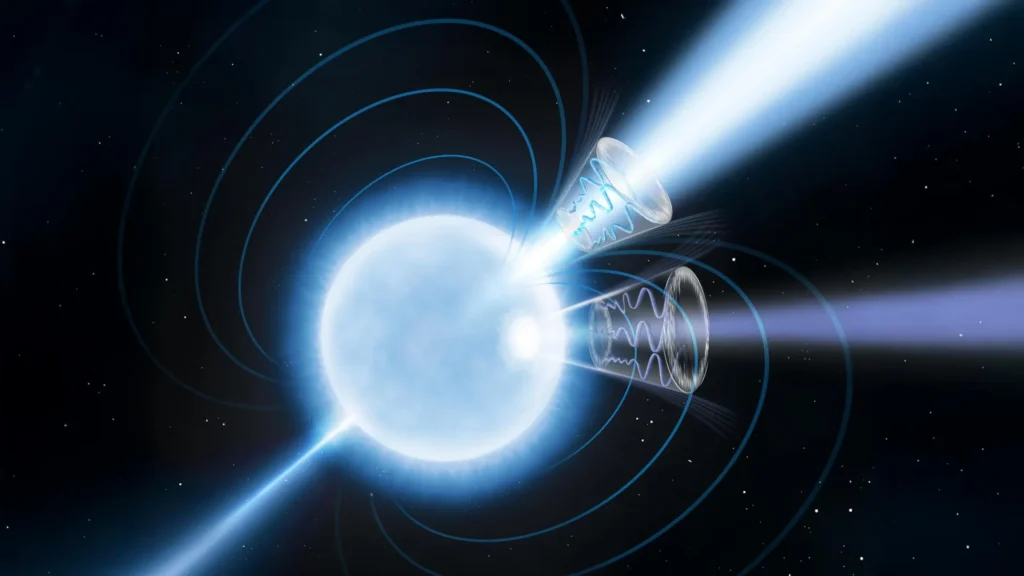
Magnetars are a rare and exotic type of neutron star, the super-dense remnants of massive stars that have collapsed under their own gravity. What distinguishes magnetars from other neutron stars is their extraordinarily powerful magnetic fields, which are the strongest known in the universe. These fields can be thousands of trillions of times stronger than Earth’s magnetic field (which is typically around 0.5 Gauss or 50 microtesla), and millions of times stronger than those found around conventional neutron stars. To put this in perspective, a typical medical MRI scanner operates with a field of about 1.5 to 3 Tesla (15,000 to 30,000 Gauss), while a magnetar’s surface field can reach up to 10^15 Gauss or 10^11 Tesla. It is within these unimaginably intense magnetic environments that the subtle effects of virtual particles are predicted to become significant enough to influence the propagation of light, specifically by inducing vacuum birefringence.
"Detecting vacuum birefringence requires a magnetic field that is over 100 million times stronger than any we’ve ever made on Earth," explained Dr. Marcus Lower from Swinburne University of Technology, a key member of the international research team. "Thankfully, nature has provided us with magnetars, which are the perfect cosmic laboratories to go looking for this effect."
The Observational Campaign: Peering into the Extreme
The research team focused their efforts on a specific magnetar designated 1E 1547.0-5408, or 1E1547 for short. This particular object, located approximately 15,000 light-years away in the constellation Norma, was chosen due to its exceptionally strong magnetic field and its favorable viewing geometry from Earth. The observational campaign involved a synergistic approach, combining data from several cutting-edge astronomical instruments.
A primary instrument for these observations was NASA’s Imaging X-ray Polarimetry Explorer (IXPE). Launched in December 2021, IXPE is a space observatory specifically designed to measure the polarization of X-rays from cosmic sources. X-ray polarization provides crucial information about the magnetic fields and particle acceleration mechanisms in extreme astrophysical environments. By measuring how the X-rays emitted by 1E1547 were polarized, the researchers could infer details about the magnetic field structure and the interactions occurring within it.
Complementing IXPE’s X-ray data were observations from NASA’s Neutron star Interior Composition Explorer (NICER) telescope, located aboard the International Space Station. NICER provides high-precision timing and spectroscopy of X-ray emissions, offering additional insights into the magnetar’s activity and helping to characterize its X-ray spectrum.
Crucially, the team also utilized radio observations collected by Dr. Lower himself, using Murriyang, CSIRO’s Parkes radio telescope. This iconic 64-meter radio dish, owned and operated by Australia’s national science agency, provided vital information about the magnetar’s radio emissions and how their polarization changed as the star rotated. The analysis of these complex radio data, particularly concerning the rotation and polarization shifts, was performed using Swinburne’s Ngarrgu Tindebeek supercomputer, highlighting the essential role of advanced computational power in modern astrophysics.
Key Evidence and Findings
The observational data from 1E1547 presented two critical clues strongly indicative of vacuum birefringence. Firstly, the X-rays detected by IXPE exhibited exceptionally high levels of polarization. Polarization refers to the orientation of the oscillations of light waves. When light is polarized, its electric field oscillates predominantly in a particular direction. The degree of polarization observed in the magnetar’s X-rays was significantly higher than what would be expected from standard astrophysical processes alone.
Secondly, and perhaps even more tellingly, the direction of this X-ray polarization remained consistently tied to the magnetic field of 1E1547, mirroring the pattern observed in the radio data. The researchers meticulously tracked how the radio waves changed direction as the magnetar rotated, a process that allowed them to determine the alignment between the star’s magnetic axis and its rotational axis. They found that for 1E1547, these axes are almost perfectly aligned, and the magnetar is observed from a nearly ‘pole-on’ perspective. This unique geometric configuration provides an unusually favorable view for detecting the subtle effects of vacuum birefringence.
"Because of the magnetic field’s strength, Heisenberg’s virtual particles become aligned with the direction the field is pointing," Dr. Lower elaborated. "By carefully tracking the direction the radio waves and X-rays oscillate as the magnetar rotates, the team found that the alignment of 1E1547’s magnetic and rotational poles were ideal for detecting vacuum birefringence." The consistent alignment of both radio and X-ray polarization with the magnetic field, particularly in such an extreme environment, strongly suggests that the vacuum itself is playing an active role in modifying the light’s properties, precisely as QED predicts for vacuum birefringence.
Historical Context and Theoretical Foundations
The journey to this potential detection spans nearly a century, rooted deeply in the revolutionary ideas of quantum mechanics. Werner Heisenberg’s initial prediction in 1934, alongside Hans Heinrich Euler, laid the theoretical groundwork, proposing that quantum fluctuations could cause the vacuum to become birefringent in the presence of strong electromagnetic fields. This concept was further developed within Quantum Electrodynamics (QED), which emerged in the mid-20th century as one of the most successful and precisely tested theories in physics. QED describes how light (photons) and charged particles (like electrons) interact, and it inherently incorporates the idea of a fluctuating quantum vacuum.
The challenge, however, has always been to find conditions extreme enough to make these theoretical predictions experimentally verifiable. While QED has been validated to astonishing precision in many contexts – for example, in calculating the anomalous magnetic moment of the electron – direct evidence for vacuum birefringence has remained elusive. Previous attempts, such as the PVLAS experiment in Italy, have set upper limits on the effect but have not yielded a definitive detection. The magnetar observation thus represents a significant leap, moving the phenomenon from the realm of pure theory and laboratory limits into the observable cosmos.
Expert Commentary and Institutional Roles
The collaborative nature of this discovery highlights the global effort in cutting-edge astrophysics. Swinburne University of Technology in Australia, through Dr. Marcus Lower’s involvement and the use of its supercomputing facilities, played a crucial role in the radio observations and data analysis. NASA’s IXPE mission, a joint effort with the Italian Space Agency (ASI), provided the critical X-ray polarimetry data, underscoring the importance of international space-based observatories. CSIRO’s Parkes radio telescope (Murriyang) contributed essential ground-based observations, demonstrating the continued relevance of established facilities in new discoveries.
While the current findings are highly compelling, the scientific community maintains a rigorous standard for "definitive detection." Dr. Lower acknowledged this, stating, "Although vacuum birefringence was predicted in the 1930s, scientists have yet to obtain a definitive detection." This cautious optimism is typical in groundbreaking scientific endeavors, emphasizing the need for further verification. The current evidence is strong, but additional data and refinements in theoretical modeling will be key to solidifying this claim.
Challenges and Future Research
Confirming this interpretation as the definitive detection of vacuum birefringence will require further investigation. The complex environments around magnetars involve numerous physical processes that could potentially influence light polarization. Distinguishing the unique quantum signature of vacuum birefringence from other astrophysical effects, such as scattering by plasma or anisotropic emission from the magnetar’s surface, is a critical challenge.
Dr. Lower outlined the path forward: "Additional observations and more advanced computer simulations could help establish whether the signal truly comes from vacuum birefringence. Those improvements should make it easier for researchers to distinguish the predicted quantum signature from other physical processes taking place around magnetars." Future missions with enhanced polarimetry capabilities, or extended observations of 1E1547 and other magnetars, will be instrumental. Refining the theoretical models that describe the propagation of light through such extreme magnetic fields will also be essential to confirm the findings unequivocally.
Broader Impact and Implications
If confirmed, this detection carries profound implications across several fields of physics. For quantum mechanics, it would provide a spectacular validation of one of its most exotic and counter-intuitive predictions, cementing QED’s status as an extraordinarily accurate description of fundamental interactions even under the most extreme conditions imaginable. It would demonstrate that the ’empty’ vacuum is indeed a dynamic entity, capable of influencing physical phenomena.
For astrophysics, this discovery would equip scientists with a powerful new tool. By studying vacuum birefringence in magnetars, researchers could gain unprecedented insights into the properties of these enigmatic objects, including the precise strength and configuration of their magnetic fields, which are notoriously difficult to measure directly. It could also offer a new window into the physics of neutron star surfaces and magnetospheres, where matter exists in states far beyond anything achievable in terrestrial laboratories.
Beyond the immediate scientific applications, the potential detection of vacuum birefringence touches upon fundamental questions about the nature of reality. It reinforces the idea that what appears to be empty space is, at a quantum level, a vibrant and dynamic medium, constantly fluctuating with virtual particles. This understanding deepens our appreciation for the intricate and often surprising ways in which the universe operates at its most fundamental scales.
"With these future data on hand and our updated simulations, we may finally be able to complete the quest started by Heisenberg nearly 90 years ago," Dr. Lower concluded, reflecting on the long journey from theoretical prediction to potential cosmic validation. The ongoing exploration of magnetars, fueled by advanced observatories and computational power, promises to continue unveiling the universe’s deepest quantum secrets. The paper, titled "Vacuum birefringence and the polarized X-ray emission of a radio magnetar," stands as a testament to humanity’s relentless pursuit of knowledge at the cosmic frontier.