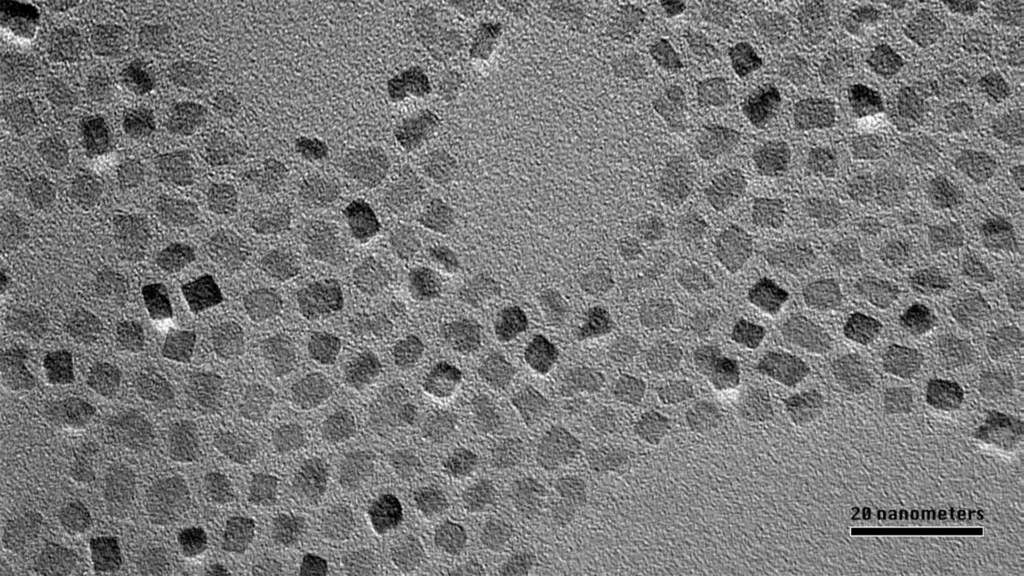
The field of materials science has been revolutionized by the advent of nanocrystals, microscopic structures that exhibit extraordinary properties distinct from their bulk counterparts. This transformative impact was underscored by the 2023 Nobel Prize in Chemistry, awarded for the groundbreaking discovery and development of quantum dots, a specific class of nanocrystals. While quantum dots have garnered significant attention, the broader potential of nanocrystal technology has been constrained by the limited range of materials amenable to their synthesis. This limitation has now been significantly addressed by a team of chemists from the University of Chicago and Argonne National Laboratory, who have successfully developed a novel method for creating nanocrystals from metal nitrides, a class of materials previously considered recalcitrant to such fabrication. This pioneering work, published in the prestigious journal Nature, is poised to unlock a wealth of new applications, ranging from advanced flexible electronics and vibrant lighting solutions to biocompatible medical implants.
Unlocking the Potential of Metal Nitride Nanocrystals
Metal nitrides are already indispensable components across a vast spectrum of technological and industrial applications. Gallium nitride (GaN), for instance, is a cornerstone of modern lighting technology, powering everything from energy-efficient LED bulbs that illuminate our homes and offices to the vibrant displays on our laptops and smartphones. The ability to transform these robust materials into nanocrystals opens up a vista of possibilities. Currently, metal nitrides are primarily utilized in rigid films. However, in their nanocrystalline form, they could be incorporated into polymers, enabling the creation of flexible electronic components. They could be printed using advanced inkjet techniques for intricate designs or woven into fabrics, paving the way for smart textiles and wearable technology.
“This development pushes the boundaries of what was previously thought to be fundamentally constrained in nanomaterials,” stated Dmitri Talapin, the Ernest DeWitt Burton Distinguished Service Professor of Chemistry and Molecular Engineering at the University of Chicago and a distinguished scientist at Argonne National Laboratory, who served as the senior author on the research paper. “It lays the critical foundation for the widespread utilization of nitrides as versatile nanomaterials.”
Ruiming Lin, a graduate student at the University of Chicago and the first author of the new study, elaborated on the team’s achievement: “We have successfully demonstrated a method to synthesize nearly a dozen materials that were previously impossible to create using traditional nanocrystal synthesis techniques.” This significant breakthrough addresses a long-standing bottleneck in materials science, offering a pathway to harness the unique properties of metal nitrides at the nanoscale.
The Profound Utility of Nanocrystals
Nanocrystals, by definition, are extraordinarily small crystals, with millions or even billions capable of fitting onto the surface of a single fingernail. At this minuscule scale, materials often exhibit drastically altered properties compared to their bulk counterparts. These emergent phenomena can include the emission of brilliant light, as seen in quantum dots, or enhanced catalytic activity, making them exceptionally effective at accelerating chemical reactions.
Theoretically, scientists should be able to engineer nanocrystals from an immense variety of substances. However, in practice, a considerable number of materials have proven exceptionally difficult, if not entirely impossible, to produce in this form. Lin and his colleagues within Talapin’s laboratory embarked on a mission to overcome these inherent limitations.
Their research focused specifically on metal nitrides, compounds formed by the chemical union of metals with nitrogen. This class of materials is characterized by its exceptional strength, inherent biocompatibility, and remarkable resistance to both high temperatures and corrosive environments. These attributes make metal nitrides highly desirable for a wide array of applications, including those in consumer electronics. Paradoxically, the very stability that renders them so valuable also presents a formidable obstacle to their transformation into nanocrystals.
The Challenge of Strong Bonds: A Decades-Old Hurdle
The process of nanocrystal formation involves the controlled arrangement of atoms or ions into a crystalline lattice. For this to occur effectively, the constituent ions must possess sufficient mobility to rearrange themselves before settling into their final, stable positions. This dynamic process can be likened to partners shifting positions during a complex dance. In the case of metal nitrides, the chemical bonds between the metal and nitrogen atoms are exceptionally strong. This inherent strength significantly restricts the mobility of the ions, making the necessary rearrangement during crystal growth exceedingly difficult.
“If the bonds cannot break during this critical formation process, it essentially spells the end for successful nanocrystal synthesis,” explained Professor Talapin. “Any misstep in bond formation at this nascent stage can lead to a cascade of errors, rendering the entire effort futile.”
The research team identified that overcoming this formidable challenge required two key conceptual and technical advancements.
The first critical step built upon a prior discovery within the Talapin laboratory, which established that molten salts could serve as an effective liquid medium for nanocrystal synthesis. Molten salts, under specific conditions, can provide a stabilizing environment for the nascent nanocrystals, mitigating the tendency for uncontrolled aggregation or decomposition.
The second, and perhaps most innovative, aspect of their approach involved extensive experimentation to pinpoint a precise "sweet spot" in terms of reaction conditions. This involved carefully calibrating the temperature and the pressure of ammonia – a crucial component in nitride formation. Under these meticulously controlled parameters, the researchers found that the otherwise robust bonds between metal and nitrogen atoms could be selectively weakened and reformed. This controlled breaking and reforming of bonds allowed the crystal structure to organize itself correctly, leading to the formation of stable, well-defined metal nitride nanocrystals.
“This process is highly unconventional; it defies much of the conventional wisdom in the field,” remarked Professor Talapin. “We had to fundamentally re-evaluate and rethink our entire approach to synthesizing these materials.”
A Cascade of Newly Synthesized Nanocrystal Materials
The success of this novel method extended far beyond the synthesis of gallium nitride nanocrystals. The team demonstrated its versatility by successfully producing nanocrystals from several other related nitride materials, each with its own significant industrial and technological relevance. These included:
- Titanium Nitride (TiN): Widely used in medical implants due to its biocompatibility and wear resistance, as well as in coatings for tools and architectural elements.
- Niobium Nitride (NbN): An important superconducting material with applications in advanced electronics, magnetic resonance imaging (MRI) magnets, and high-frequency detectors.
- Molybdenum Nitride (MoN): Commonly employed as a catalyst in various chemical processes, including petroleum refining and ammonia synthesis.
These newly synthesized nanocrystalline materials are not only technologically valuable but also relatively cost-effective in their bulk forms. The researchers are optimistic that their conversion into nanocrystals will unlock their potential for an even broader and more sophisticated range of applications.
“I vividly recall the moment I first observed these crystals under the electron microscope,” shared Ruiming Lin, the lead author. “There’s always a profound hope that one’s discoveries will ultimately find practical applications. I am confident that these new nanocrystals will have numerous significant uses.”
The collaborative effort involved a multidisciplinary team from the University of Chicago, with contributions from Ningxin Jiang, Wooje Cho, Zirui Zhou, Di Wang, Justin Ondry, Zehan Mi, James Cassidy, Alex Hinckle, Alexander Filatov, and John S. Anderson. The researchers leveraged state-of-the-art facilities, including the National Science Foundation Materials Research Science and Engineering Center at the University of Chicago, the UChicago Soft Matter Characterization Facility, and the Center for Nanoscale Materials at Argonne National Laboratory.
This groundbreaking research was supported by funding from the U.S. Department of Energy, the Samsung QD Cluster Collaboration, the National Science Foundation, and the Air Force Office of Scientific Research, underscoring the broad governmental and industrial interest in advancing nanomaterials science.
Broader Implications and Future Directions
The successful synthesis of metal nitride nanocrystals represents a paradigm shift in materials science. For decades, the inherent stability of these compounds has been both their greatest asset and their most significant limitation in the realm of nanotechnology. This breakthrough not only overcomes a fundamental barrier but also opens up avenues for research that were previously unimaginable.
Impact on Electronics: The ability to integrate metal nitride nanocrystals into flexible substrates could lead to the development of truly flexible displays, bendable sensors, and even electronic paper that is both durable and energy-efficient. This could revolutionize consumer electronics, wearable technology, and the Internet of Things (IoT).
Advancements in Healthcare: Biocompatible metal nitride nanocrystals, such as those derived from titanium nitride, could find new applications in advanced drug delivery systems, targeted therapies, and next-generation medical implants. Their unique properties might enable novel functionalities, such as enhanced integration with biological tissues or the development of smart implants that can monitor physiological conditions.
Catalysis and Energy: The enhanced surface area and unique electronic properties of metal nitride nanocrystals could lead to more efficient catalysts for industrial processes, potentially reducing energy consumption and waste. In the energy sector, they might contribute to improved battery technologies or more efficient solar cells.
Lighting and Optics: Beyond the established use of gallium nitride in LEDs, nanocrystalline forms could enable novel lighting solutions with tunable colors, higher efficiency, and unique form factors, such as transparent or integrated lighting.
The research team’s work is not only a testament to scientific ingenuity but also a harbinger of future innovations. As the understanding and control of these nanoscale materials deepen, we can anticipate a wave of new technologies that leverage their remarkable properties, fundamentally reshaping various industries and improving aspects of our daily lives. The implications of this breakthrough are far-reaching, promising a future where the limitations of materials science are continuously pushed forward by the power of nanoscale engineering.