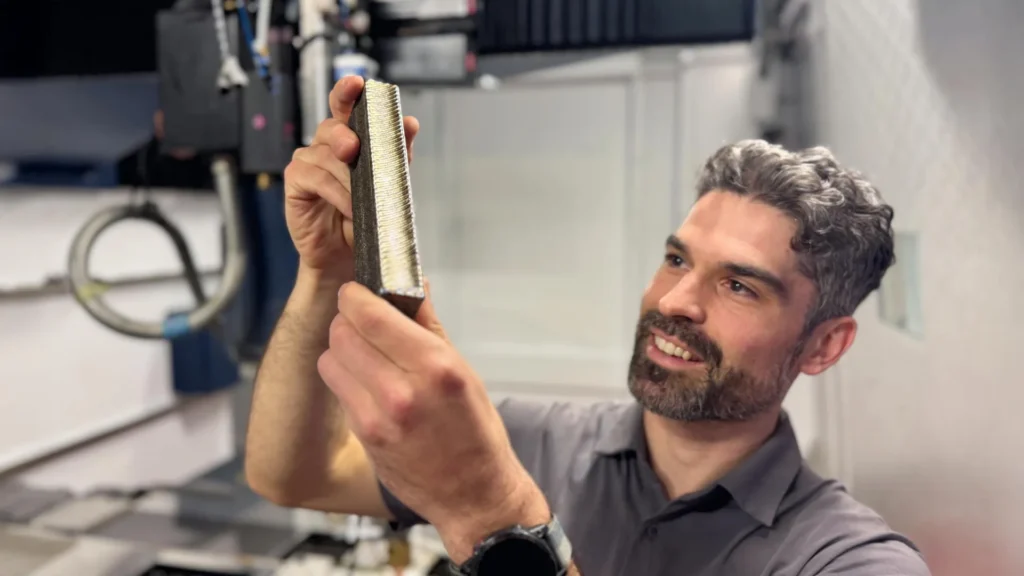
Engineers at RMIT University in Melbourne, Australia, have achieved a significant breakthrough in additive manufacturing with the development of a novel 3D-printable titanium alloy. This innovative material is projected to be approximately one-third cheaper than conventional titanium alloys currently used in critical industries such as aerospace and medical devices. The research, which has led to a provisional patent filing by RMIT, addresses long-standing limitations in the widespread adoption of 3D printing for metallic components, offering a compelling combination of cost savings, improved material properties, and enhanced manufacturing predictability.
A New Era for 3D-Printed Titanium
The cornerstone of this advancement lies in RMIT’s innovative approach to alloy composition. Traditionally, titanium alloys for additive manufacturing, such as the widely utilized Ti-6Al-4V (titanium-6 aluminum-4 vanadium), rely on expensive elements like vanadium. The RMIT team has successfully formulated a new alloy by substituting these costly components with more readily available and economical alternatives. This strategic shift in material science not only drives down production costs but also unlocks the full potential of 3D printing technology, which is inherently designed for faster, less wasteful, and more customizable manufacturing processes.
Ryan Brooke, a PhD candidate at RMIT’s Centre for Additive Manufacturing (RCAM) and the lead author of the study, highlighted the limitations of existing titanium alloys in the context of additive manufacturing. "3D printing allows faster, less wasteful and more tailorable production yet we’re still relying on legacy alloys like Ti-6Al-4V that doesn’t allow full capitalization of this potential. It’s like we’ve created an aeroplane and are still just driving it around the streets," Brooke explained. He emphasized that the development of new alloy types is crucial for pushing the boundaries of what is achievable with 3D printing. "New types of titanium and other alloys will allow us to really push the boundaries of what’s possible with 3D printing and the framework for designing new alloys outlined in our study is a significant step in that direction."
The findings of this groundbreaking research have been meticulously detailed in the prestigious scientific journal Nature Communications, underscoring the significance and rigor of the work. RMIT is actively exploring commercialization opportunities, aiming to bring this low-cost, high-performance titanium alloy to market for applications where precision, strength, and cost-effectiveness are paramount.
Unlocking Predictability and Performance
Beyond the significant cost reduction, the new RMIT alloy demonstrates a superior printing behavior and enhanced mechanical properties. A key challenge in 3D printing metals has been achieving consistent and predictable grain structures. In many conventional 3D-printed titanium alloys, the rapid cooling rates inherent in the process can lead to the formation of undesirable columnar microstructures. These structures can result in uneven mechanical properties, compromising the overall integrity and reliability of the printed part.
The RMIT team’s research provides a clearer framework for predicting and controlling the printed grain structure of metallic alloys in additive manufacturing. Their novel alloy design process actively avoids the formation of these detrimental columnar microstructures. This leads to more uniform printing and, consequently, more consistent and reliable mechanical performance.
"By developing a more cost-effective formula that avoids this columnar microstructure, we have solved two key challenges preventing widespread adoption of 3D printing," stated Brooke. He elaborated on his extensive market validation efforts, including participation in CSIRO’s ON Prime program, where he engaged with industry leaders in aerospace, automotive, and MedTech. "What I heard loud and clear from end users was that to bring new alloys to market, the benefits have to not just be minor incremental steps but a full leap forward, and that’s what we have achieved here," Brooke asserted.
The benefits are multifaceted. The alloy not only boasts reduced production costs but also exhibits improved strength and ductility. This combination of attributes is precisely what end-users in demanding sectors have been seeking. The ability to produce titanium alloys with a uniform grain structure, at a lower cost, while simultaneously enhancing their strength and ductility represents a significant leap forward, moving beyond incremental improvements to a truly transformative solution.
The Framework for Innovation
The research published in Nature Communications outlines a time- and cost-saving methodology for selecting elements for alloying, specifically designed to leverage the advantages of emerging 3D printing technologies. This systematic approach provides a valuable blueprint for future alloy development in additive manufacturing. It moves beyond trial-and-error experimentation, offering a more rational and predictive pathway to designing advanced metallic materials.
The team’s alloy, while not publicly detailed in the study for commercial confidentiality reasons, has undergone rigorous testing. These tests have confirmed its superiority in both cost and performance. The alloy is approximately 29% cheaper to produce than standard titanium, a figure that translates into substantial savings for manufacturers. Furthermore, the improved printability and uniform grain structure contribute to enhanced mechanical properties, making it a highly attractive option for high-stakes applications.
Chronology of Innovation
The development of this new titanium alloy represents the culmination of dedicated research and development at RMIT University’s Centre for Additive Manufacturing. While a precise timeline for the initial ideation and experimental phases is not publicly available, the publication of the findings in Nature Communications and the subsequent provisional patent filing indicate a significant period of intensive work.
- Early-to-Mid Research Phase: The team likely engaged in extensive theoretical modeling and material science research to identify potential substitute elements for vanadium and to understand their interactions within a 3D printing context. This phase would have involved numerous simulations and laboratory experiments to test fundamental alloy properties.
- Alloy Formulation and Testing: Based on initial findings, the RMIT engineers developed and refined specific alloy compositions. This would have been followed by a rigorous testing regime to assess the mechanical properties, printability, and microstructural characteristics of the newly formulated alloys. Early tests would have focused on identifying promising candidates.
- Optimization and Validation: Further refinement of the alloy composition and printing parameters would have occurred to optimize performance and cost-effectiveness. Crucially, the team would have focused on addressing the challenges of microstructural control, aiming for uniform grain structures.
- Market Validation and Commercialization Exploration: Concurrent with or following the technical validation, Ryan Brooke’s engagement with industry through programs like CSIRO’s ON Prime signifies a proactive effort to understand market needs and potential applications. This phase is critical for bridging the gap between academic research and industrial adoption.
- Publication and Patent Filing: The formal documentation of the research in Nature Communications and the filing of a provisional patent are key milestones, signaling the maturity of the technology and the university’s intent to protect its intellectual property and explore commercial pathways.
- Future Development: The current phase focuses on seeking strategic partnerships to further develop and scale the technology, moving towards eventual commercial production.
Supporting Data and Scientific Foundation
The scientific underpinnings of this innovation are rooted in a deep understanding of metallurgy and additive manufacturing processes. The research provides a clearer framework for predicting the printed grain structure of metallic alloys. This predictive capability is a significant advancement, moving beyond empirical observation to a more science-driven approach to alloy design.
The published study details a methodology that allows for the efficient selection of alloying elements. This framework is designed to capitalize on the unique capabilities of additive manufacturing, which can create complex geometries and internal structures not possible with traditional manufacturing methods. By understanding how different elements influence the solidification process during 3D printing, engineers can design alloys that are not only cost-effective but also exhibit superior performance characteristics.
The specific data regarding the cost savings, while not providing the exact alloy composition for commercial reasons, is compelling. A 29% reduction in production cost is a significant incentive for industries that rely heavily on titanium. When combined with improved strength and ductility, this cost advantage becomes even more impactful.
The avoidance of columnar microstructures is a critical technical achievement. This is often addressed through post-processing techniques like heat treatment, which add time and cost to the manufacturing process. By designing the alloy to intrinsically avoid these structures, the RMIT team is streamlining the production of high-quality 3D-printed titanium components.
Official Responses and Industry Perspectives
Professor Mark Easton, the corresponding author of the study and a key figure at RMIT’s Centre for Additive Manufacturing (RCAM), expressed considerable optimism about the future of this new alloy. "We are very excited about the prospects of this new alloy, but it requires a team from across the supply chain to make it successful. So, we are looking for partners to provide guidance for the next stages of development," Professor Easton stated. This call for collaboration highlights the university’s commitment to translating its research into tangible industrial applications.
The involvement of industry representatives during the market validation phase, as described by Ryan Brooke, indicates a strong alignment with market demands. The feedback from aerospace, automotive, and MedTech sectors suggests a clear need for transformative solutions, not just incremental improvements. The RMIT alloy appears to meet this demand by offering a substantial leap forward in cost-effectiveness, performance, and manufacturing predictability.
While specific reactions from potential industry partners are not yet public, the general sentiment within the advanced manufacturing sectors is one of keen interest in novel materials that can enhance the capabilities and reduce the costs of additive manufacturing. Companies are actively seeking ways to leverage 3D printing for critical applications, and materials that offer a compelling combination of benefits are highly sought after.
Broader Impact and Implications
The implications of RMIT’s breakthrough are far-reaching, potentially reshaping the landscape of additive manufacturing for titanium.
Aerospace Industry: The aerospace sector is a significant consumer of titanium alloys due to their high strength-to-weight ratio and corrosion resistance. The development of a cheaper, stronger, and more predictable 3D-printable titanium alloy could lead to lighter aircraft components, reduced manufacturing costs, and faster production cycles for critical parts like engine components, structural elements, and landing gear. This could contribute to improved fuel efficiency and reduced environmental impact.
Medical Device Industry: In the medical field, titanium is widely used for implants, prosthetics, and surgical instruments due to its biocompatibility and durability. A more cost-effective 3D-printable titanium alloy could make advanced customized medical devices more accessible and affordable. This could lead to improved patient outcomes and a broader range of treatment options. The ability to print complex, patient-specific implants with enhanced properties could revolutionize personalized medicine.
Automotive Sector: While perhaps less prevalent than in aerospace and medical, titanium is also finding increasing use in high-performance automotive applications, such as exhaust systems and engine components, where weight reduction and high-temperature resistance are critical. The cost savings offered by the new alloy could make its adoption more widespread in these demanding areas.
Advancement of Additive Manufacturing: This research contributes significantly to the broader field of additive manufacturing by providing a clear framework for alloy design and demonstrating a successful pathway to overcome key technical hurdles. It encourages further innovation in material science, paving the way for the development of other advanced metallic materials tailored for 3D printing. The success of this project highlights the potential of universities to drive industrial innovation through fundamental research and strategic commercialization efforts.
The samples for this groundbreaking work were produced and tested at RMIT’s cutting-edge Advanced Manufacturing Precinct, a facility equipped with state-of-the-art additive manufacturing and materials characterization equipment. This provides a robust foundation for the ongoing development and scaling of the technology. The successful commercialization of this new titanium alloy by RMIT University could mark a pivotal moment in the evolution of 3D printing, making advanced manufacturing capabilities more accessible and impactful across a wide spectrum of industries.