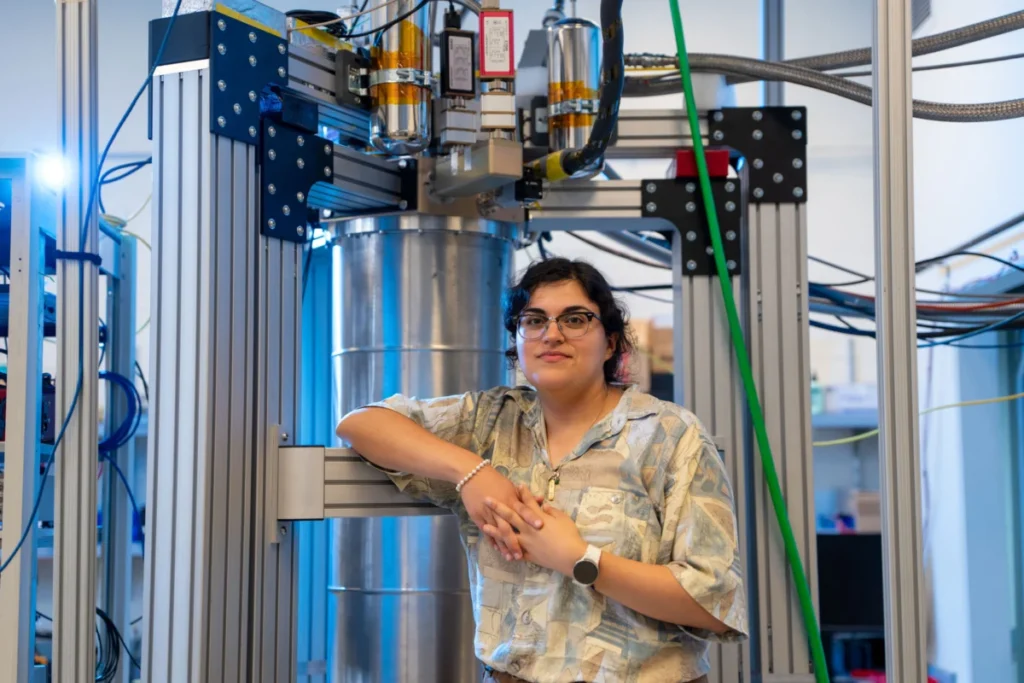
In the high-stakes world of experimental particle physics, the smallest particles often yield the most significant questions about the nature of the universe. For Reyes, a sixth-year PhD student in the Formaggio Group within the Laboratory for Nuclear Science at the Massachusetts Institute of Technology (MIT), these questions are centered on the neutrino. Often referred to as "ghost particles," neutrinos are elementary particles that possess vanishingly little mass and lack an electric charge, allowing them to pass through ordinary matter almost entirely undetected. Every second, trillions of neutrinos produced by the sun stream through the human body, yet they leave no trace and cause no sensation. To study them is to peer into the very fabric of existence, seeking answers that the current framework of physics, known as the Standard Model, cannot fully provide.
The Standard Model has served as the bedrock of particle physics for over half a century, successfully describing three of the four fundamental forces and the zoo of subatomic particles that compose our reality. However, as Reyes notes, the model is famously incomplete. It does not account for gravity, it offers no explanation for dark matter, and it originally predicted that neutrinos should have no mass at all—a theory debunked by the discovery of neutrino oscillations at the turn of the millennium. By investigating the unusual behavior of these particles, researchers like Reyes hope to find the "new physics" that lies beyond current human understanding.
The Ricochet Experiment and the Quest for CEvNS
Reyes’ research is conducted under the auspices of the Ricochet neutrino experiment, a high-profile international collaboration designed to observe a specific and elusive phenomenon: coherent elastic neutrino-nucleus scattering (CEvNS). While neutrinos were first hypothesized in 1930 and detected in 1956, CEvNS remained a theoretical prediction for decades due to the extreme difficulty of detecting the low-energy recoil of an atomic nucleus after being struck by a neutrino. It was not until 2017 that the COHERENT collaboration first observed this process, opening a new window into neutrino physics.
The Ricochet experiment is situated at the Institut Laue-Langevin (ILL) in Grenoble, France, home to one of the world’s most intense sources of neutrinos: a high-flux nuclear research reactor. In the heart of a nuclear reactor, the beta decay of fission products releases a staggering number of antineutrinos. By placing sophisticated detectors near this source, the Ricochet team can study these particles in a controlled environment. The goal is to measure the CEvNS process with unprecedented precision, looking for deviations from the Standard Model that could signal the existence of "sterile neutrinos" or other exotic particles.
Reyes’ role in this global effort involves the technical management and operation of the experiment’s detectors. These are not typical sensors; they must be sensitive enough to detect the minute energy deposited when a single neutrino scatters off a nucleus, a task akin to hearing a pin drop in the middle of a hurricane.
Adaptability in the Face of Academic Realities
The path of a doctoral candidate is rarely a straight line, and Reyes’ experience is a testament to the necessity of adaptability in high-level research. When she first joined the Ricochet collaboration, she expected to focus on a project based locally at MIT. However, experimental physics is often subject to the timelines of hardware development, funding cycles, and logistical hurdles. A few years into her residency, it became evident that the MIT-based project would not reach fruition within the window of her PhD timeline.
Rather than allowing this setback to stall her progress, Reyes pivoted. She shifted her focus to the work being conducted on-site in France. This transition required her to immerse herself in the technical minutiae of the experiment’s detectors, moving from theoretical planning to the hands-on realities of experimental maintenance and data acquisition.
Her first stint in Grenoble lasted three months, a period characterized by the "routine work" of particle physics—calibration, monitoring, and troubleshooting. At that stage, the experiment was operating with only two detectors. However, as the project scaled up to nine and eventually 18 detectors, the complexity of managing the system grew exponentially. The manual processes that worked for two sensors were no longer sustainable for a larger array.
Innovation Through Automation: Replacing the Self
Faced with a mounting workload of repetitive tasks, Reyes and a colleague identified an opportunity for innovation. They recognized that the low-level analysis and constant monitoring of the detectors could be streamlined through software. Together, they developed a comprehensive software framework designed to automate the monitoring and preliminary data analysis that Reyes had previously performed by hand.
This project was more than a labor-saving measure; it was a critical contribution to the experiment’s infrastructure. By building tools that could "replace" her daily manual tasks, Reyes gained a profound, bottom-up understanding of how the entire experimental system functioned. This move from operator to architect of the system marked a turning point in her professional development.
"It’s sort of like you’re building your own stuff to replace yourself," Reyes observed. This philosophy of automation is a hallmark of modern "Big Science." As experiments grow in scale and data volume, the ability of individual researchers to manually oversee every data point diminishes. The software framework developed by Reyes ensures that the Ricochet experiment can maintain high data fidelity as it continues to expand, allowing physicists to focus on high-level interpretation rather than rote monitoring.
Leadership and the Evolution of a Physicist
Beyond the technical achievements, Reyes’ journey reflects a significant personal and professional evolution. In the early stages of her academic career, she admits to a preference for following established protocols rather than asserting her own scientific vision. The transition to a leadership role within the Ricochet collaboration forced a change in that dynamic.
As she took on more responsibility for coordinating groups and guiding the work of other scientists, Reyes found her voice. The trust placed in her by international collaborators served as a powerful validator of her expertise. This shift from a student mindset to that of a professional peer is a crucial milestone in the PhD process, often more difficult to navigate than the research itself.
"I think I was sometimes not really standing up for myself," she reflected. "But now I feel more confident in my position and my prowess as a physicist." This confidence has enabled her to navigate the complex social and organizational structures of an international collaboration, where "wrangling people" is as much a part of the job as solving equations.
The French Connection: A Global Perspective on Science
Reyes’ research also took her across the Atlantic for an extended period through the Chateaubriand Fellowship, a grant program offered by the Embassy of France in the United States to support outstanding PhD students. She spent nine months living and working in France, a stay that deepened her connection to the Ricochet project and her colleagues.
Working in the same physical office as her collaborators eliminated the logistical headaches of cross-continental time zones and fostered a more collaborative atmosphere. However, the impact of her time in France extended beyond the laboratory. Reyes found herself drawn to the French work culture, which often emphasizes a healthier work-life balance than the high-pressure environments common in American elite academia.
This cultural immersion provided a necessary counterweight to the intense demands of a physics PhD. It was during her time in France that Reyes picked up the hobby of crocheting—a tactile, manual craft that provides a sense of immediate, tangible accomplishment. For a scientist dealing with particles that cannot be seen or felt, and whose research may take decades to yield a definitive "discovery," the act of creating something physical with one’s hands offers a unique form of satisfaction.
Broader Implications and the Future of the Field
As Reyes nears the completion of her doctorate, the broader implications of her work with the Ricochet collaboration remain clear. The study of CEvNS is not just a niche pursuit; it has potential applications in nuclear non-proliferation, as neutrino detectors could theoretically be used to monitor reactor activity from a distance. Furthermore, understanding the fundamental properties of neutrinos is essential for cosmology, helping to explain how the universe evolved from the Big Bang to its current state.
The success of researchers like Reyes also highlights the importance of international cooperation in science. The Ricochet experiment brings together institutions from the United States, France, and beyond, pooling resources and expertise to tackle questions that no single nation could answer alone.
Following the defense of her thesis, Reyes plans to pursue a postdoctoral position, continuing her career in research. Whether she remains in the United States or returns to the European research community, she carries with her a skillset that blends high-level theoretical knowledge with practical engineering and leadership experience.
The story of Reyes at MIT is a microcosm of the modern scientific endeavor. It is a narrative of pivoting when plans fail, of automating when tasks become overwhelming, and of finding the confidence to lead in a field that seeks to map the invisible. As she moves toward the next stage of her career, the "ghost particles" she studies remain as elusive as ever, but the framework for understanding them is stronger thanks to her contributions. In the search for what lies beyond the Standard Model, it is often the persistence and adaptability of the individual researcher that lights the way.