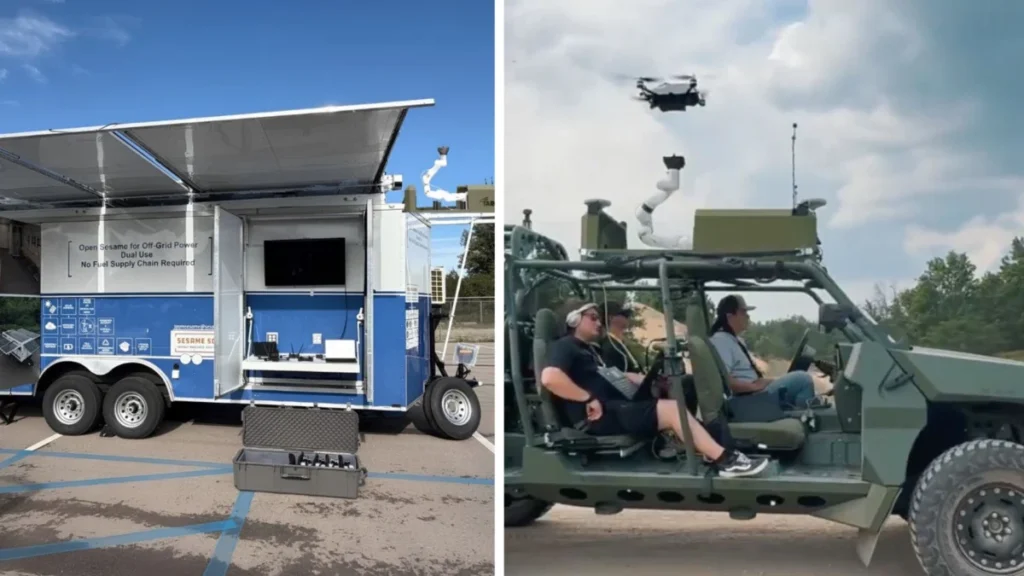
A significant advancement in autonomous drone technology has been introduced with the launch of the Persistent Drone Operations Nanogrid, a collaborative solution designed to revolutionize continuous drone operations by eliminating the traditional reliance on fuel resupply. This integrated system, developed through a partnership between Sesame Solar, Target Arm, and AG3 Labs, promises to provide an unprecedented level of endurance and autonomy for unmanned aerial systems (UAS) across military, law enforcement, and emergency response applications. Operators will gain the ability to remotely monitor the Nanogrid’s energy performance, alongside controlling the robotic arm and the drones themselves, ensuring uninterrupted missions even in the most challenging environments.
The Evolving Landscape of Drone Warfare and Logistics
The modern battlefield and critical civilian operations are increasingly characterized by the pervasive use of drones. From intelligence, surveillance, and reconnaissance (ISR) to logistics and, more recently, kinetic strike capabilities, UAS have become indispensable assets. However, their full potential has historically been hampered by a fundamental logistical constraint: power. Drones, particularly electric models, are only as effective as their battery life and the availability of charging infrastructure. This dependency creates vulnerabilities, requiring human intervention for battery swaps or refueling, exposing personnel to danger, and creating a cumbersome supply chain for fuel or replacement batteries.
The U.S. Army, among other defense organizations, has formally acknowledged this critical gap, highlighting the absence of a standardized procedure for delivering backup power to drone launch teams operating in remote, contested, or austere environments. This logistical challenge not only limits mission endurance but also dictates operational tempo, often forcing premature mission termination or the exposure of personnel in vulnerable situations. The need for an autonomous solution capable of transport, charging, safe storage across a wide range of temperatures, launching, recovering, and recharging drones with minimal detection signatures has become a paramount requirement for modern expeditionary forces and first responders.
Beyond the immediate tactical concerns, strategic considerations are also driving innovation in this space. Federal policy, as evidenced by Executive Order 14307, strongly advocates for expanding U.S. UAS manufacturing and reducing reliance on foreign-made drones. This directive aims to bolster national security, protect sensitive technologies, and secure supply chains against geopolitical risks. Concurrently, the Department of Defense (DoD) has initiated efforts to equip units with small, U.S.-sourced drones at scale, further emphasizing the demand for domestically manufactured and operationally robust solutions. The Persistent Drone Operations Nanogrid, being a domestically manufactured system, directly addresses these policy mandates, aligning with national security objectives for improved operational readiness and supply chain resilience.
The Persistent Drone Operations Nanogrid: A Trio of Innovations
The newly unveiled Nanogrid represents a holistic approach to solving the persistent drone power and operational challenges, integrating three distinct yet complementary technologies: Sesame Solar’s autonomous power generation, Target Arm’s robotic launch and recovery system, and AG3 Labs’ versatile drone platform.
Sesame Solar’s Contribution: The Autonomous Power Hub
At the heart of the solution lies Sesame Solar’s Nanogrid technology, which serves as the mobile electric power source. Lauren Flanagan, CEO and co-founder of Sesame Solar, articulates the fundamental importance of this innovation: "Mobile electric power is a critical fifth supply requirement along with food, water, munitions, and fuel. If a forward expeditionary team can’t power its drones, or their batteries fail from heat or cold, warfighters lose one of their most valuable assets." This statement underscores the strategic shift in military logistics, elevating power to the same critical status as other essential provisions.
The Nanogrid is designed to provide continuous drone operations without the need for traditional fuel resupply. This is achieved through its self-sustaining solar power generation capabilities, which not only eliminate the logistical burden and environmental impact of fossil fuels but also significantly reduce the detection signatures associated with fuel convoys and noisy generators. The system’s robustness allows it to operate effectively in extreme temperatures, a crucial feature for global deployments ranging from arctic conditions to desert heat, where conventional batteries often fail or perform suboptimally. Operators can remotely monitor the Nanogrid’s energy performance, ensuring optimal power management, and can also control the integrated robotic arm and drones, offering a high degree of operational flexibility and autonomy.
Furthermore, the Nanogrid is not merely a drone charging station; it is a versatile mobile microgrid. Available as a standalone solution or scalable in a series of two to twelve units, it can form a comprehensive MIL-STD compliant mobile microgrid capable of charging a wide array of forward expeditionary equipment, including man-portable batteries. This modularity ensures that forces can deploy the right amount of power for their specific mission needs, reducing logistical bulk and increasing overall energy resilience. "Together with Target Arm and AG3 Labs, we’ve built a comprehensive solution that eliminates the fuel supply chain while keeping drones in the air for extended durations," Flanagan added, emphasizing the collaborative success in addressing a long-standing operational bottleneck.
Target Arm’s Ralar System: Automating Launch and Recovery for Enhanced Safety
Complementing the power solution is Target Arm’s Ralar system, an autonomous robotic arm designed for the seamless launch and recovery of drones. This component directly addresses one of the most hazardous and exposed aspects of drone operations: the manual deployment and retrieval of aircraft. Jeffrey A. McChesney, CEO and Founder of Target Arm, highlights the human-centric design philosophy behind their technology: "Every system we build at Target Arm starts with the same question: does this bring someone home safe?"
The Ralar system fundamentally transforms drone operations by removing human personnel from the dangerous "kill zone" during launch and recovery. "The launch and the recovery are two of the most exposed moments of a drone mission – someone standing in the open, waiting on an aircraft. Ralar takes a person out of that moment entirely," McChesney explains. This innovation dramatically enhances warfighter safety, reducing the risk of casualties from enemy fire or environmental hazards.
A groundbreaking feature of the Ralar system is its ability to launch and recover drones from moving vehicles or boats. This capability provides an unparalleled tactical advantage, allowing military personnel or first responders to deploy and retrieve drones without having to stop their movement. "What makes our system even more unique is that drones can be launched from a moving vehicle or a boat, so warfighters never need to stop to complete their mission," McChesney stated. This enables continuous reconnaissance, communication relay, or target tracking, maintaining operational tempo and reducing the chances of becoming static targets. The Ralar system is integrated with Target Arm’s drone magazines, which autonomously cycle drones through deployment, ensuring persistent 24/7/365 coverage, a crucial requirement for long-duration surveillance or security missions.
AG3 Labs’ SPADE Platform: The Versatile Aerial Asset
The third pillar of the Persistent Drone Operations Nanogrid is AG3 Labs’ SPADE platform, a Group 1 Unmanned Aerial System (UAS) engineered for maximum mission versatility. Nick Smock, Co-Founder/Head of Growth at AG3 Labs, articulates the design philosophy: "Operators shouldn’t need a different drone for every mission – they need one airframe they can reconfigure in the field and put up in numbers." This principle addresses the logistical complexities and cost inefficiencies associated with maintaining a diverse fleet of specialized drones.
The SPADE platform is highly reconfigurable, allowing it to adapt rapidly to changing mission requirements in the field. It supports a range of critical functions, including intelligence, surveillance, and reconnaissance (ISR), communications relay, and, for defense users, the deployment of kinetic payloads. This modularity means a single drone type can fulfill multiple roles, simplifying training, maintenance, and logistics.
A significant capability of the SPADE platform is its ability to be flown one-to-one or controlled one-to-many as an autonomous swarm. This swarming capability offers tremendous tactical advantages, including enhanced coverage, increased redundancy, and the potential for complex, coordinated operations that overwhelm adversary defenses. The SPADE system’s versatility makes it suitable for a broad spectrum of users and missions, including military operations, law enforcement, first responder scenarios, and specialized training exercises. Its ability to provide robust ISR, establish temporary communication networks, or deliver precision payloads, all while being rapidly reconfigured, positions it as a highly adaptable asset in modern operational contexts.
Addressing Critical Gaps and Policy Mandates: A Strategic Imperative
The development and deployment of the Persistent Drone Operations Nanogrid directly addresses several critical operational and strategic imperatives. As highlighted by the U.S. Army, the lack of standardized backup power for drone teams in austere or contested environments has been a significant limitation. This integrated solution provides an autonomous, resilient power source that can be deployed rapidly, ensuring that drones remain operational when and where they are most needed. Its design, which minimizes detection signatures, is particularly crucial in high-threat environments where traditional logistical support would be impossible or too risky.
From a policy standpoint, the Nanogrid aligns perfectly with Executive Order 14307, which mandates the expansion of U.S. UAS manufacturing and a reduction in reliance on foreign-made drones. As a domestically manufactured solution, it not only strengthens the national industrial base but also enhances supply chain security, mitigating risks associated with foreign dependencies, intellectual property theft, or potential vulnerabilities in foreign-sourced components. The DoD’s strategic shift towards arming units with small, U.S.-sourced drones at scale finds a ready and compliant solution in this integrated system, fostering self-sufficiency and technological leadership.
The emphasis on warfighter safety, as articulated by Target Arm’s CEO, also resonates deeply with military doctrine. By automating the most exposed phases of drone operations – launch and recovery – the system directly contributes to force protection and reduces the human cost of conflict. This technological advancement allows military personnel to focus on higher-level strategic and tactical decision-making, rather than being diverted by routine, yet dangerous, logistical tasks.
Broader Impact and Implications
The introduction of the Persistent Drone Operations Nanogrid heralds a new era for autonomous operations, with far-reaching implications across multiple sectors.
Military Applications: For defense forces, the solution promises significantly enhanced operational readiness and endurance. The elimination of the fuel supply chain for drone operations reduces the logistical footprint, lowers operational costs, and minimizes environmental impact. More critically, it provides a strategic advantage in peer and near-peer conflicts by enabling sustained ISR, communication, and strike capabilities in contested environments without the need for vulnerable forward operating bases or extensive logistical trains. This could fundamentally alter Concepts of Operations (CONOPS), allowing for more distributed, agile, and persistent deployments. The ability to launch from moving platforms also expands tactical flexibility for naval and ground forces, supporting expeditionary operations and rapid response scenarios.
Civilian Applications: Beyond military utility, the Nanogrid’s capabilities have profound implications for civilian applications. In disaster relief efforts, such a self-sustaining system could rapidly deploy drones for damage assessment, search and rescue, and communication relay in areas where traditional infrastructure has been destroyed. Law enforcement agencies could utilize it for extended surveillance, border security, or crowd control without the constraints of battery life. First responders in remote areas could leverage its autonomy for critical infrastructure inspection, environmental monitoring, or wildfire management, operating continuously without needing to return to base for power. The system’s resilience to extreme temperatures makes it ideal for operations in diverse climates, from arctic research to monitoring in arid zones.
Economic and Technological Impact: The domestic manufacturing of such advanced integrated systems contributes to economic growth, job creation, and fosters innovation within the U.S. defense technology sector. It positions the nation at the forefront of autonomous systems development, driving further research and development in areas such as artificial intelligence, robotics, and renewable energy integration. This technological leadership has ripple effects, influencing civilian markets and creating new opportunities for commercialization.
Environmental Considerations: By significantly reducing reliance on fossil fuels for drone operations and associated power generation, the Nanogrid contributes to a smaller carbon footprint for military and emergency operations. This aligns with broader global initiatives to promote sustainable practices and reduce environmental impact, even in critical operational contexts.
Challenges and Future Outlook: While the Persistent Drone Operations Nanogrid represents a significant leap forward, its full integration into existing military architectures will require addressing challenges such as cybersecurity for autonomous systems, interoperability with diverse platforms, and scaling production to meet global demand. Continuous research and development will be essential to evolve the system against emerging threats and to incorporate future advancements in battery technology, drone capabilities, and AI-driven autonomy.
In conclusion, the collaboration between Sesame Solar, Target Arm, and AG3 Labs has yielded a transformative solution that directly addresses critical operational gaps and aligns with strategic national security directives. The Persistent Drone Operations Nanogrid is poised to redefine the capabilities of unmanned systems, offering an unprecedented level of autonomy, endurance, and safety, thereby enhancing mission outcomes across both defense and civilian applications for years to come.